UC's collaboration with Siemens prepares engineers for the future
Siemens has been working with the University of Cincinnati for more than 50 years

In the 1960s, a handful of engineering professors at the University of Cincinnati joined together to form the Structural Dynamics Research Corporation (SDRC), a group that would eventually become one of the founding pillars of major technology company, Siemens Digital Industries Software.
For more than 50 years, Siemens has remained a strong supporter of UC’s College of Engineering and Applied Science, supporting students and faculty through cooperative education (co-op), research efforts, software access and more.
“Siemens has had such a long-term relationship with the University of Cincinnati because the history of our company goes back to its beginnings on campus,” said Mohsen Rezayat, PhD, chief solutions architect at Siemens Digital Industries Software.
SDRC’s initial focus was on dynamic simulation, using shake tables and predicting vibration, as well as acting as a mechanical engineering consultant. Over time, it developed simulation software, which evolved into some of the earliest integrated Computer Aided Design/Computer Aided Engineering tools. SDRC operated as an engineering software company until it was acquired by Siemens in the early 2000s.
Over the years, hundreds of alumni who worked at SDRC continued their careers at Siemens, including Rezayat, who was hired by SDRC in 1985. Rezayat served as a CEAS adjunct professor for many years and is now a member of the college’s advisory council.
For decades, Siemens has been a dedicated supporter to UC and the College of Engineering and Applied Science
John "Marty" Emmert CEAS interim dean
Additionally, Siemens is dedicated to training the next generation of engineers through participation in UC’s cooperative education program. Through the top-ranked co-op program, CEAS students alternate between semesters of full-time work and semesters in the classroom.
“For decades, Siemens has welcomed UC students into its co-op program, with hundreds transitioning into full-time roles after graduation,” Rezayat said. “Between 2020 and 2024, the company brought in 242 UC co-ops.”
While on co-op with Siemens, students get experience in various aspects of the company, including software development, testing, quality assurance, project management and more.
Siemens supports these young engineers both through co-op opportunities at their facilities and on UC’s campus. In 2016, the Siemens Simulation Technology Center was established at the college, furthering students’ exposure to and understanding of complex systems. Since its opening, the center has been engaged in multiple industry-related research and problem-solving projects. Its software capabilities include modeling and analyzing dynamic systems, creating simulations to apply to real-world problems and making complex theoretical concepts more interactive and understandable to students.
“For decades, Siemens has been a dedicated supporter to UC and the College of Engineering and Applied Science,” said John “Marty” Emmert, PhD, CEAS interim dean. “By providing our students and faculty with access to powerful software tools — and being one of our top co-op employers — Siemens helps us connect classroom learning with real-world experience.”
The software is beneficial to students outside of the classroom as well. The college’s Formula SAE team, Bearcats Motorsports, has used Siemens’ software to develop a lap simulation tool, allowing them to run their car on the track and gather data to make necessary improvements before finalizing the race car’s design.
Thanks to Siemens, UC students have unique access to get hands-on experience with complex software, including Product Lifecycle Management and Electronic Design Automation, preparing them for careers in the field after graduation.
“With broadened access to the software, we want to support faculty with teaching and integration of the software so we can develop students with the skill set for the future of work, meaning our customers have talented graduates they can then hire,” said Joanna Pritchard, PhD, head of academic engagement for electronic design automation for Siemens Digital Industries Software.
In 2017, UC was given access to Siemens’ product lifecycle management. modeling and simulation software. Earlier this year, the university also received Siemens’ electronic design automation software, expanding opportunities for students to learn cutting-edge design tools. The software is focused on designing semiconductors and chips before they are physically manufactured. By doing testing and verification in the digital phase, the goal is to eliminate many of the errors that may arise during production, reducing waste and improving efficiency, Pritchard said.
Getting UC's name out there as being the center of this software hub is really useful. Potentially bringing students here to get exposed to the software and campus is really positive for UC.
Mohsen Rezayat chief solutions architect at Siemens
On campus, the software will be used both by students and faculty, enhancing educational and research initiatives. The software also will be used in the Ohio Alliance on Semiconductors and Integrated Scalable Manufacturing (OASiS) program, a partnership between UC and more than a dozen other universities to train people for jobs in the semiconductor industry. The OASiS curriculum has been released through the Skills@UC program and features modules focused on advanced electronic materials, devices and circuits, as well as hands-on training in UC’s on-campus cleanroom.
Marc Cahay, PhD, head of the Department of Electrical and Computer Engineering at CEAS, oversees the OASiS program. He shared that Siemens’ EDA software will be used in the modules to further broaden the knowledge of learners who enroll in the OASiS program, fulfilling the U.S. need for 100,000 new workers in the semiconductor industry by 2030.
“Our hope is to integrate the software into different classes and as part of the new OASiS modules we are currently developing,” Cahay said. “The EDA software is used by many semiconductor companies. If students are trained on this, they’re much more marketable.”
UC and Siemens also hope to create programs allowing students from community colleges and under-resourced universities to come to campus and get access to the software as well.
“Getting UC’s name out there as being the center of this software hub is really useful,” Rezayat said. “Potentially bringing students here to get exposed to the software and campus is really positive for UC.”
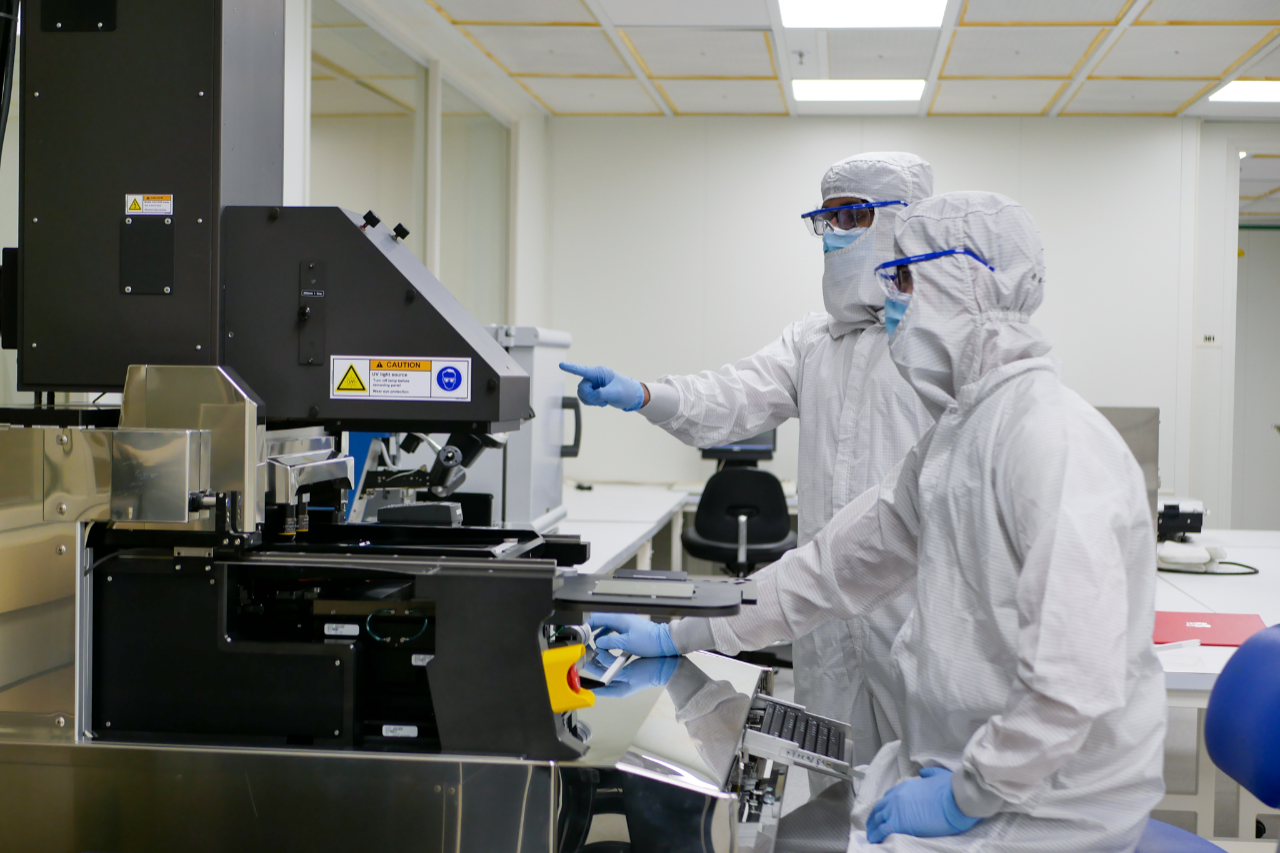
Featured image at top: The University of Cincinnati has an 8,000 square foot cleanroom. Photo/University of Cincinnati Marketing + Communications
Related Stories
President Neville Pinto welcomes UC back for 207th academic year
August 25, 2025
UC President Neville Pinto shares welcome back message for Fall 2025: The power of a public mission in a changing world
Quo family establishes $1M endowed professorship at UC to honor engineering professor
October 2, 2025
The University of Cincinnati College of Engineering and Applied Science (CEAS) has received a $1 million gift from the family of long-time faculty member Phillip C. Quo and his wife Consuelo Y. Quo.
President Pinto celebrates 2024: A year in review
December 12, 2024
University of Cincinnati President Neville G. Pinto shares a message and year-in-review highlights as UC's 2024 comes to a close