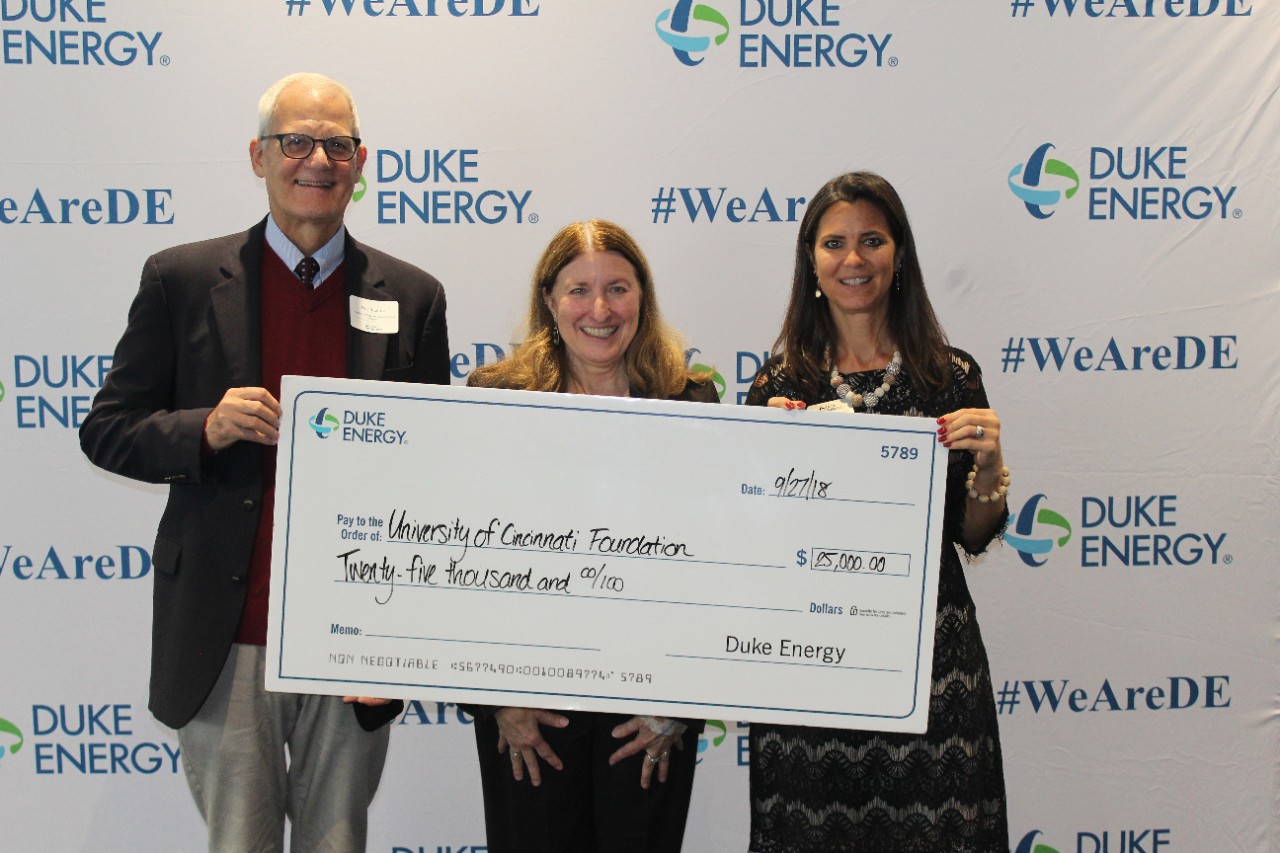
Duke Energy gives $25,000 to UC Center for Field Studies
Broadening the scope of science-based education

Duke Energy has donated $25,000 to the University of Cincinnati Center for Field Studies, one of the university’s most advanced teaching and research facilities. The center is dedicated to providing hands-on learning and research opportunities to students, the community, and high school instructors seeking to enhance their teaching skills.
The donation will help fund the center’s teacher training programs, says David Lentz, UC biology professor and executive director of the field station. Although the center has primarily focused on educating teachers from urban school districts, it will use the 2019 grant to broaden that scope to include teachers from suburban and rural areas.
Founded in 2008, the field station was designed as a hub for environmental research and education for the Greater Cincinnati area and beyond. The Duke Energy donation will allow the center to increase the reach of its mission by educating area educators. Instructors usually come from teaching backgrounds, not scientific ones, Lentz explains. Because of that, “these teachers are hungry for content, and that’s what we provide,” he says. “That’s how we are going to grow the program.”
Over the past five years, Duke Energy has granted $300,000 to UC for a variety of environmental education programs.
“University of Cincinnati has created inventive frameworks for programs that are positively impacting our environment and the development of the STEM workforce,” says Kim Vogelgesang, stakeholder philanthropy manager for Duke Energy. “Education and sustainability are the keys to success, ad we continue to believe that UC, its Center for Field Studies and the hands-on learning experiences offered will have positive, lasting impacts on our region.”
DeAnn O’Toole, fourth grade math and science teacher at Pattison Elementary and participant in the program, says: “I had always taken my kids outside for science, but after taking classes at the field station, I began to do that even more.” She adds: “After taking a week of archaeology, now I actually do a real dig at my school every year…the kids I think just love it.”
Duke Energy rarely supports any program for longer than two years, says Lentz, but 2019 marks the fifth year they have given to UCCFS. “They really like this program,” he says. “They have visited many times, and see we’re doing something really good.”
What is the field center?
Located on 17.6 acres in Hamilton, Ohio, 20 miles north of Uptown Campus, the UC Center for Field Studies is connected administratively with UC’s College of Arts and Sciences. Its terrain provides a variety of settings for exploration and study: Rivers, wetlands, prairies and forests. The center offers a wide range of college courses, such as Environmental Field Techniques, Stream Ecosystems and Ornithology, in addition to its teacher training programs. Made possible by a partnership with the Great Parks of Hamilton County, the center provides access to all 4,000 acres of the Miami Whitewater Forest.
For more information about the field center, please visit artsci.uc.edu/fieldstudies.
Related Stories
Driven by curiosity, guided by care
May 14, 2026
Max Wilson, a University of Cincinnati College of Allied Health Sciences health sciences major on the pre-physician assistant track, found his path expanding beyond the classroom and into hands-on research focused on human performance and patient care.
Telescope captures information about lonely Jupiter-like gas giant
May 13, 2026

Science outlets highlight a University of Cincinnati student's collaborative discoveries about an exoplanet 901 light years away.
University of Cincinnati graduate programs rise in national rankings across high-demand fields
May 13, 2026
University of Cincinnati graduate programs climbed in the latest U.S. News & World Report rankings, led by strong gains in workforce-focused fields including public health, clinical psychology and business.