
Decoding heart-brain talk
UC researcher receives innovator award to uncover clues to cardiovascular disease

The crosstalk of the heart and brain is continuous and deciphering those messages may help researchers unlock the key to cardiovascular disease, says Deeptankar DeMazumder, MD, PhD, assistant professor in the University of Cincinnati College of Medicine.
“Typically, you’d think the brain tells the heart what to do, but we are finding out that the heart also tells the brain what to do,” says DeMazumder. “The brain can sense the onset of critical illness that typically eludes detection in routine clinical tests until the disease process has overwhelmed the body’s ability to adapt. We are able to eavesdrop on these heart-brain conversations and identify which individuals are at a greater risk for cardiovascular death.”
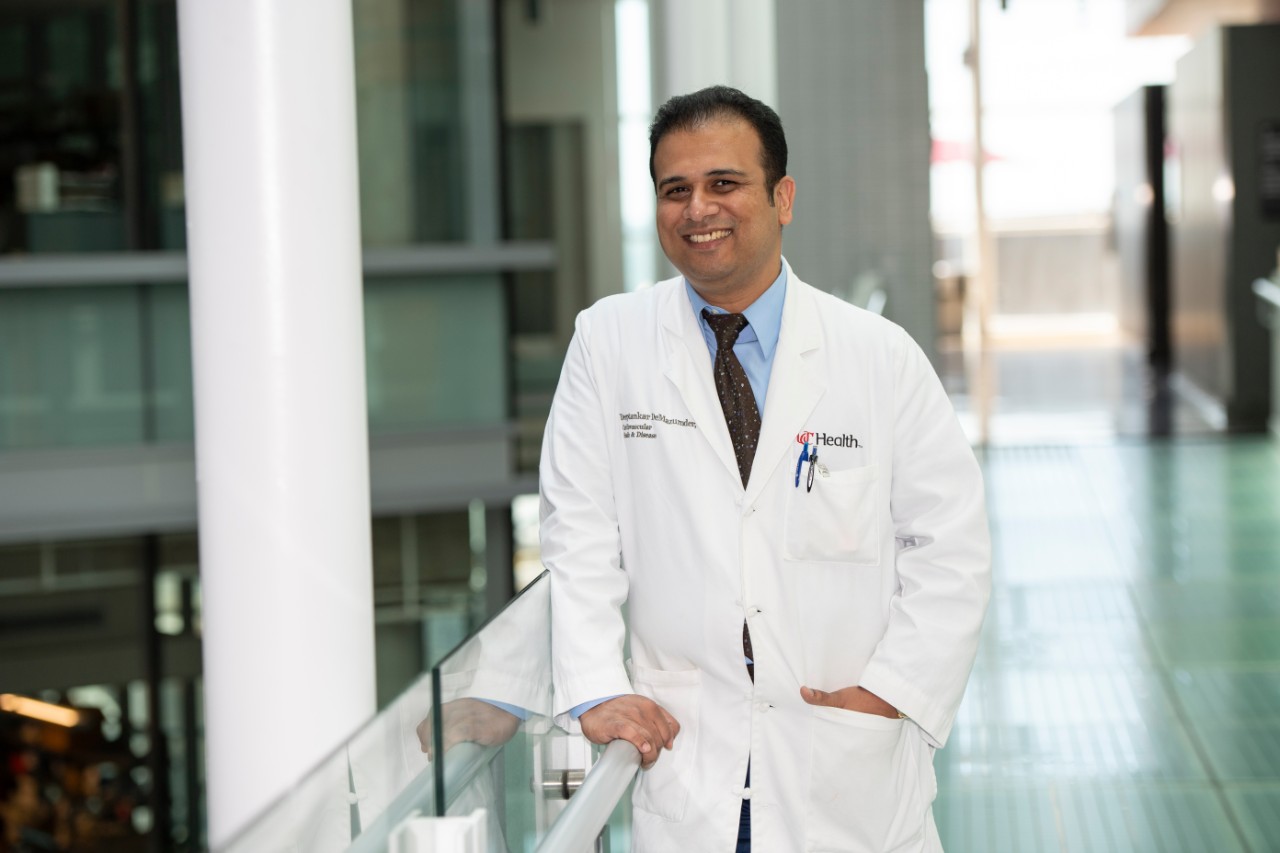
Deeptankar DeMazumder, MD, PhD, assistant professor in the University of Cincinnati College of Medicine. Photo by Colleen Kelley/UC Creative + Brand
DeMazumder, also a clinical cardiac electrophysiologist at UC Health, has developed a set of artificial intelligence algorithms to decipher waveform bio signals from the heart and the brain. Those messages like many heart/brain signals are routinely captured in bedside telemetry monitoring. However, researchers are just beginning to make sense of these newly recognized signals, which while present throughout the day are often more detectable during sleep.
“There is a lot of noise because the brain is speaking to many parts of the body,” DeMazumder says. “When we go to sleep that quiets down because the brain isn’t telling the arms and legs when to move and it is focusing on vital communications. We can focus on this communication and decode it. In this communication is a hidden signature that tells us who has homeostatic imbalance in their body or early onset of potentially fatal disease. The brain can sense this and if we can tap into this then we can identify who is going to have really bad clinical outcomes.”
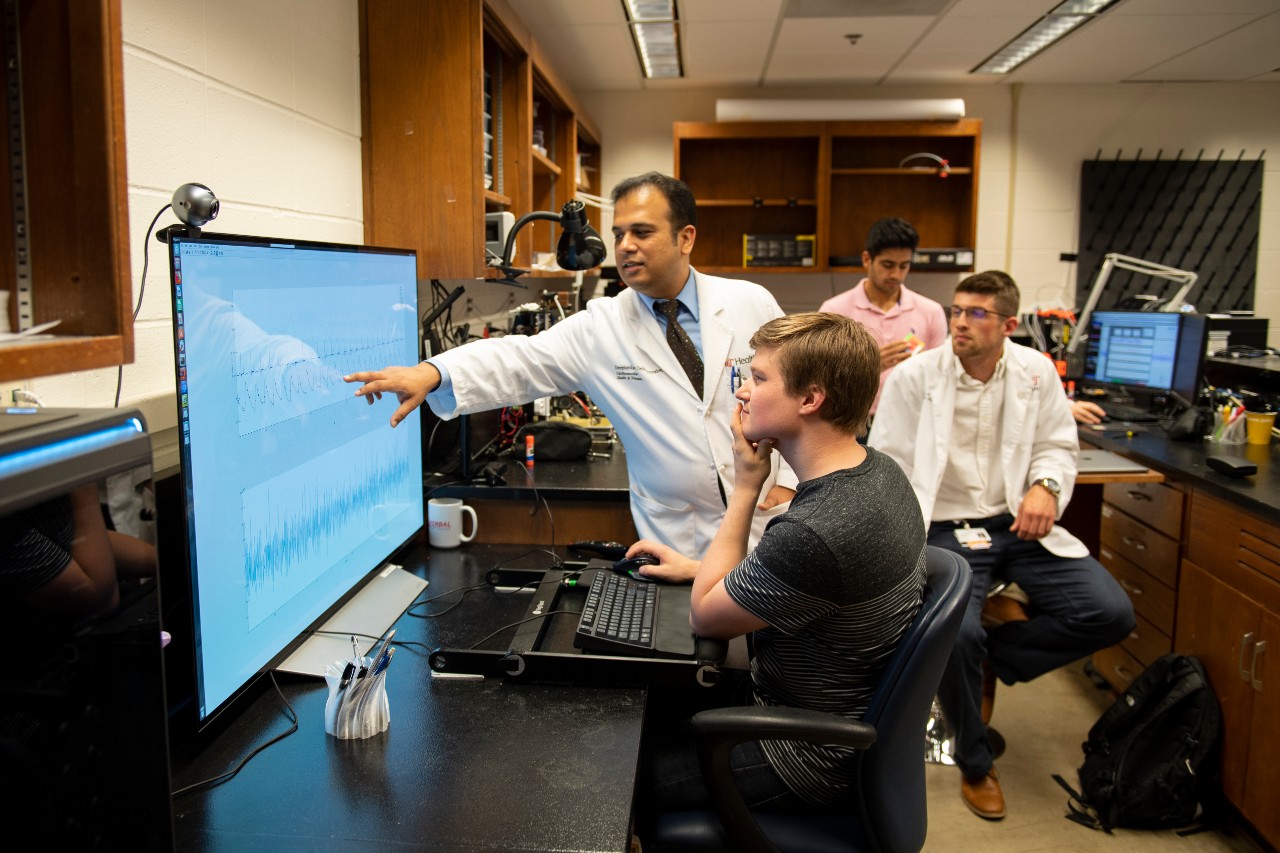
Deeptankar DeMazumder, MD, PhD, shown (center) in his College of Medicine laboratory with graduate and medical students. Photo by Colleen Kelley/UC Creative + Brand.
DeMazumder’s research in this area is promising. It has captured the attention of the National Institutes of Health (NIH). He has received an NIH Director’s New Innovator Award of $2.4 million to further his work for the project titled “Eavesdropping on heart-brain conversations during sleep for early detection and prevention of fatal cardiovascular disease.”
The award, established in 2007, supports innovative research from early career investigators who are within 10 years of their final degree or clinical residency and have not yet received an equivalent NIH grant. DeMazumder is among 53 new innovator grant awardees in 2020.
“It is among the most competitive and highly coveted awards from the NIH and culminates after a series of intensive reviews undertaken by a carefully selected group of the most accomplished scientists in the country,” says Richard Becker, MD, director of the UC Heart, Lung and Vascular Institute and a professor in the College of Medicine. “In receiving the NIH Director's New Innovator Award, Dr. DeMazumder joins a list of prior awardees who have changed paradigms and opened new doors in science and medicine through brilliance, creativity and a passion to unravel their mysteries.”
Our ability to decode [heart-brain] messages and reveal hidden critical illness has potential to save many lives.
Deeptankar DeMazumder, MD, PhD assistant professor, UC College of Medicine
DeMazumder’s research has also been supported by the National Institutes of Health, separately from the above award, the U.S. Department of Defense and the American Heart Association.
“The heart is more than just a simple pump,” says DeMazumder. “It is a highly complex sensory organ for receiving and processing important information from other organ systems, and influencing the higher brain centers involved in perception, cognition, emotion, and adaptive response to illness. We are just beginning to understand the central role played by heart-brain conversations. Our ability to decode these messages and reveal hidden critical illness has potential to save many lives.”
Featured image of Deeptankar DeMazumder, MD, PhD, and UC graduate student Jeffrey Crocker in a College of Medicine laboratory. Photo by Colleen Kelley/UC Creative + Brand.
Impact Lives Here
The University of Cincinnati is leading public urban universities into a new era of innovation and impact. Our faculty, staff and students are saving lives, changing outcomes and bending the future in our city's direction. Next Lives Here.
Stay up on all UC's COVID-19 stories, read more #UCtheGood content, or take a UC virtual visit and begin picturing yourself at an institution that inspires incredible stories.
Related Stories
UC Foundation celebrates 2026 philanthropy winners
October 23, 2026
The University of Cincinnati Foundation recognized its Outstanding Philanthropic Volunteer Award honorees at the George Rieveschl Recognition Dinner on October 22, 2026.
AI breast cancer survival model from Cancer Center could improve accuracy and personalize care
October 23, 2026
UC Cancer Center researchers, including lead author Wedad Alatebi, developed a deep learning survival model for breast cancer that combines detailed clinical and genetic information, potentially offering physicians a more accurate tool to guide treatment decisions.
UC expert explains potential impact of Pennsylvania’s new vape product law
October 22, 2026

UC professor Ashley Merianos speaks to the Pittsburgh Post-Gazette about Pennsylvania’s new vape law, youth vaping prevention, enforcement challenges and possible unintended consequences.