WVXU: Tech industry needs more Black women
UC engineering dean explains what UC is doing to improve diversity in high-tech fields

WVXU's Cincinnati Edition talked to a University of Cincinnati engineering dean about why the region's high-tech fields are lacking in diversity.
Assistant Dean of Inclusive Excellence and Community Engagement Whitney Gaskins in UC's College of Engineering and Applied Science discussed what UC is doing to create more opportunities for its graduates.
The region has more high-tech jobs than ever before — with more on the way. Intel Corp. plans to build two microchip fabrication plants outside Columbus and Honda is partnering on a new factory to build batteries for electric vehicles off I-71 outside Cincinnati.
But according to the UC Economics Center, Black women occupied just 3% of jobs in the five highest-earning occupation groups in 2018. Median incomes for Black women were 36% lower than median annual earnings across all workers in the region.
And one in four Black women earn incomes below the federal poverty level.
Nearly one in three Black women with a bachelor's degree earns less than $15 per hour compared to just 13% of White women, 10% of Black men and 11% of White men with similar educations.
One of the biggest barriers is having the self-esteem to say, 'Yes, I actually can do this career.'
Whitney Gaskins, Assistant Dean of Inclusive Excellence and Community Engagement
Gaskins said Black women occupy less than 4% of the tech workforce both nationally and in Cincinnati.
"It starts from a very young age," Gaskins told Cincinnati Edition host Lucy May. "This is a pathway development problem from middle school all the way through high school and college."
Gaskins said young Black girls can become discouraged from pursuing STEM and engineering fields if they do not receive positive feedback about subjects such as math or science.
It's harder for girls to envision doing these jobs themselves when they don't see role models around them doing them, Gaskins said.
"One of the biggest barriers is having the self-esteem to say, 'Yes, I actually can do this career,'" Gaskins said.
Gaskins joined Candice Matthews Brackeen of the nonprofit Lightship Foundation and Cincinnati USA Regional Chamber CEO Jill Meyer on the panel.
Gaskins said UC is addressing disparities with outreach such as the Women of Color Summer Engineering Camp, which gives high school students a firsthand look at the many career paths available to them in engineering.
UC also makes an effort to make every incoming student feel like they belong, she said.
"You can imagine that being in a space with such low representation could feel hostile or unwelcoming," Gaskins said. "So we do a lot of work in our retention programming on campus to ensure students have a warm, welcoming environment."
Listen to the Cincinnati Edition episode.
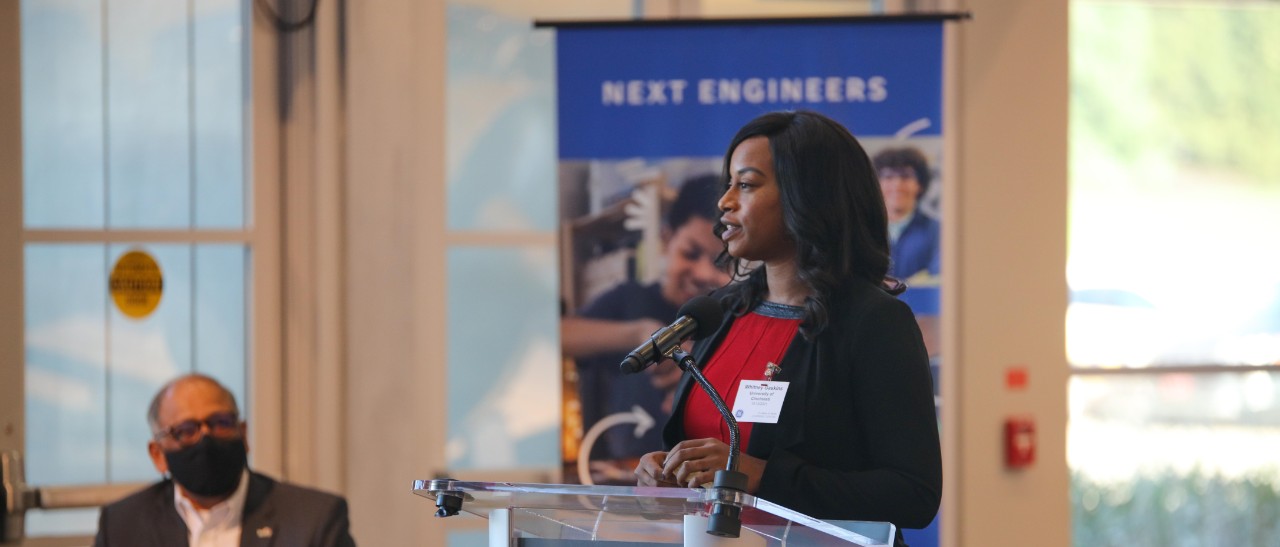
Featured image at top: Whitney Gaskins, assistant dean in UC's College of Engineering and Applied Science, talks about the gap in diversity in the high-tech industry at General Electric Co. GE in 2021 announced its Next Engineers program, designed to recruit underrepresented groups to engineering. Photo/GE

UC College of Engineering and Applied Science students get firsthand experience working with semiconductor manufacturing in the Mantei Center's Clean Room. Photo/Corrie Mayer/CEAS Marketing
Related Stories
Drone-delivered groceries descending into Cincinnati
June 25, 2026

Walmart is bringing drone delivery to Cincinnati, as reported by 700WLW. Host Scott Sloan spoke with Michael Jones, associate professor of economics at the University of Cincinnati's Lindner College of Business, for a look at what it means for Cincinnati shoppers.
A leg up in a challenging job market
June 24, 2026

Spectrum interviewed a panel of University of Cincinnati experts and alum for a look into how to stand out in today’s competitive job market. They highlighted UC's cooperative education (co-op) programs and courses that integrate artificial intelligence (AI) competence as key to being ready for the workplace.
Measuring emissions from vintage street lamps
June 24, 2026
UC Professor Amy Townsend-Small talks to Resources Radio about her examination of escaped methane from natural gas lights in Boston and Cincinnati.