
Local 12: Report: Person was 'cured' of HIV, but a local doctor says treatment is dangerous
UC expert has concerns about stem cell transplants

New research published in the Nature Medicine journal says a 53-year-old German man is now clear of HIV after a procedure that replaced his bone marrow cells with HIV-resistant stem cells from a donor. He is just the third person to be cured of HIV.
WKRC-TV, Local 12, interviewed Carl Fichtenbaum, MD, of the Division of Infectious Diseases at the University of Cincinnati College of Medicine, who was at the scientific meeting in Seattle where this research was released.
"I do hope in my professional lifetime will be able to see him the situation where we can cure a disease like HIV,” said Fichtenbaum. "Every year, we get a little bit closer to a better answer.”
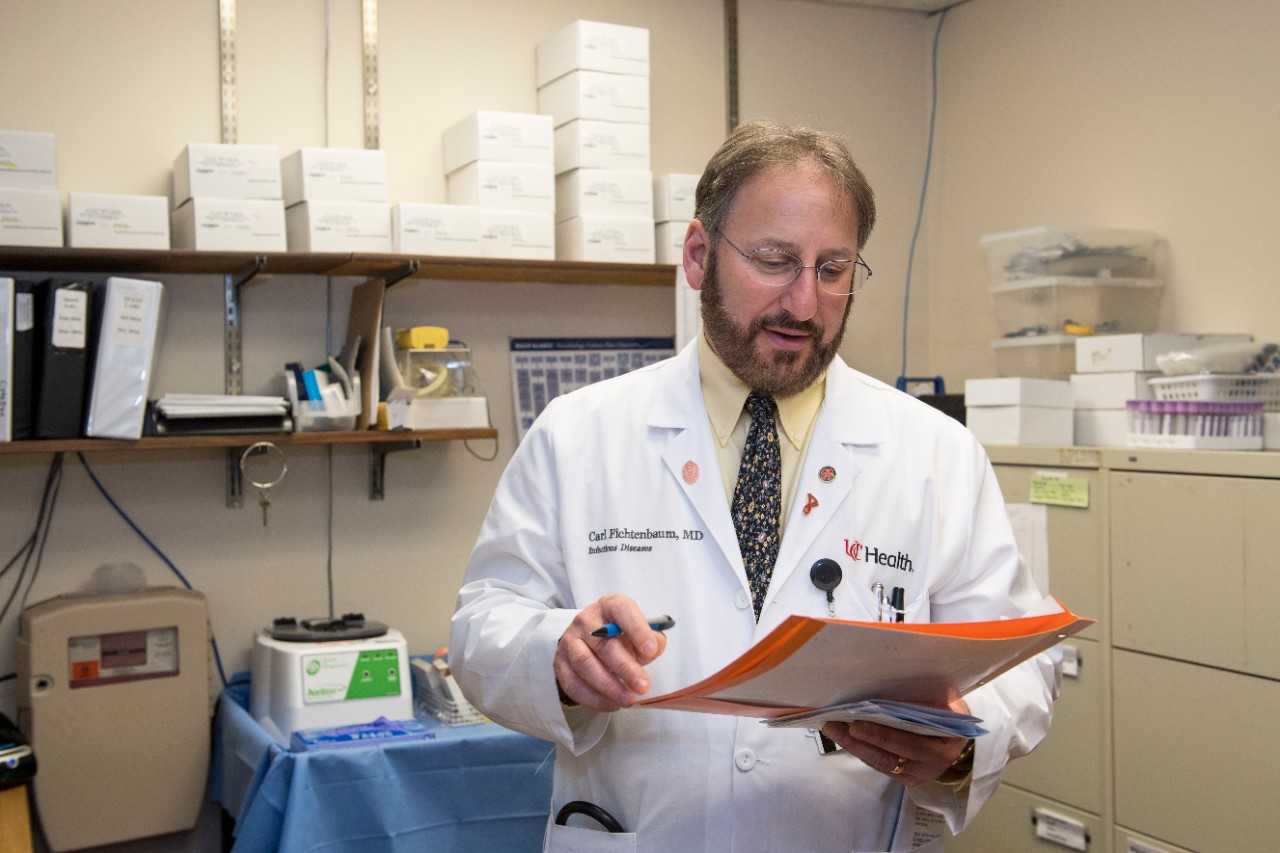
/content/dam/uc/news/ahc-public-relations/medicine/fichtenbaum-lab-folder.jpg/Photo/Colleen Kelley/UC Marketing + Brand
While the news about the German patient is exciting, Fichtenbaum knows it doesn't do much for the average person living with the virus.
"It’s very important, it gives us hope, but it’s not a scalable cure that can be down at your local pharmacy tomorrow," said Fichtenbaum.
That is mostly because of how specific the patient's health condition is and because Fichtenbaum says operations like stem cell transplants are extremely dangerous.
"We have tried this several times and it’s failed because bone marrow transplant transplants, stem cell transplants are dangerous, and these are mostly used in individuals who have cancer,” said Fichtenbaum.
Lead photo/Aaron Ufumeli/EPA-EFE
Next Lives Here
The University of Cincinnati is classified as a Research 1 institution by the Carnegie Commission and is ranked in the National Science Foundation's Top-35 public research universities. UC's graduate students and faculty investigate problems and innovate solutions with real-world impact. Next Lives Here.
Related Stories
Helping UC medical students in times of need
October 27, 2026
Ben Stamler, MD, Med ’26, will be forever grateful to his parents, Rick Stamler, MD, Med ’85 and Betsy Rabkin, MD, Med ’85, for financially supporting him through medical school. Their generosity, he says, allowed him to graduate from the University of Cincinnati College of Medicine debt-free, and removed the burden that the vast majority of his peers would have to carry forward for years to come.
UC's Anita Afzali, MD, receives American College of Gastroenterology International Leadership Award
October 27, 2026
The University of Cincinnati's Anita Afzali, MD, receives the American College of Gastroenterology's 2026 International Leadership Award for advancing global digestive health education, research and partnerships.
UC Foundation celebrates 2026 philanthropy winners
October 23, 2026
The University of Cincinnati Foundation recognized its Outstanding Philanthropic Volunteer Award honorees at the George Rieveschl Recognition Dinner on October 22, 2026.