
WVXU: UC public health nursing expert sheds light on xylazine’s community impact

An animal tranquilizer, xylazine, has been increasingly found in illicit drugs and detected in overdose deaths across the country, sounding alarm bells at the local and federal levels. Tasha Turner-Bicknell, DNP, University of Cincinnati professor and public health nursing online programs director, served as a guest on WVXU's Cincinnati Edition to discuss the impacts and risks of xylazine.

Tasha Turner-Bicknell
Although not an opioid, xylazine can depress breathing, blood pressure, heart rate and body temperature to critical levels. And, because it is not an opioid, reversing an overdose caused by xylazine with naloxone can be more difficult; rescue breathing as part of CPR is needed, but people who use drugs often are wary of calling first responders, despite Good Samaritan laws in place.
"It is still hard to test for xylazine's presence in the body since the substance is not intended for human use. This makes it difficult to estimate how many overdose deaths can be attributed to xylazine," Turner-Bicknell said. "So, in the early days, people thought xylazine wasn’t present in their community."
Additionally, people who inject drugs containing xylazine can develop severe skin wounds and patches of dead tissue that easily become infected and, if left untreated, may lead to amputation. These wounds can develop in areas of the body away from the injection site and may become life-threatening.
"Providing basic medical care to people who use drugs is essential, or else these wounds will become worse and people will end up in the emergency room," Turner-Bicknell said. "And we know that the emergency room is not the ideal place for wound treatment."
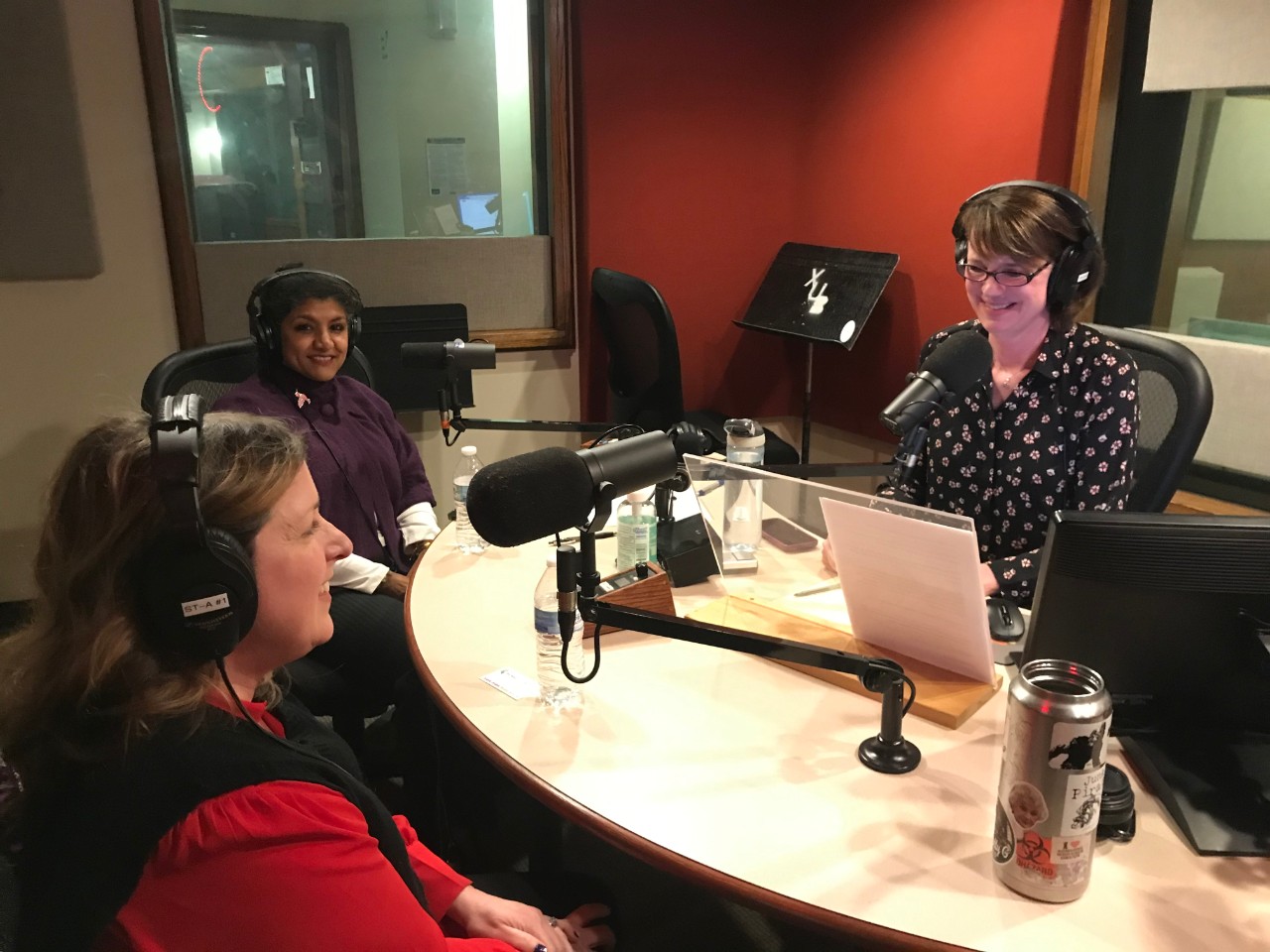
Turner-Bicknell (left) in WVXU's studios as a guest on Cincinnati Edition.
As test strips for xylazine detection haven’t been approved for mass distribution and lawmakers work through the long process of classifying xylazine as a narcotic, the inclusion of wound care to avoid infections and more serious consequences in harm reduction outreach services is a step in the right direction.
And, while safe injection sites — which provide people who use drugs with a safe environment with access to health care and education — are an important factor in harm reduction, we will never have enough to be available for everyone, Turner-Bicknell said.
As a public health nurse, Turner-Bicknell has championed these kinds of harm reduction efforts. Her latest work focuses on increasing the implementation of harm reduction vending machines, providing safer smoking kits and developing mobile units as ways to extend community outreach to individuals previously not captured by existing harm reduction services, including people who smoke drugs, use stimulants or are unable or unwilling to attend syringe service programing.
Turner-Bicknell was selected present on this work at the 27th annual Harm Reduction International Conference, April 16-19 in Melbourne, Australia.
Listen to an audio recording of the March 27 Cincinnati Edition program at wvxu.org.
Learn More about UC's Public Health Nursing Online Programs
UC College of Nursing's Public Health Nursing online programs prepare you to respond to public health events with research-backed, population-based interventions and to lead and advance public health initiatives.
Learn more:
Related Stories
Simple ways to find a deeper sense of happiness and well being
October 8, 2026

UC assistant professor Suzie White, featured in an AARP story on practical ways to live a happier, healthier life, shared research-backed strategies for increasing well-being through gratitude and service to others. White teaches Happiness in Action, a course that helps students apply the science of happiness in everyday life.
New vending machine helps people with addiction
October 8, 2026

The University of Cincinnati's Daniel Arendt was featured in a Spectrum News report on a new harm reduction vending machine installed at the IPM Food Pantry in partnership with the Hamilton County Mental Health and Recovery Services Board.
UC study correlates increased physical activity with slower Parkinson’s progression
October 7, 2026
Higher levels of physical activity were associated with slower declines in thinking and memory as well as slower worsening of movement symptoms for people with Parkinson’s disease, according to a new study led by University of Cincinnati researchers published Oct. 7, 2026, in Neurology.