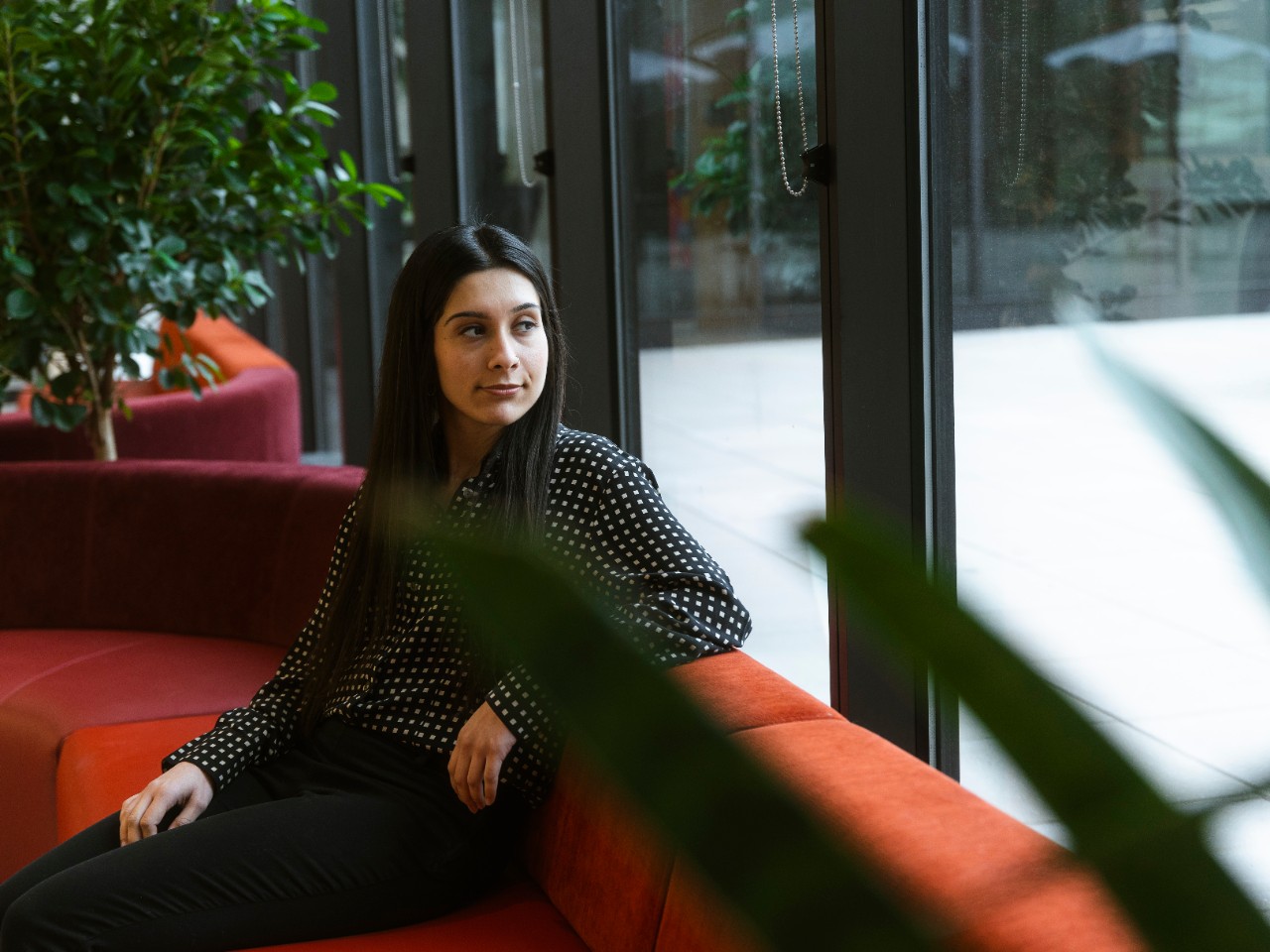
Aqdas Khudadad's goal is equitable access to the law

With its vibrant riverfront, charming Italianate architecture, 52 distinct neighborhoods, and winning NFL team, the city of Cincinnati has earned its bragging rights as of late. Even with these great strides in enhancing the quality of life for its residents, important issues facing the city's most vulnerable remain, spanning from affordable housing to immigration. Aqdas Khudadad (JD, ‘24), has dedicated her first two years of law school working with organizations affecting these issues–one legal case at a time.
“People need help, it's overwhelming,” she said. “Organizations doing public interest work have been at capacity recently because there's such a need for it.”
Aiming to learn as much as she can about public interest law before deciding on a career path, Aqdas chose to vary her clinic and externship experiences. This past fall, she interned with both the Ohio Justice and Policy Center (OJPC) and the Legal Access Clinic, and this year began a position with the Hamilton County Municipal Court’s Help Center.
“With public interest work, there's so much you have to know. You could be thrown into any type of work,” she said. “UC has a special focus on public interest and social justice work, so you get a lot of support and access to these opportunities.”
Learn more about Aqdas’s passion for promoting equitable access to the law and desire to improve the situation for those who come after her in her profile story “Next Generation Changemaker: Aqdas Khudadad”.
Photographer: Asa Featherstone
Tags
Related Stories
Cancer Center plays key role in lab research, clinical trials for new pancreatic cancer drug
September 1, 2026

WLWT and WCPO highlighted the contributions of University of Cincinnati Cancer Center researchers that helped lead to the recent FDA approval of daraxonrasib, a new treatment for pancreatic cancer.
Cancer Center physician receives $150,000 New Investigator Research Grant to study treatment-resistant leukemia
September 1, 2026
The University of Cincinnati Cancer Center’s Sarah Skuli, MD, PhD, received a two‑year, $150,000 Leukemia Research Foundation New Investigator Grant to study TP53‑mutated leukemia, a treatment‑resistant subtype with very poor outcomes.
An internal divide among unions on AI impacts the Wisconsin gubernatorial race
August 28, 2026

Anne Lofaso, a professor in the Donald P. Klekamp College of Law at UC, spoke with Wisconsin Public Radio, about the schism among unions over AI and whether it is a plus, a negative, or somewhere in between when looking at job creation.