
UC grad students bring geosciences to Northside Farmers Market
Monthly market experiments let little ones get hands-on with science
Families bring their children to Cincinnati’s Northside Farmers Market every Wednesday, rain or shine, for the vibrant social hub and healthy, and affordable foods.
This year, a group of University of Cincinnati graduate students has added a new feature to the 20-year-old market tradition — Science Harvest, an outreach initiative designed to share science with local communities through conversation and hands-on learning activities.
One of these scientists is Meg Corcoran, a UC geoscience graduate and postdoctoral fellow with UC’s Center for Public Engagement with Science, who helped launch Science Harvest last October.
“We do get a mix of community members here at the market,” says Corcoran, pointing out the draw of the outreach program.
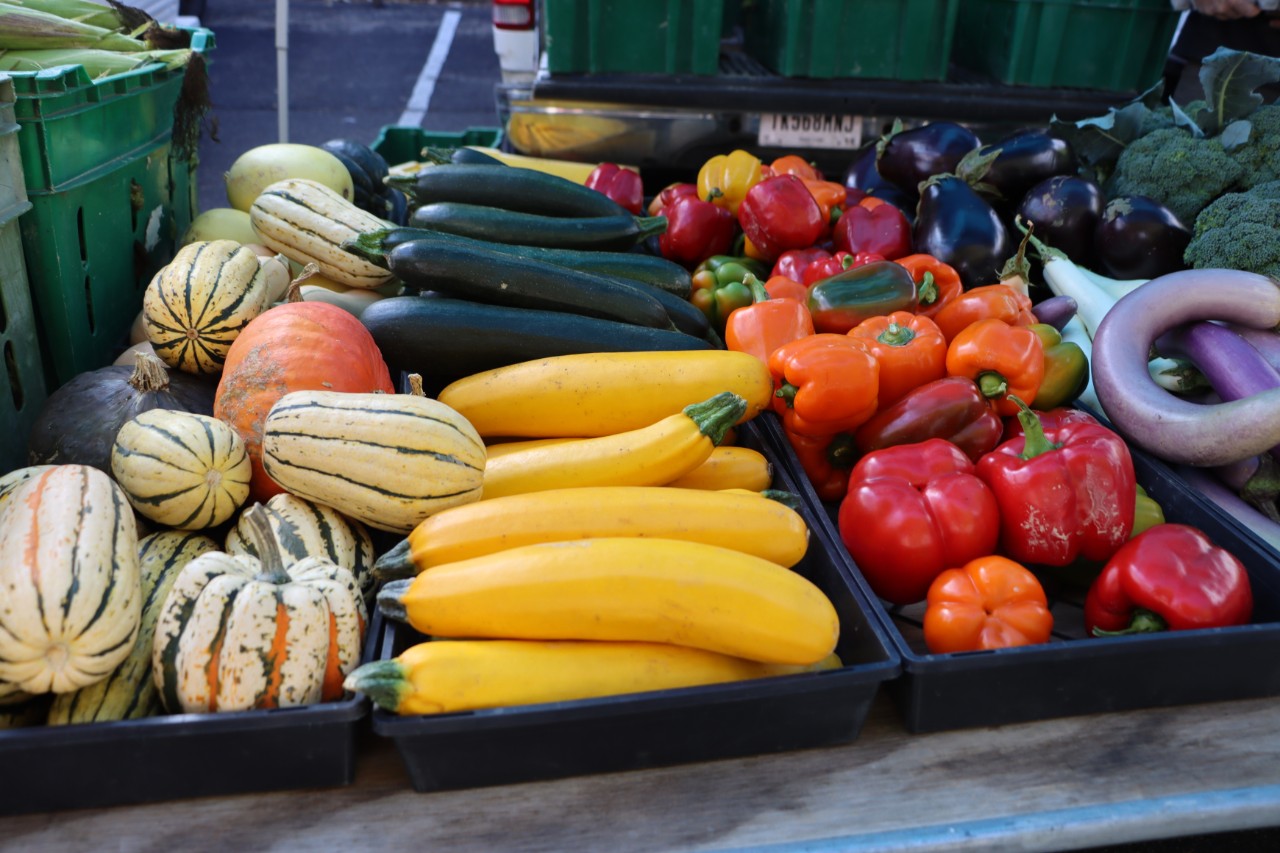
Fresh veggies and produce at the Northside Farmer's Market. Photo/Hannah White
The Center for Public Engagement with Science, operated through UC’s College of Arts and Sciences, works to foster an interactive relationship between science and the public. The center accomplishes this goal by promoting science dialogue and offering innovative forms of scientific engagement through partnerships and experiments.
Previous community activities have included science talks and a lecture series at the Mercantile Library in downtown Cincinnati.
For Corcoran and her fellow scientist Hans Laake, a 2019 UC geosciences graduate who is working on his master’s of geoscience, the goal is to have meaningful conversations about geosciences with members of the community through fun means.
“We bring different components of whatever activity so we can engage with kids and have a hands-on activity where they can get their hands dirty and try some science out,” Corcoran says. “We just try to bring a wide assortment of different activities that all show the same thing.”
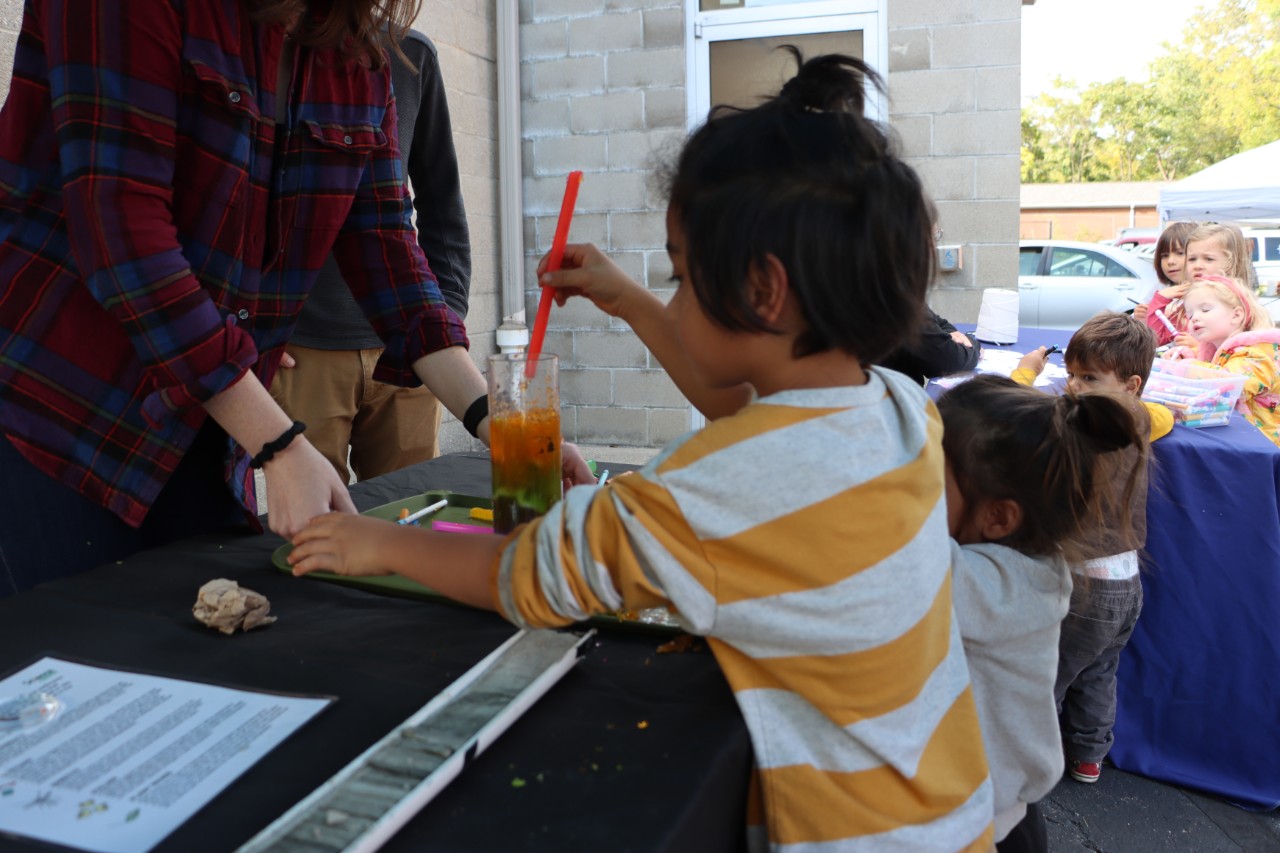
Children engage with a colorful experiment on sediment coring. Credit/Hannah White
With UC’s department of geology renamed to geosciences, the pair of scientists hope to aid the center's mission by showing community members the all-encompassing nature of geoscience, well beyond rocks and mud.
“I think a lot of people think of rocks when they think of geology, but really, geology is the study of Earth. We learn about climate, the ocean, circular motion, biology,” Laake says.
“It gives geoscientists a good understanding of what’s actually happening. It allows you to interpret different things you see in the media and tell what they really mean.”
For the duo, they say they hope their time and efforts inspire children to study geosciences. But they try to keep it fun.
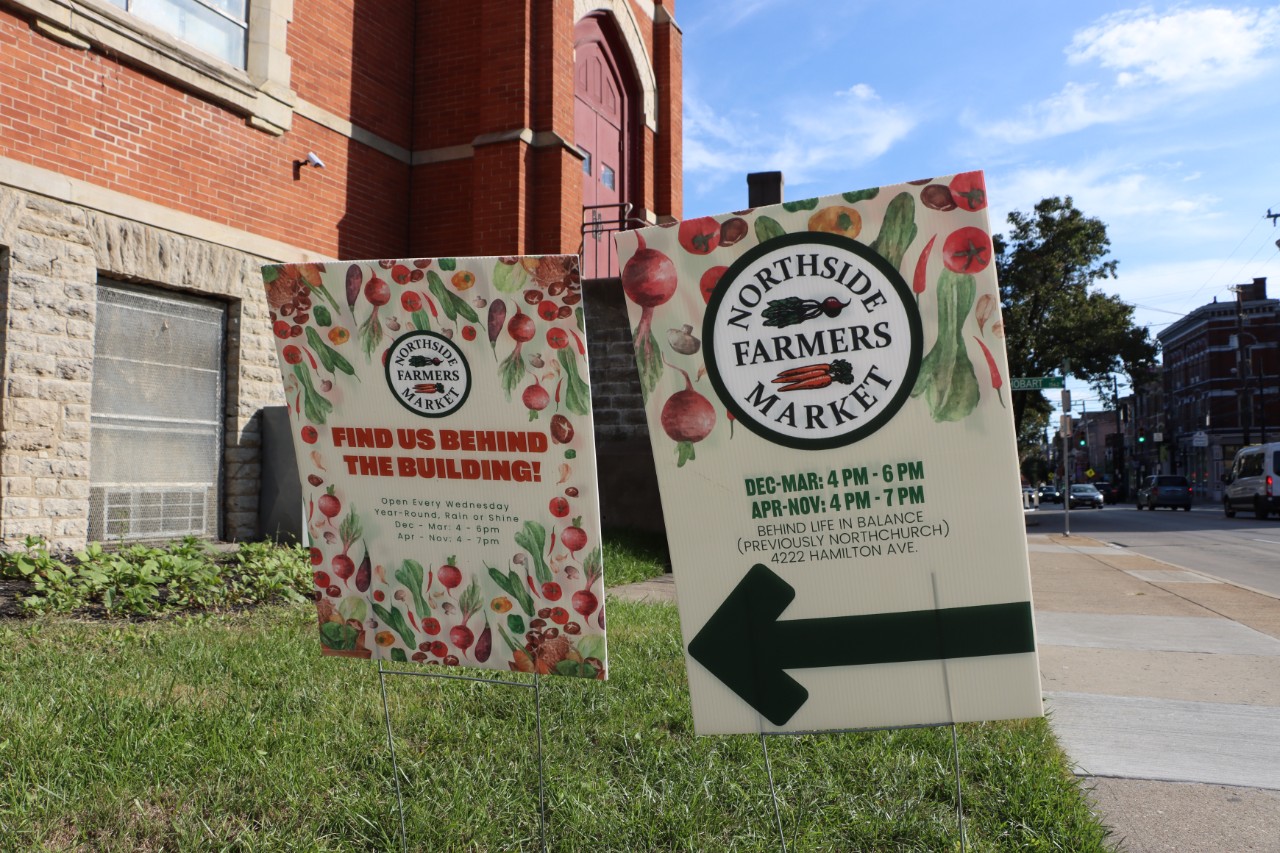
Signage guides the way to Northside Farmers Market. Credit/Hannah White
The challenge, Corcoran says, is “finding the balance between an interactive activity that kids are excited about, while also exposing them to the science. If they remember how awesome geology can be from the activity, that is a win for us.
“There’s science everywhere, anyone can be a scientist.”
The next opportunity for families to enjoy Science Harvest at the Northside Farmers Market will be from 4 to 7 p.m. Wednesday, Nov. 15, at 4222 Hamilton Ave.
Featured image at top: Children conduct experiments at the Science Harvest tent. Credit/Hannah White

Related Stories
UC launches Center for Environmental Engagement
October 5, 2026
UC’s College of Arts and Sciences is launching the Center for Environmental Engagement (CEE), a new interdisciplinary initiative focused on supporting communities that face disproportionate environmental risks. Faculty, students, community partners and environmental practitioners will work together to develop solutions to complex environmental challenges. The center’s mission is to serve the public by connecting communities with resources, subject matter expertise and community-engaged scholarship.
Digging into the bedrock of Cincinnati
October 5, 2026

Cincinnati magazine turns to University of Cincinnati Professor Carlton Brett to explain what Cincinnati was like as a shallow sea during the Ordovician period.
University of Cincinnati, UC Foundation launch UC Promise scholarship match
September 29, 2026
A partnership between the University of Cincinnati and the University of Cincinnati Foundation is expanding scholarship support for Ohio students.