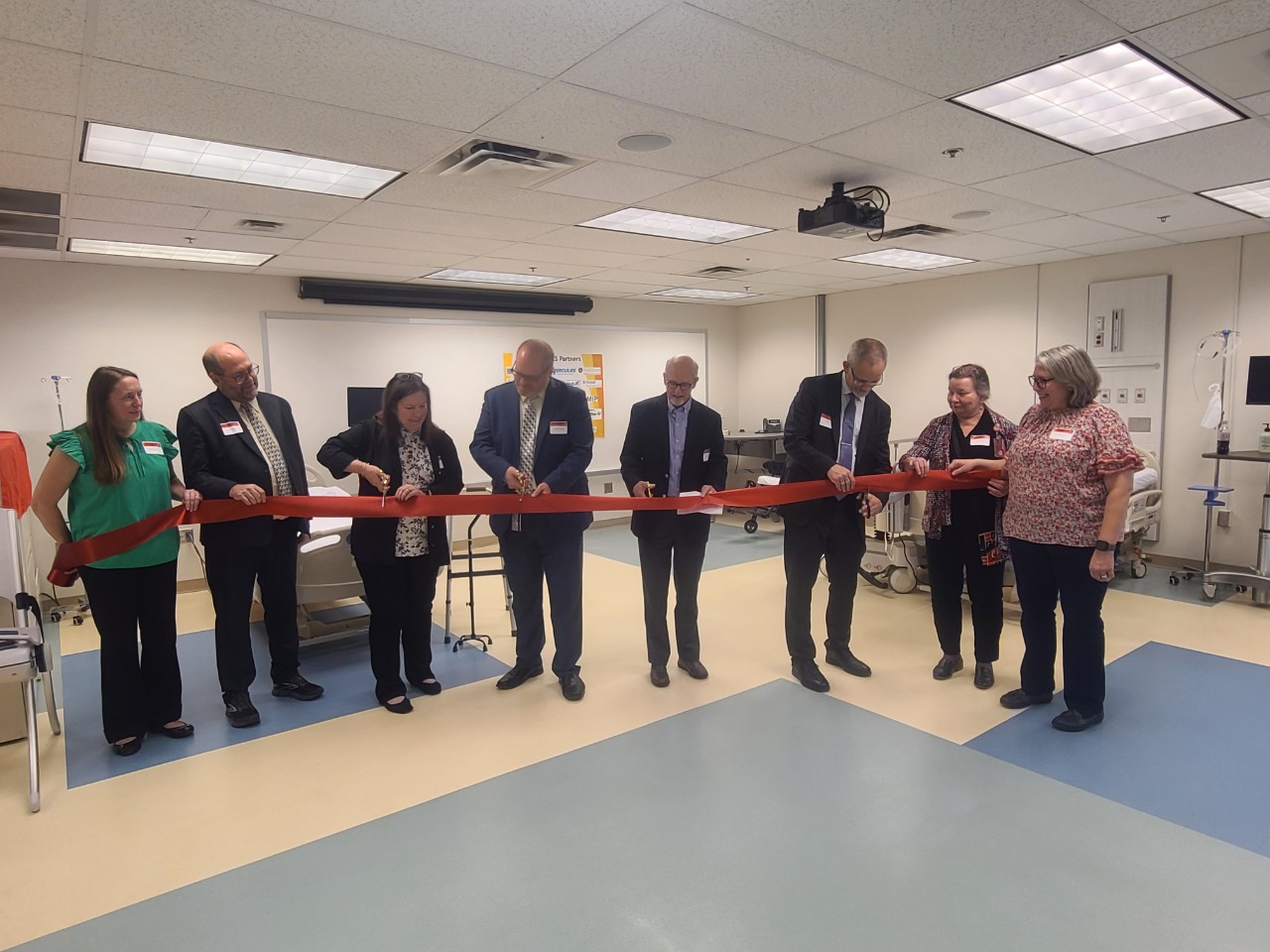
UC health colleges collaborate to prepare future health care professionals
UC’s Academic Health Center colleges have come together to create a space in which nursing, physical and occupational therapy students, and health aids can learn how to safely care for patients.
The SafeMovES Lab — a collaboration between the colleges of Nursing, Allied Health Sciences, and Medicine — helps students refine their skills in an informed, realistic, and safe environment. The lab features equipment and scenarios caretakers may encounter once they join the workforce.
Further action is required to make this image accessible
One of the below criteria must be satisfied:
- Add image alt tag OR
- Mark image as decorative
The image will not display on the live site until the issue above is resolved.
"Nurses experience more occupational injuries due to overexertion and bodily reactions than other professions and most of these injuries result from improper patient handling," says Kermit Davis, PhD, professor at the UC College of Medicine and a partner in the SafeMovES Lab development. "The active motions of lifting and pushing can put a lot of pressure on nurses’ bodies, especially as they age, so nurses also experience a higher rate of musculoskeletal disorders, including strains, sprains and tears."
According to the Bureau of Labor Statistics, nurses miss over 19,000 days of work due to occupational injuries.
“With an aging workforce, a patient population that is growing in physical size, and the already demanding requirements of these health care occupations, we need to start prioritizing the protection of our health care providers,” adds Davis.

The SafeMovES lab includes traditional equipment found in hospitals and other health care facilities.
The SafeMovES Lab is a customizable space for each student and program. It features a ceiling lift, fall recovery equipment, mobility aids and anything else a student may need to practice safe patient handling.
The lab also offers a variety of setup choices, including a traditional hospital setting, a studio apartment and a bathroom.
“We want to give health care professionals the knowledge to be able to advocate for safe patient handling equipment and practices to become the routine culture in all facilities to ensure the safety of all,” says Susan Kotowski, PhD, professor at the College of Allied Health Sciences and partner in the lab.
Safe patient handling leads to a healthier health care workforce, which translates into better patient safety.
Robin Wagner, DNP Associate professor, College of Nursing

A view of the equipment stations in the SafeMovES Lab used to teach students how to safely care for patients.
Support for the lab was also a collaborative effort. Representatives from the colleges worked with companies and organizations to secure the spaces and acquire equipment. Because of their efforts, nearly 220 sophomore nursing students have practiced safe patient handling as part of their Bachelor of Science in Nursing program. Officials hope to expand and include occupational and physical therapy students soon.
“Eventually, we want to bring students from various health care programs together to the lab so they can not only learn about the equipment and best practices, but also how to work effectively on interdisciplinary teams, much like they will in real life, ” says Carolyn Smith, PhD, RN, associate professor and associate dean for research at the College of Nursing.
The SafeMovES Lab representatives also hope to expand access beyond students, so any caretaker or health care professional can learn how to protect themselves and their patients.
“Safe patient handling leads to a healthier health care workforce, which translates into better patient safety,” says Robin Wagner, DNP, associate professor and director of the skills and simulation lab at the College of Nursing. “This space is integral to educating responsible and compassionate nurses and therapists and will continue to establish UC as a regional leader in safe-patient care and culture throughout the Cincinnati area.”
All photos/provided

Ella Wahlquist
Student Journalist
Office of the Provost, Communications
Ella Wahlquist is a student in the College-Conservatory of Music's Media Production program. She joined the Office of the Provost's communications team in the Spring of 2024. Ella is a member of the University Honors Program.
Related Stories
Campus buzz returns as UC students experience their first week
August 27, 2026
Near-perfect weather, record first-year enrollment, Thrifty Move-In and a packed Involvement Fair mark the University of Cincinnati’s first week back as thousands of Bearcats move into campus housing.
On-site training in Speech & Hearing Clinic sets UC’s programs apart
August 27, 2026
At the University of Cincinnati’s Speech & Hearing Clinic, Doctor of Audiology and Speech-Language Pathology graduate students gain real-world experience while providing free speech and hearing services to the community.
Designing with cancer patients' needs in focus
August 27, 2026
Kristina Shin is designing garments that prioritize the comfort, function and confidence of breast cancer patients, addressing a need often overlooked by traditional fashion.