Engineering expert discusses next steps after fire closes bridge
UC College of Engineering and Applied Science professor discusses bridge repairs

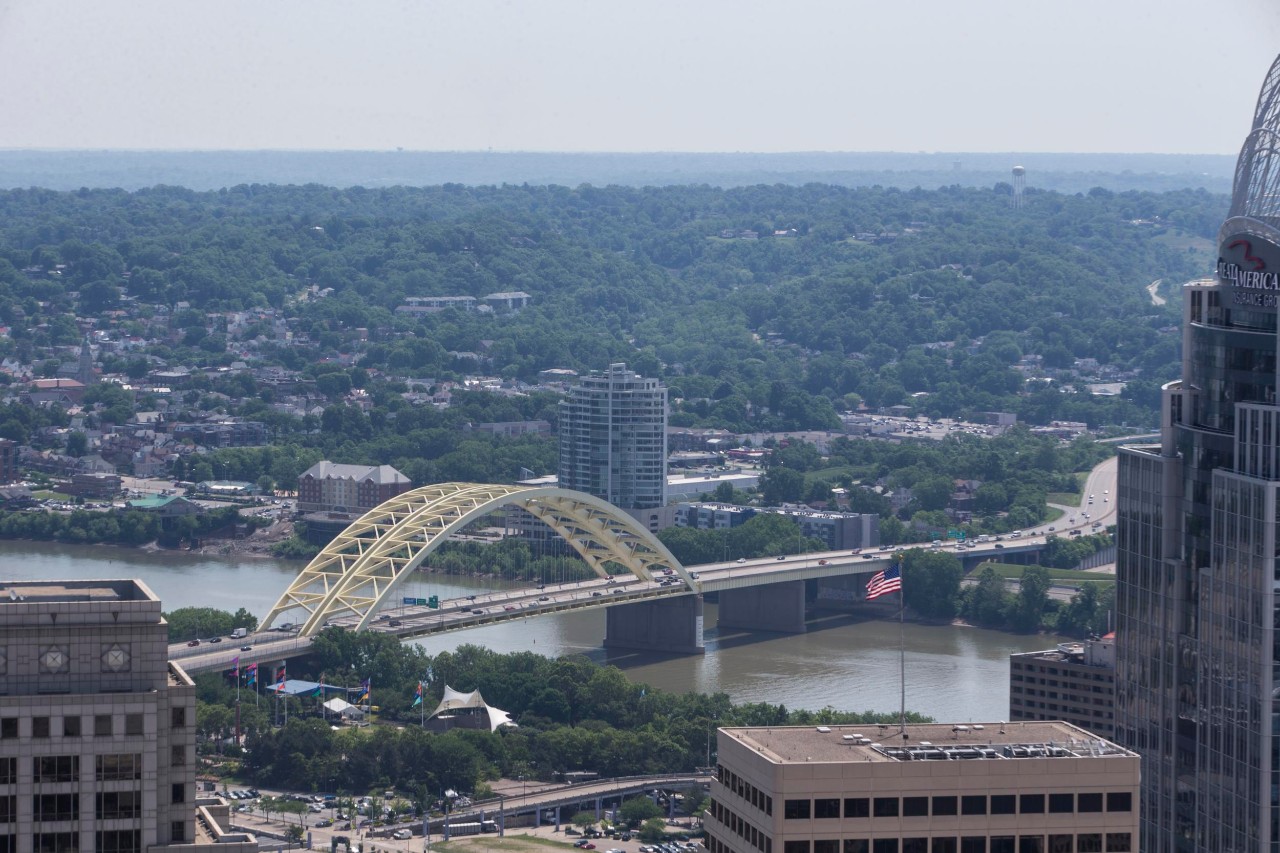
WLWT-5 turned to an engineering professor at the University of Cincinnati to explain what inspectors would be looking for to assess fire damage on the Daniel Carter Beard Bridge.
The bridge was closed to traffic in both directions early Friday morning after a fire erupted under the span on the Cincinnati side at Sawyer Point's 1,000 Hands Playground.
Nobody was injured in the blaze, but the southbound span was substantially damaged, officials said. The northbound span reopened to traffic on Friday night.

UC Associate Professor Gian Andrea Rassati talks to WLWT-5 about reopening the Daniel Carter Beard Bridge. Photo/WLWT-5
UC College of Engineering and Applied Science Associate Professor Gian Andrea Rassati spoke to WLWT5's Ashley Kirklen and Sheree Paolello about what engineers look for to determine if the span's steel or concrete sustained structural damage.
Rassati teaches in UC's Department of Civil and Architectural Engineering and Construction Management. He said inspectors will examine the structural integrity of the steel members.
“They're looking at which members will need replacing. And based on the pictures I've seen, there are several that will need replacement,” Rassati said.
“And they're also looking at the concrete deck, the roadway and all the ancillary structures like the signs,” he said. “So there's a lot to do.”
A fire caused by a truck crash damaged and closed the Brent Spence Bridge in 2020. That span was closed to traffic for six weeks.
Rassati said the fire captured on video Friday morning looked much bigger than the fire that damaged and closed the Brent Spence Bridge.
“That's the million-dollar question: how hot did that fire burn?” he said.
“Depending on the temperature and time of exposure, some steel members might be OK. And others that look OK might need to be replaced because of the temperature they reached in the fire,” he said.
Rassati said bridge repairs can be done more quickly than most people realize.
“It's suprisingly fast. The fabricators, erectors and design engineers know what to do. A lot of them were trained by our program,” he said.
“It's shorter than you think, but it's still going to be a little painful. It's not going to be days. It will probably be weeks or months.”
Featured image at top: UC College of Engineering and Applied Science Associate Professor Gian Andrea Rassati talks to WLWT5's Ashley Kirklen and Sheree Paolello about fire damage to the Daniel Carter Beard Bridge. Photo/WLWT5

UC's College of Engineering and Applied Science hosts a contest to design a bridge that will support the most weight using tiny wooden beams. Photo/Katie Hageman
Related Stories
Co-op broadens horizons for architectural engineer
August 17, 2026
UC architectural engineering graduate Jeremy Ackley turned his co-op rotations with CMTA, a national engineering consulting firm in Texas, into a full-time role, showcasing the University of Cincinnati’s national co-op footprint.
Emeritus professor honored for gas turbine research
August 17, 2026
Mark Turner has been part of the University of Cincinnati's College of Engineering and Applied Science for 25 years. His work in the field of gas turbine simulation and design continues to leave a significant impact on the industry. He was honored by the American Society of Mechanical Engineers with the International Gas Turbine Institute Scholar Award. Turner is part of the Department of Aerospace Engineering and Engineering Mechanics at UC.
UC scholarship honoring a family’s matriarch continues
August 17, 2026
“I get chills thinking about what she means to our family,” says Norma Wellman Cobb’s grandson, Thomas Beach, reflecting on how his grandmother’s perseverance and unwavering belief in the power of education shaped generations.