
Physicists outline next 10 years of neutrino research
UC physicists say they are excited about upcoming experiments

MSN and other science outlets highlighted a paper co-written by University of Cincinnati professors that outlines the next 10 years of particle physics research.
UC College of Arts and Sciences Professor Alexandre Sousa was an editor on the paper that discusses the upcoming experiments on neutrinos, the most abundant particles with mass in the universe. They are created by nuclear fusion reactions in the sun, radioactive decay in nuclear reactors or the Earth’s crust or in particle accelerator labs. As they travel, they can transition between one of three types or “flavors” of neutrinos and back.
According to the white paper published in the Journal of Physics G Nuclear and Particle Physics, neutrino research might help explain one of the universe’s greatest mysteries: why there is more matter than antimatter when the Big Bang should have created equal amounts of both. This asymmetry is the reason galaxies, planets, and we ourselves exist.
“It might not make a difference in your daily life, but we’re trying to understand why we’re here,” Sousa said. “Neutrinos seem to hold the key to answering these very deep questions.”
UC Professor Jure Zupan, UC Associate Professor Adam Aurisano, UC visiting scholar Tarak Thakore, UC postdoctoral fellow Michael Wallbank and UC physics students Herilala Razafinime and Miriama Rajaoalisoa also contributed to the paper.
Sousa said he is excited about the next 10 years of neutrino experiments, including Fermilab's Deep Underground Neutrino Experiment, or DUNE, to which he is a contributor.
“With these two detector modules and the most powerful neutrino beam ever we can do a lot of science,” Sousa said. “DUNE coming online will be extremely exciting. It will be the best neutrino experiment ever.”
Featured image at top: Workers excavate the interior of a cavern to make room for detectors for the Deep Underground Neutrino Experiment. Photo/Lynn Johnson/Fermilab
UC Physics in the news
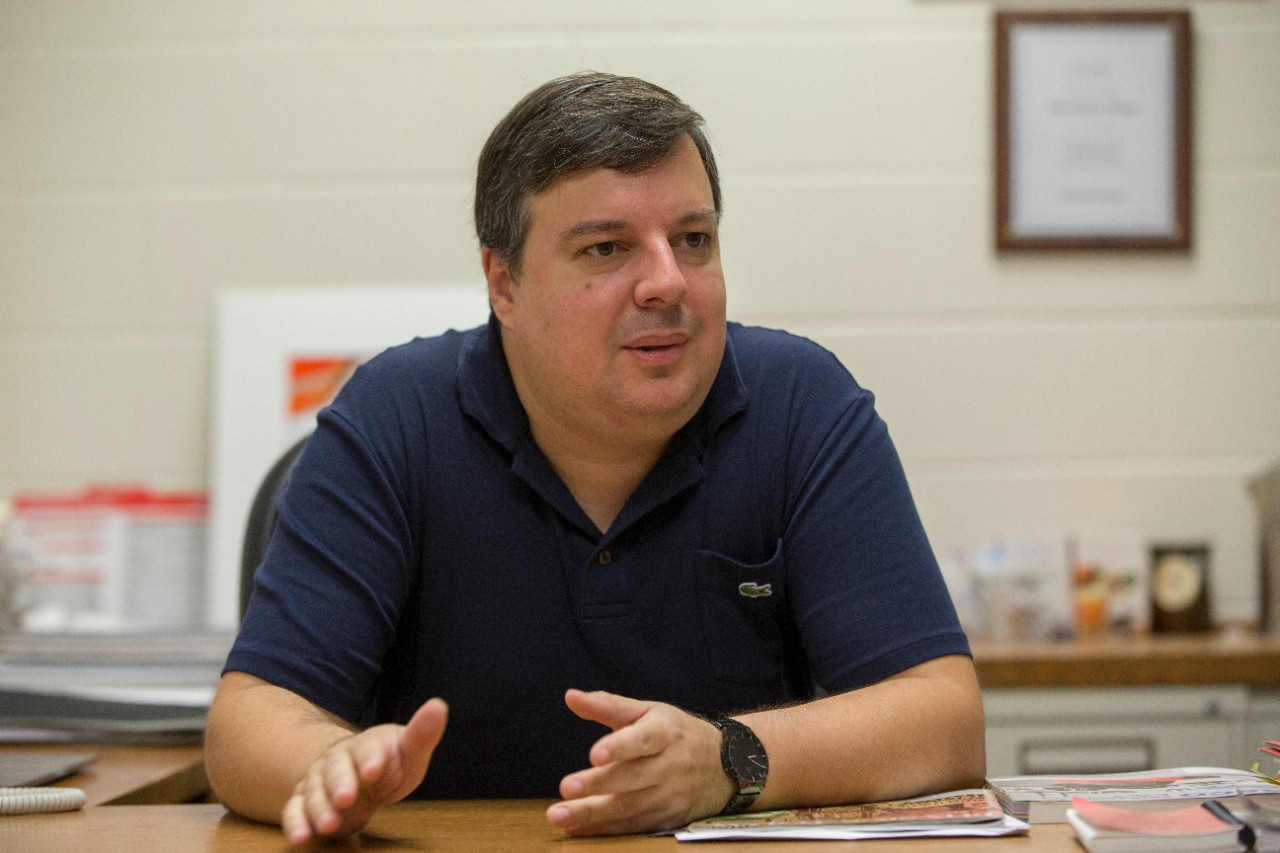
UC Professor Alexandre Sousa is working on several upcoming neutrino experiments with colleagues around the world. Photo/Joseph Fuqua II/UC
- WinFuture: (Germany) The next 10 years of neutrino research
Related Stories
Still the top ‘cat
October 20, 2026

The University of Cincinnati Bearcat mascot was voted Cincinnati’s favorite mascot in a Cincinnati Enquirer reader poll, earning 45.1% of the vote and topping other local favorites.
How will Ohio's minimum wage bump impact businesses and their employees?
October 20, 2026

UC economist Michael Jones spoke to WVXU's "Cincinnati Edition" on if Ohio's latest minimum wage increase will actually impact employees and businesses as inflation continues to rise.
Researchers test gene therapy as less invasive treatment for hydrocephalus
October 20, 2026

Researchers at the University of Cincinnati College of Medicine say an experimental gene therapy could eventually lead to a less invasive treatment for hydrocephalus, a condition in which excess fluid accumulates in the brain. The early-stage study, led by Agnes (Yu) Luo, PhD, professor and vice chair for research, was published in the journal Fluids and Barriers of the CNS. Yahoo! News recently featured it.