Fertility podcast highlights UC fibroids research
Biomedical engineers are studying how compressive force influences fibroids

A podcast produced by the American Society for Reproductive Medicine highlighted a new study by the University of Cincinnati that examined the way compressive force influences the growth of fibroid cells.
The podcast Fertility and Sterility on the Air discussed a study by UC College of Engineering and Applied Science Assistant Professor Stacey Schutte published in the journal F&S Science.
In her biomedical engineering lab in UC's Bioscience Center, Schutte and her students are examining the ways that cells respond differently to compressive force or strain. And these insights could give hope to millions of women who deal with painful and ubiquitous fibroids.
Co-host Daylon James, MD, highlighted the study.
“This is a mind-boggling stat for me that 70% of women at some point are affected by fibroids by age 50. That's a huge percentage,“ James said. “From a technical standpoint, I thought this was a real state-of-the-art (study).“
Researchers cultured fibroid cells and healthy myometrium cells from five patients. And they simulated compressive force, identifying 61 genes that were expressed differentially.
“It makes me wonder that maybe we've missed the boat on prevention strategies for fibroids,“ James said.
Schutte's co-authors included UC project coordinator Andreja Moset Zupan, UC doctoral grad Carolyn Nietupski and UC College of Medicine researchers Megan Sax, Emily Hurley and Rose Dean.
Listen to the Fertility and Sterility on the Air episode.
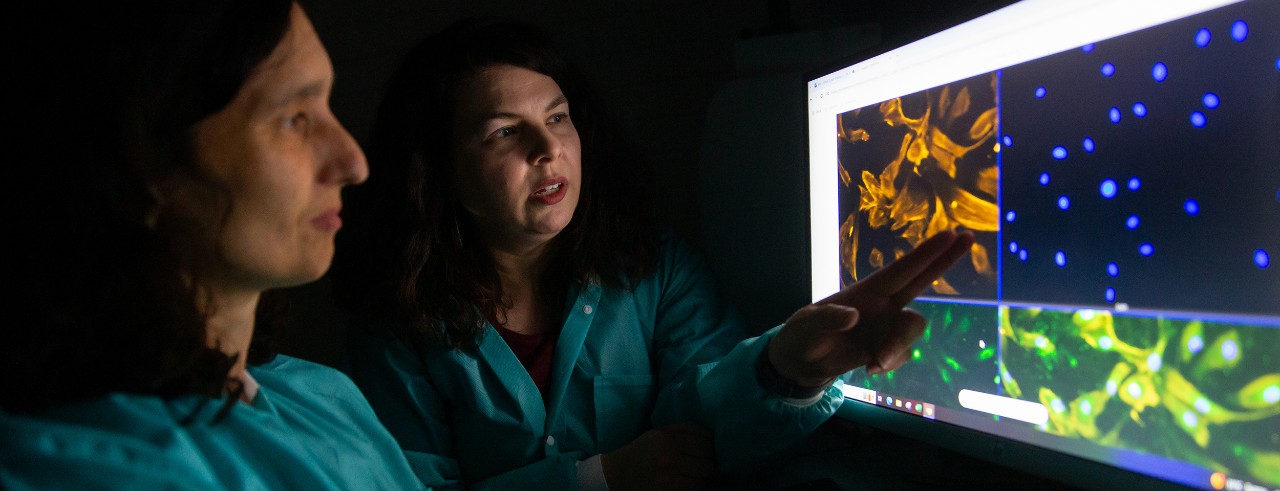
Featured image at top: Assistant Professor Stacey Schutte, right, and Research Associate Andreja Moset Zupan are looking for new treatments for fibroids in Schutte's biomedical engineering lab. Photo/Andrew Higley/UC

UC Assistant Professor Stacey Schutte is studying fibroids in her biomedical engineering lab. Photo/Andrew Higley/UC
Related Stories
Colorado silica dust trial could change the way industry does business
May 17, 2026

Betsy Malloy, Andrew Katsanis Professor of Law, at the University of Cincinnati, spoke with Bloomberg Law about how a Colorado trial could change the way the stone fabrication industry does business.
Driven by curiosity, guided by care
May 14, 2026
Max Wilson, a University of Cincinnati College of Allied Health Sciences health sciences major on the pre-physician assistant track, found his path expanding beyond the classroom and into hands-on research focused on human performance and patient care.
Computer science student's color blindness inspires outfit matching app
May 14, 2026
Eric Langhorne, a computer science undergraduate student at the University of Cincinnati, has developed a smartphone application that tells users whether or not their clothes are a match. Langhorne has color blindness, so this is a question he often asks himself and was a challenge he wanted to address. This project was done through the Experiential Explorations Program (EEP).