
Did plants nearly wipe out all marine life on Earth — twice?
UC extinction expert provides context to how land plants colonized Earth

An expert on global mass extinctions at the University of Cincinnati provided context to a new study examining the spread of the first land plants about 460 million years ago.
UC College of Arts and Sciences Professor Thomas Algeo has been studying the planet’s five major mass extinctions since the Ordovician Period when global sea levels were much higher than today.
In a paper published this week in the Nature journal Ecology and Evolution, Algeo provided context for a study examining the process of colonization and spread of plants, known as terrestrialization.
Jiachen Cai at the Chinese Academy of Sciences and his co-authors found that the carbon and phosphorus records provide evidence of how rapidly the first land plants colonized and spread across continents about 460-450 million years ago.
Terrestrialization essentially terraformed the planet, filling the atmosphere and the oceans with oxygen and generating nutrients that reached marine waters.
Cai and his co-authors concluded that evidence for the ratio of carbon to phosphorus suggests that land plants might have appeared on one of the equatorial continents called Laurentia sooner than others, particularly the largest land mass at the time called Gondwana that sat roughly where Antarctica is today at the South Pole, albeit covering a vast area that reached all the way to the paleo-equator.
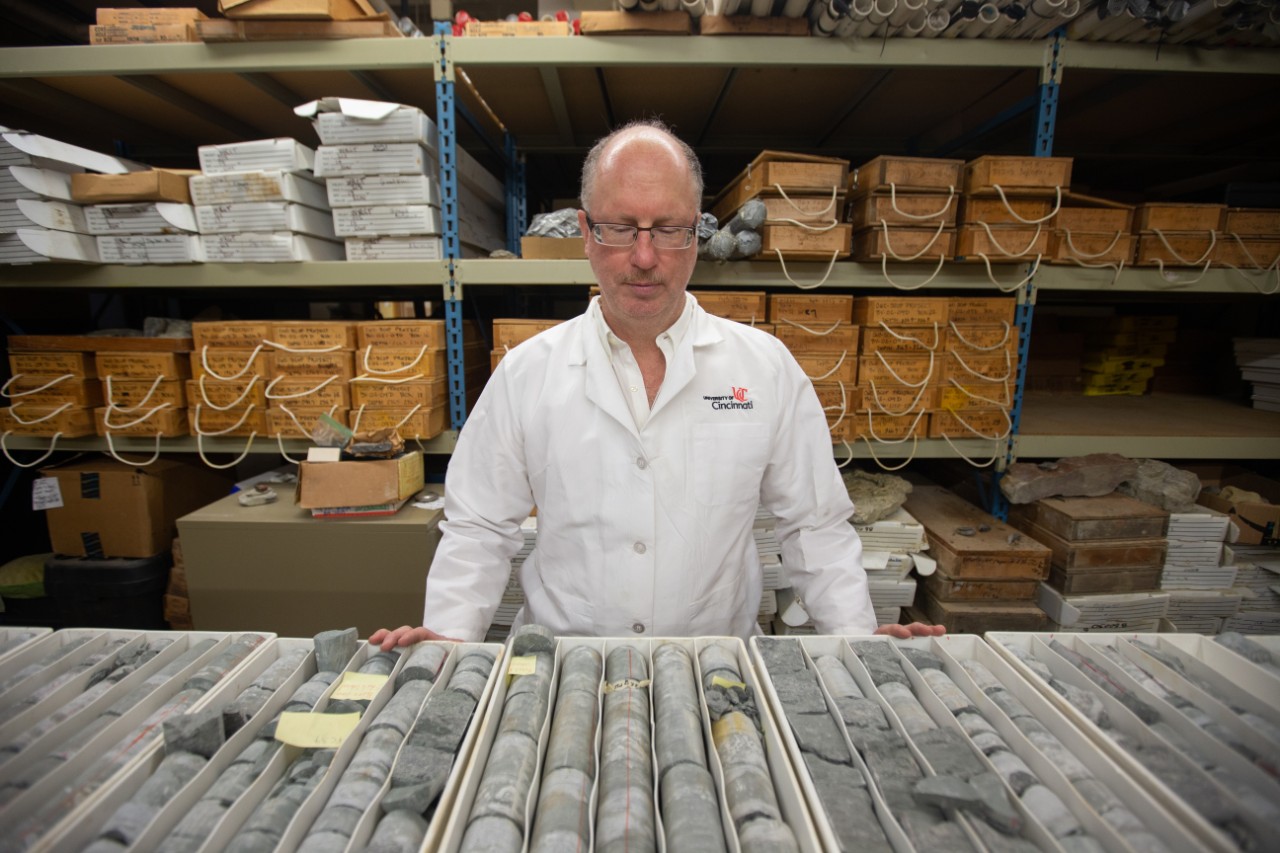
UC geosciences Professor Thomas Algeo stands in front of rock cores that he and his students analyze in his lab. Photo/Andrew Higley/UC
In his contextual paper, Algeo noted that the macrofossil record suggests land plants first appeared on the largest of the continents, Gondwana, before spreading to the other ancient continents.
Likewise, Algeo said researchers still aren’t sure what kinds of plants might have been to blame for the mass extinction that occurred in the Late Ordovician 445 million years ago: mosses, liverworts and other plants without internal circulatory systems or vascular plants like trees and ferns.
Researchers also theorize that an excess of nutrients contributed to the second mass extinction that occured in the Devonian around 360 million years ago.
Algeo said researchers are studying whether the rapid spread of plants on land might have contributed to the immense proliferation of species in the oceans 460 million years ago that created the foundation of today’s modern marine ecosystems.
“There is actually a lot of debate about whether the evolution of land plants triggered the Great Ordovician Biodiversification Event with its rapid increase in the diversity of marine invertebrates,” he said. “I would say there is no consensus yet.”

We know that cooling triggered this mass extinction. The question is what caused the climatic cooling?
Thomas Algeo, UC College of Arts and Sciences
We can observe the way plants colonize new barren land surfaces today, particularly in volcanic islands like Surtsey in Iceland and the Galapagos in the Pacific, he said.
“You see the first life in just a few years as seeds wash onto the shores and establish themselves,” Algeo said.
These pioneer plants help break down the crusty lava surface of the new land.
“Birds and marine invertebrates and mammals all contribute to the process of forming soils that help establish plant communities,” he said.
“The early successional stage to peak successional stage might take hundreds of years, but on a geological timescale that’s nothing,” he said.
Around 372 million years ago, during the Devonian Period, Earth saw a second mass extinction that killed off an estimated 70% of all marine life.
Some scientists, including Algeo, believe this mass extinction was caused by the proliferation of more advanced land plants that filled the oceans with so many nutrients that it spurred massive algal blooms or red tides.
Other scientists say the cooling was the result of eruptions of massive volcanic systems called large igneous provinces that generated easily eroded rock such as basalt, the weathering of which led to drawdown of atmospheric greenhouse gases and global climatic cooling.
“Ultimately, we know that cooling triggered this mass extinction. The question is what caused the climatic cooling?” Algeo said.
“The debate goes on,” he added.
Featured image at top: UC Professor Thomas Algeo is studying the causes behind the biggest mass extinctions on Earth. Photo/Desirea Navarro/iStockPhoto
The next groundbreaking discovery
UC is a powerhouse of discovery and impact as a Carnegie 1 research institution. From pioneering medical research to transformative engineering and social innovation, our faculty and students drive progress that reaches across the world.
Related Stories
'We’ve gone farther than any mission'
September 10, 2025
UC graduate student Samuel Hall and UC Associate Professor Andy Czaja are helping NASA use the Perseverance rover to look for evidence of ancient life on Mars. This week NASA said they might have found it.
Search for life on Mars continues on anniversary of rover mission
February 22, 2024
UC Geosciences Associate Professor Andy Czaja and his students reflect on three years of Martian exploration using the Perseverance rover as members of the NASA science team.
UC professors named scientific society fellows
June 7, 2024
Three University of Cincinnati professors were named to the 2023 class of American Association for the Advancement of Science Fellows, a distinguished lifetime honor within the scientific community. From UC's College of Arts and Sciences, Carlton Brett, a professor in the department of geosciences, and George Uetz, a biological sciences professor, were honored. Dionysios Dionysiou, a professor of environmental engineering in the College of Engineering and Applied Science, was honored posthumously.