AI as a creative partner
Exploring AI’s role in architecture and research innovation

In architecture and design, artificial intelligence is increasingly becoming more than a tool; it's a collaborator. University of Cincinnati architecture professor Ming Tang is exploring how AI can enhance research, teaching, and design creativity in his XRLab (Extended Reality Lab).
Tang’s lab is focused on more than visualization and immersive experiences; it investigates how digital technologies and computational methods intersect with human-centered design. A significant area of research is computer vision. “AI has become powerful enough to recognize not just objects but the meaning of images,” Tang said. One long-term project, conducted with Cincinnati Insurance Companies, uses AI to assess building risk in the event of hurricanes. By annotating images and training AI models, his team can classify building components and predict vulnerabilities as a practical application that integrates architecture, computation, and real-world problem solving.

Feeding large datasets into AI lets us communicate complex information to people who are not experts.
Ming Tang UC architecture professor and director of XRLab
Another research area involves large language models. Tang’s lab uses AI to enhance VR-based training, simulating interactions of users with the built environment. “Feeding large datasets into AI lets us communicate complex information to people who are not experts,” he said. These tools support a new level of simulation research from smart building management, digital twins, and Internet of Things applications, allowing humans to interact meaningfully with massive, previously opaque data sets.
AI in the classroom
Tang encourages students to use AI to generate rapid design iterations. “I want to see students have something to discuss,” he said. “AI is a quick way to create starting points for conversation and exploration.”

Rendering by Emma Cek for the "Museum of Emotions" course. Photo provided.
In a recent course, themed “Museum of Emotions,” students used AI to translate abstract inspirations into architectural forms. Tang remarks that one student associated the emotions with tomatos, using AI image-to-image translation to create renderings inspired by the color, texture and form of strawberries. Another student drew inspiration from the curves and aesthetics of a PlayStation console, prompting AI to explore industrial design elements within a convention center project. Tang sees AI as a partner in experimentation, accelerating creativity while leaving students in charge of interpretation.

Rendering of a convention center by Gustavo Reyes. Photo provided.
Training AI to think differently

Abstract renderings by students using Deep Dream. Photo provided.
Tang finds value in the unexpected results AI produces. Early experiments with Deep Dream, a primitive AI tool, would transform building images into collages of animal faces, creating unusual and sometimes “creepy” visual results. These moments of imperfection, he says, are crucial for creativity. “AI can be too polished or deductive; the most inspiring outcomes often come from its unpredictability”, he said.
Tang also cautions against AI as an echo chamber. “If you train AI only on a specific style, it will just reproduce that style,” he said. Creative exploration requires moving outside the bubble, embracing inductive and experimental approaches and intentionally challenging AI-generated results.
To foster creativity, Tang integrates AI exercises that focus on abstraction and transformation. In a graduate-level visualization course, students designed temporary structures for the Burning Man festival, using AI to experiment with erosion, turbulence, and distortion in patterns. “It’s not about producing a polished rendering on day one,” he said. “It’s about experimenting, evolving ideas and translating abstract concepts into buildable forms.”
Tang emphasizes that AI encompasses many different tools and applications, and educators must clarify which type of AI is being used. “Without specifying the AI’s purpose, the conversation can’t go anywhere,” he said. In both teaching and research, Tang advocates for a careful, iterative approach where AI is a partner, not a replacement, encouraging curiosity, experimentation and critical engagement.
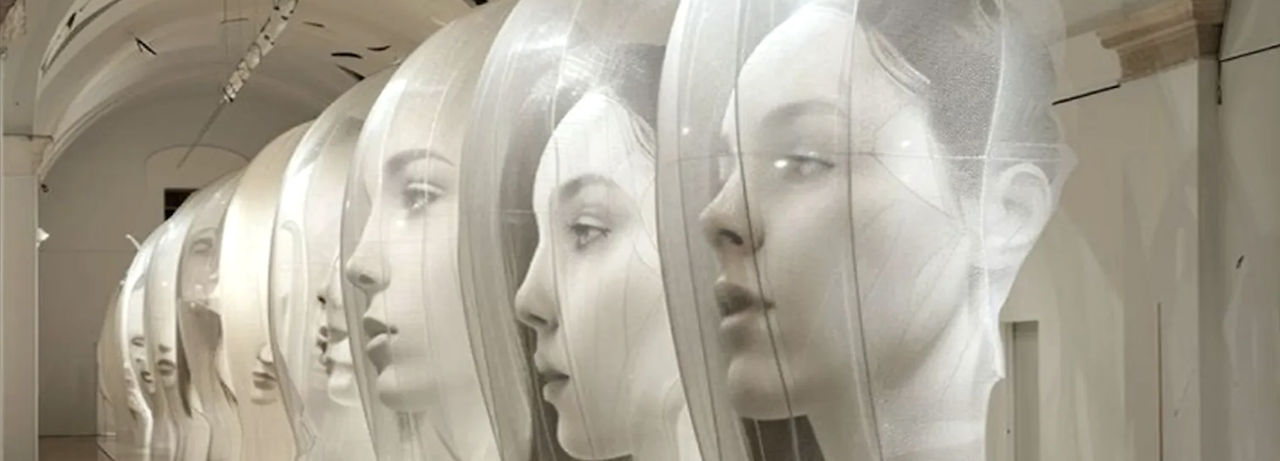
Featured image at top: Rendering by Meghan Powell for the "Museum of Emotions" course. Photo provided.
Your next big idea
Innovation is a daily practice at UC. The 1819 Innovation Hub is UC’s front door for industry, inventors, innovators and entrepreneurs. We foster bold thinking and collaborative breakthroughs that shape industries and improve lives — and we move at the speed of need to make them happen.
Related Stories
Back to School 2026: UC remains a destination campus
August 24, 2026
The University of Cincinnati welcomes its largest first-year class and a record share of first-generation students for fall 2026, reinforced by affordability initiatives, co-op opportunities and new academic offerings across all campuses.
UC workshop shows AI alone cannot best human input
September 11, 2024
As AI starts to permeate industry, how will those in the creative fields adapt? A workshop hosted by UC’s College of Design, Architecture, Art, and Planning (DAAP) brought industry and academics together to discuss the future of AI and how creative disciplines benefit.
University of Cincinnati gets $1.1M for AI physician training
January 30, 2026

The University of Cincinnati College of Medicine has received a four-year, $1.1 million grant to explore using artificial intelligence and personalized learning to improve physician education.