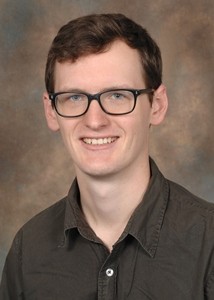
UC Student Awarded National Goldwater Scholarship

University of Cincinnati, biomedical engineering student, Matthew Davenport was among this years winners of the National Goldwater Scholarship.
The Barry Goldwater Scholarship and Excellence in Education Program was established by Congress in 1986 to provide a continuing source of highly qualified scientists, mathematicians, and engineers by awarding scholarships to college students who intend to pursue research careers in these fields.
This prestigious scholarship is awarded to students at the university level enrolled in STEM programs and are conducting undergraduate research. Each year a maximum of four nominees can be named from each university.
Matthew began his research career his freshman year as a volunteer in Dr. Tori Schaefers lab at Cincinnati Childrens Hospital Medical Center (CCHMC) in the Departments of Psychiatry and Developmental Biology. Matthew went on to complete his first co-op rotation at Assurex, under Dr. Tony Altar, performing literature review for the company on topics that complemented his laboratory work at CCHMC. Matthew completed his second and third co-ops back at CCHMC, where he works with Dr. Schaefer to assess the therapeutic potential of various pharmaceutical compounds for their efficacy in treating Autism spectrum disorders, while characterizing the neural circuit dysfunctions underlying these disorders.
After graduation from UC, Matthew plans to continue his education, pursuing a PhD in the field of systems neuroscience. According to Matthew, it is not well understood how regions of the brain are connected and how alteration in these connections can lead to functional changes in the ability of the brain to store and recall memories.
Matthew believes Co-op is hands down the best part of being a College of Engineering student. "Thanks to Cooperative Education Program, I already have a full year of full time experience in my lab...This has allowed me the opportunity to be actively involved in the hypothesis and experimental design aspects of research. Designing the experiments and troubleshooting protocols while in class and then executing them while on co-op."
"Co-op has provided me with a good understanding of what life is like in academic research. I have experienced the frustration of spending a month unsuccessfully working on a protocol, the disappointment of having a hypothesis shot down by the data, the scramble to pull together data at the eleventh hour for a grant, and the rare excitement of a new, unexpected discovery. Without the opportunity to invest significant time in lab, I dont know that I would have as complete a picture of what life as researcher is like," stated Davenport.
Matthew strongly recommends undergraduate research and the cooperative education program to prospective University of Cincinnati students, and is open to speak to students who may have questions about the programs. Matthew Davenport can be contacted by e-mail at davenpmh@mail.uc.edu.
Related Stories
UC, NKU renew longstanding partnership supporting Army ROTC cadets
August 26, 2026
The University of Cincinnati Army ROTC and Northern Kentucky University (NKU) have renewed a longstanding partnership that supports students preparing to become Army officers and leaders in their communities. The universities formalized the renewed agreement during a signing event Aug. 11 at NKU.
One in four NFL players had CTE at death
August 25, 2026

Forbes cites research on concussions and football helmets by the University of Cincinnati in a report that found one in four NFL players had brain damage at death.
A new year, a shared purpose: President Pinto welcomes Bearcats to UC’s 208th fall
August 24, 2026
President Neville G. Pinto welcomes students, faculty and staff back to UC's 208th academic year.