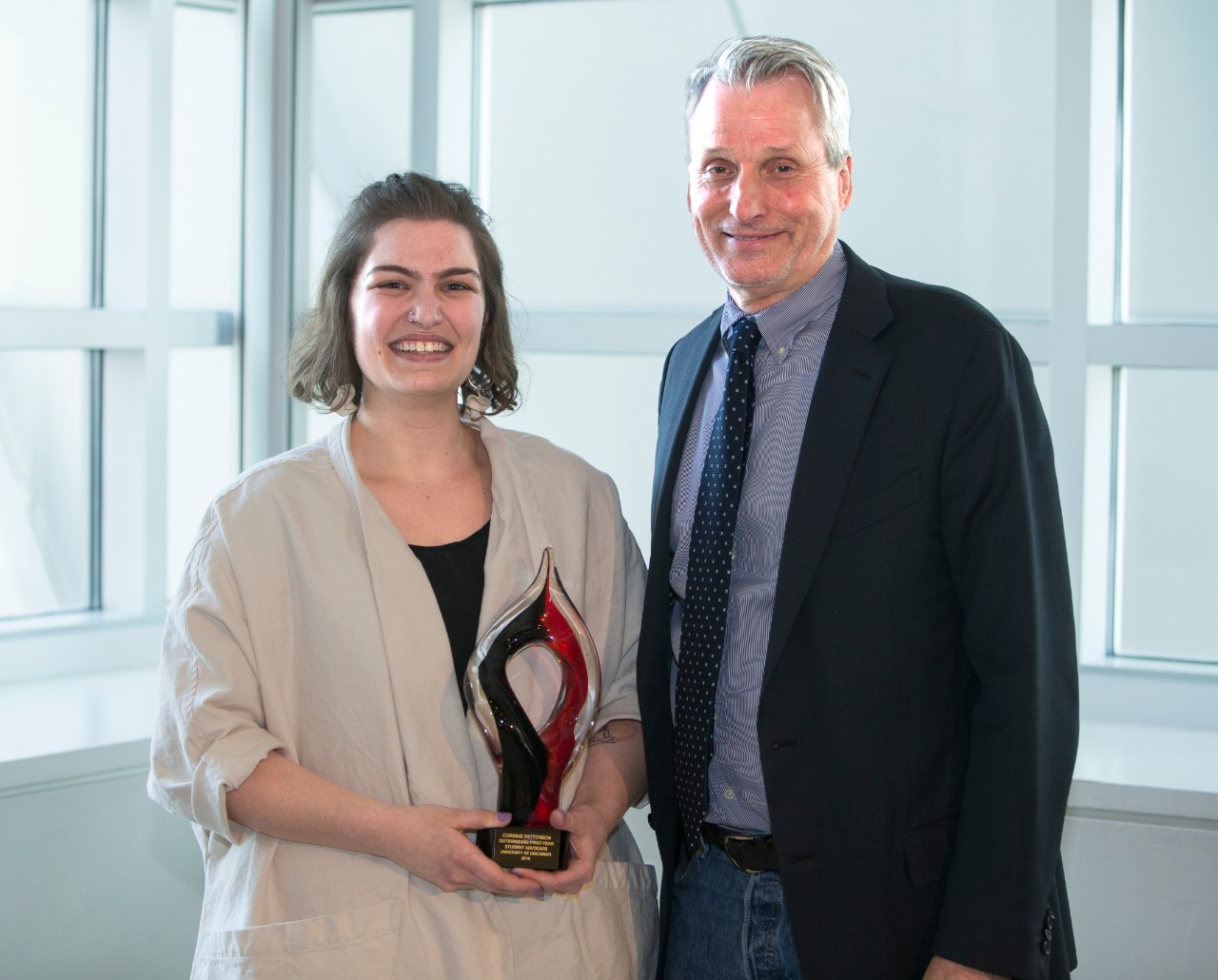
Patterson receives UC Outstanding First-Year Advocate Award

On April 11, University of Cincinnati Senior Academic Advisor Corrine Patterson received the UC Outstanding First-Year Advocate Award. This university award recognizes exceptional work in first-year student learning, development and success and honors recipients for their positive impact on the university culture.
"This award was really representative of how rewarding this past year has been," Patterson said.
Patterson advises all first-year students accepted into UC's Freshman Engineering Program and Engineering and Applied Science Entrance program, two first-year tracks for undecided and conditionally admitted engineering students.
Patterson has helped transform the way these students transition into their best-fit majors. Part of her goal is breaking down students' fixed mindsets.
"A large number of these students come in set on majors like mechanical or aerospace engineering," Patterson said. "Our job is to break down these barriers and help these students see the connections and overlapping elements between programs."
Patterson is also interested in building trusting relationships with students through authentic conversations. She enjoys seeing students grow over their first year and being part of that shaping process.
"One of the great things about working with first-year programs is you can really reinvent the culture in a short amount of time," Patterson said. "Creating an environment where these students have someone who knows them and who they trust is very powerful."
Creating an environment where these students have someone who knows them and who they trust is very powerful.
Corrine Patterson, UC senior academic advisor
Patterson creates this environment through proactive and intrusive advising, addressing students' needs early on, rather than letting these needs slip through the cracks. This leads to a better first-year experience and a higher retention rate. It also supports students' transition into a major they are passionate about.
"Corinne constantly pushed me to set more goals for myself and challenged me to be better, work harder and balance my time between school and friends," one student advisee said. "I wouldn't be where I am today without Corinne's guidance my first semester."
Patterson does not just advise first-year students. She also plans year-long programs, shaping the collective experience of these students. Last October, Patterson started the college's first ever Meet Your Major, a large-scale major exploration event for undecided CEAS students. In the fall, she is integrating programming into the new engineering living-learning community.
"Ms. Patterson's passion, enthusiasm and overall demeanor have a direct and positive impact on first-year student learning, development and success," said P.K. Imbrie, UC professor and head of the Department of Engineering Education. "These students have a cheerleader, mentor and advocate in their corner."
Featured image at top: Corrine Patterson poses with her award alongside UC professsor P.K. Imbrie. Photo/Provided
Explore Engineering
Interested in exploring majors within UC's College of Engineering and Applied Science? Visit the college's website, or explore transfer and transition opportunities at UC's Center for Pathways Advising and Student Sucess.
Related Stories
Engineering professor named KEEN Fellow
August 31, 2026
Dhuree Seth, assistant professor educator in the Department of Aerospace Engineering, is one of 30 engineering faculty members nationwide who were named 2026 KEEN Engineering Unleashed Fellows. The University of Cincinnati College of Engineering and Applied Science has been a partner of the Kern Entrepreneurial Engineering Network (KEEN) since 2024. Seth has been part of KEEN since she was a PhD student more than 10 years ago.
Major grant expands apprenticeship opportunities at UC
August 31, 2026
UC will expand registered apprenticeship opportunities in AI, semiconductor, and nuclear-energy infrastructure through a major U.S. Department of Labor grant partnership led by JFF.
Heavy social media use linked to depression
August 31, 2026

U.S. News and World Report, Yahoo! News, MSN, USA Today and other national media highlight a new study by the University of Cincinnati and Northwestern University that found a correlation between heavy social media use and depression in adults.