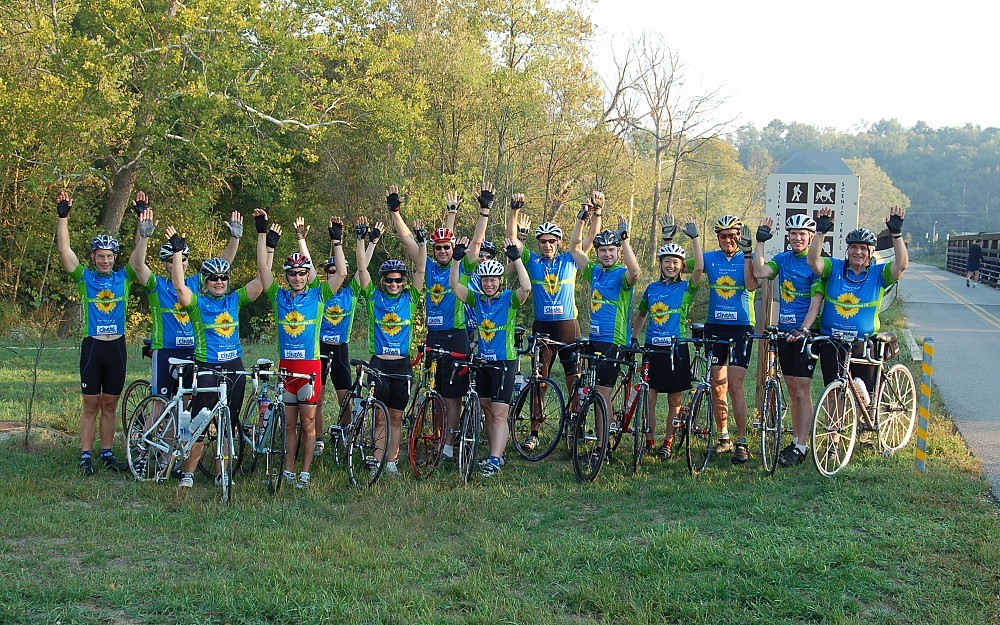
Record Proceeds Recorded From Sunflower Revolution IV

Sunflower Revolution officials celebrated the fifth anniversary of the regions largest and most important fundraiser for Parkinsons disease research Thursday at the Queen City Club by announcing record proceeds of $442,000 from the 2007 gala and bike ride.
Since 2004 the Sunflower Revolution and related events have raised $967,000 for Parkinsons disease research and wellness programs at the Neuroscience Institute at the University of Cincinnati (UC) and
Numerous Sunflower-funded research projects are in progress at the James J. and
Sunflower organizers also announced that Joe Broderick, MD, chairman of the UC neurology department and research director of the Neuroscience Institute, and his wife, Donna, will chair the 2008 Sunflower Revolution gala. Honorary chairs are Bob Kohlhepp, vice chairman of Cintas, and his wife, Linda. Ron Koetters, chairman and CEO of Monarch Construction, will head the corporate steering committee.
Sunflower Revolution V will take place Sept. 5, 6 and 7. The event is a collaboration involving the University Hospital Foundation, the Neuroscience Institute, the Mayfield Clinic, and the Davis Phinney Foundation, based in
· the fundraising gala (Sept. 5 at the Hyatt Regency Cincinnati);
· a free educational symposium for patients, families and caregivers (Sept. 6 at the Hyatt);
· and fundraising bike rides of 100K, 40K and 10K (Sept. 7).
Gala tickets are $150, $250 and $500 each; ride fees are $80 per cyclist. For more information about the gala, symposium and ride, please visit www.sunflowerrev.org.
Researchers funded by Sunflower Revolution proceeds are currently studying:
· the potential for a surgical procedure called deep brain stimulation to help protect brain cells. · the effect of deep brain stimulation on balance and gait. · the impact of depression on the progression of Parkinsons disease. · the development of Parkinsons disease years after a toxic exposure. · the measurement of two aspects of bradykinesia, the slowing and constricting of movement and reflexes that are characteristic of Parkinsons disease.
The Neuroscience Institute, a regional center of excellence, is dedicated to patient care, research, education, and the development of new treatments for stroke, brain and spinal tumors, epilepsy, traumatic brain and spinal injury, Alzheimers disease, Parkinsons disease, disorders of the senses (swallowing, voice, hearing, pain, taste and smell), and psychiatric conditions (bipolar disorder, schizophrenia and depression).
Tags
Related Stories
On-site training in Speech & Hearing Clinic sets UC’s programs apart
August 27, 2026
At the University of Cincinnati’s Speech & Hearing Clinic, Doctor of Audiology and Speech-Language Pathology graduate students gain real-world experience while providing free speech and hearing services to the community.
Funding expands UC research into weight gain side effects of bipolar medication
August 26, 2026
University of Cincinnati researchers have been approved for funding by the Patient-Centered Outcomes Research Institute (PCORI) to expand the implementation of healthy lifestyle interventions and metformin prescription to help manage weight gain in overweight or obese youth taking second-generation antipsychotic medications.
One in four NFL players had CTE at death
August 25, 2026

Forbes cites research on concussions and football helmets by the University of Cincinnati in a report that found one in four NFL players had brain damage at death.