Health a Focus of UC's Billion-Dollar Campaign

CINCINNATIThe University of Cincinnati's health enterprise takes center stage in the new Proudly Cincinnati capital campaignan effort aimed at raising $1 billion for a number of key initiatives.
Cancer,cardiovascular diseases, metabolic diseases and neurosciencesall identified as priorities in the College of Medicines strategic planning effortswill serve as the primary focus for the campaigns Health in the 21st Century fundraising efforts.
Research related to trauma, nanomedicine and hearing will also be supported by the campaign.
Distance and experiential learningeducational tools in the colleges of allied health sciences, nursing and pharmacyare key components of the campaigns 21st Century Learning initiative
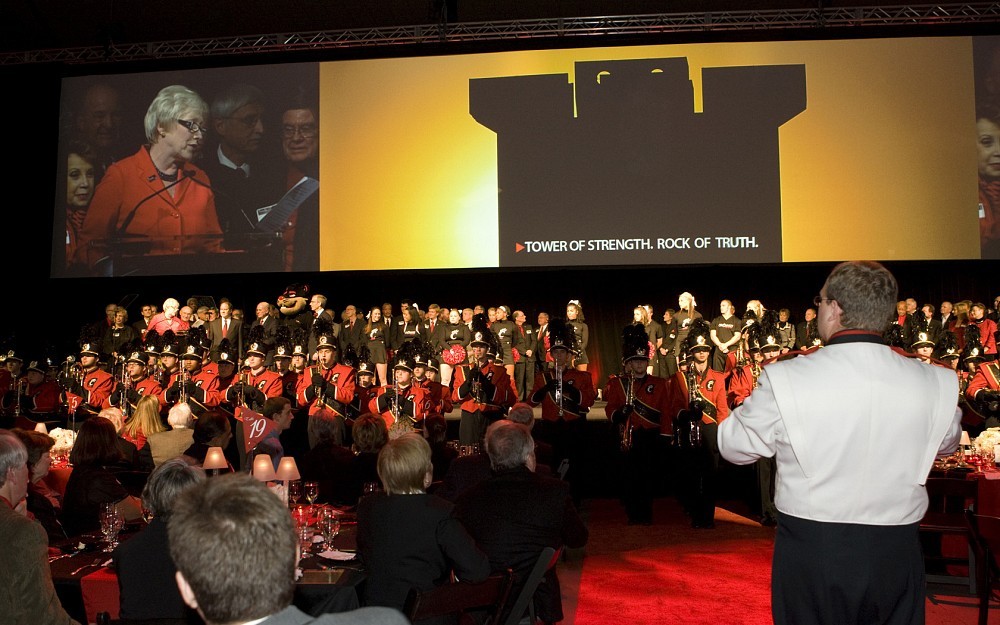
UCs capital campaign, originally set for a goal of $800 million, was officially kicked off at an Oct. 25 celebration in Fifth Third Arena.
Like most large-scale campaigns, UCs began with whats termed a quiet phasea period of fundraising leading up to the official campaign announcement. UC raised more than $453 million during the quiet campaigning period, giving university leaders a strong indication that reaching beyond the original goal would be possible.
The university announced during its campaign kick-off celebration that it will seek approval from the UC Board of Trustees to change the campaign goal to $1 billion.
We are committed to an ambitious future and Proudly Cincinnati will truly be a game changer, said UC President Nancy Zimpher.
David Stern, MD, vice president for health affairs and College of Medicine dean, says the capital campaign will be especially important for UCs health enterprise. A significant portion of the $1 billion raised during this campaign will go towards initiatives at UCs Academic Health Center, he says. Health care is a top priority for people everywhere, and UC is in a position to take its top-notch programs and make them even better.
The Academic Health Center and its affiliates receive more than $270 million in external research funding in 2007.
Private support sought through UC's capital campaign supports the creation of fellowship positions and endowed chair positions, scholarships and research activity. Key initiatives already supported by gifts given during the quiet phase of the Proudly Cincinnati campaign include:
- The Edith J. Crawley Vision Science Research LaboratoryEdith J. Crawley
- James L. Winkle College of PharmacyJames L. Winkle
- The Donald C. Harrison Health Sciences LibraryDonald C. Harrison, MD
- The James J. and Joan A. Gardner Center for Parkinsons Disease and Movement DisordersJames J. and Joan A. Gardner Family Foundation
- Wedbush Legacy CenterJean and Ed Wedbush
Learn more about UCs capital campaign at uc.edu/proudlycincinnati/.

A patient has an magnetic resonance imaging scan to identify signs of breast cancer.
Related Stories
Cancer Center plays key role in lab research, clinical trials for new pancreatic cancer drug
September 1, 2026

WLWT and WCPO highlighted the contributions of University of Cincinnati Cancer Center researchers that helped lead to the recent FDA approval of daraxonrasib, a new treatment for pancreatic cancer.
Cancer Center physician receives $150,000 New Investigator Research Grant to study treatment-resistant leukemia
September 1, 2026
The University of Cincinnati Cancer Center’s Sarah Skuli, MD, PhD, received a two‑year, $150,000 Leukemia Research Foundation New Investigator Grant to study TP53‑mutated leukemia, a treatment‑resistant subtype with very poor outcomes.
Heavy social media use linked to depression
August 31, 2026

U.S. News and World Report, Yahoo! News, MSN, USA Today and other national media highlight a new study by the University of Cincinnati and Northwestern University that found a correlation between heavy social media use and depression in adults.