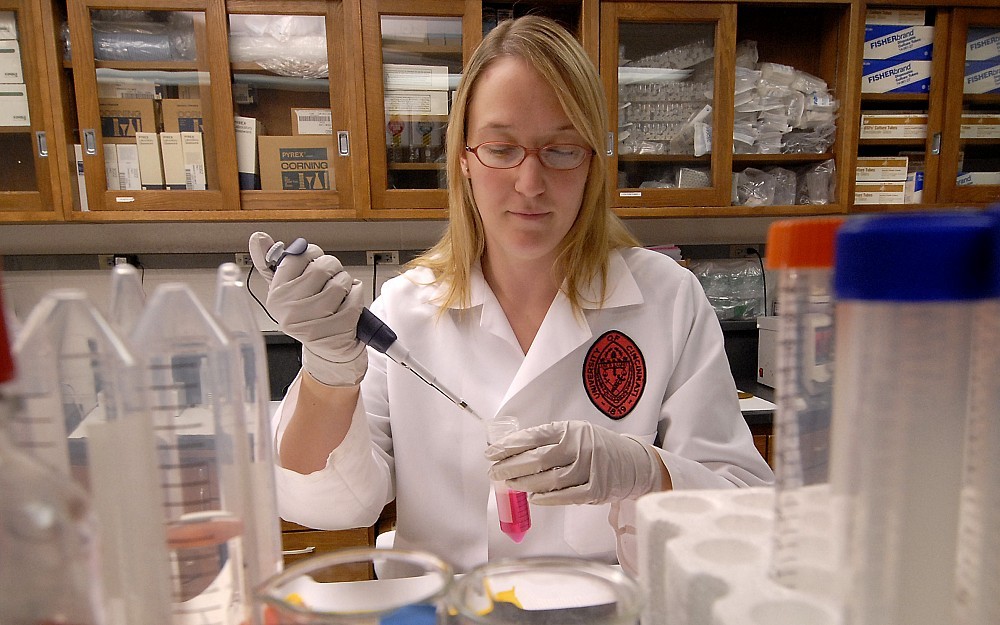
Researchers Study How Mother's High-fat Diet Contributes to Obesity in Children

CINCINNATIThe catch phrase eating for two isnt license for pregnant women to forgo concerns about weight gain during pregnancy, say researchers at the University of Cincinnati (UC).
It is well established that overweight and obese women give birth to larger babies, which increases the childs risks for injury at delivery and makes these babies susceptible to develop obesity and diabetes later in life, says Helen Jones, PhD, a postdoctoral fellow in the obstetrics and gynecology department at the UC College of Medicine.
Exactly which mechanisms cause fetal overgrowth is the basis for a report by Jones now available in the Federation of American Societies for Experimental Biology (FASEB) Journal.
Jones and her collaborators recently developed a novel mouse model in which one group of female mice was fed a normal diet and another group a higher fat diet for eight weeks, and were then mated. The offspring of the mice on the high fat diet were larger by more than one-third, even though the placentas were similar in size at delivery.
The most striking finding in the study, says Jones, was that the high fat diet markedly increased the abundance of two specific nutrient transporter proteins in the placenta. The increased transfer of nutrients to the fetus therefore stimulated fetal growth.
The most important factor triggering the changes in placental function and fetal growth was that the pregnant mice in the model were not yet obese, says the studys principal investigator and co-author Thomas Jansson, MD, PhD, also with the obstetrics and gynecology department.
These studies, Jones says, may help to better understand the underlying causes of fetal overgrowth in the obese woman.
If this holds true for obese women, decreasing dietary fat intake may be effective in decreasing the risk of having a large baby even if the woman remains obese, Jansson says.
The two-year study began in April 2008 and is funded by the National Institutes of Health.
Related Stories
Cancer Center plays key role in lab research, clinical trials for new pancreatic cancer drug
September 1, 2026

WLWT and WCPO highlighted the contributions of University of Cincinnati Cancer Center researchers that helped lead to the recent FDA approval of daraxonrasib, a new treatment for pancreatic cancer.
Cancer Center physician receives $150,000 New Investigator Research Grant to study treatment-resistant leukemia
September 1, 2026
The University of Cincinnati Cancer Center’s Sarah Skuli, MD, PhD, received a two‑year, $150,000 Leukemia Research Foundation New Investigator Grant to study TP53‑mutated leukemia, a treatment‑resistant subtype with very poor outcomes.
Heavy social media use linked to depression
August 31, 2026

U.S. News and World Report, Yahoo! News, MSN, USA Today and other national media highlight a new study by the University of Cincinnati and Northwestern University that found a correlation between heavy social media use and depression in adults.