UC HEALTH LINE: New Breath Test Can Detect Tummy Troubles

CINCINNATIA persons breath can tell you a lot of things, like whether they are garlic lovers or regularly chew gum.
But according to doctors at the University of Cincinnati, it can also help uncover problems in the gastrointestinal (GI) tract.
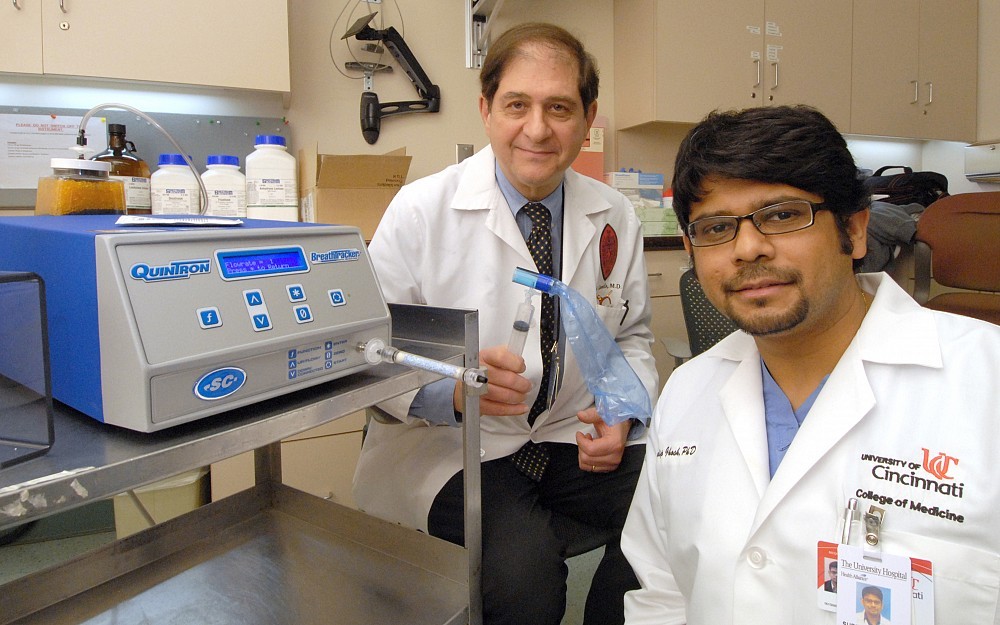
Ralph Giannella, MD, and colleagues in the digestive diseases division are now offering hydrogen/methane breath testing at University Hospital to help patients discover whether they have bacterial overgrowth in their small intestines or are lactose or fructose intolerant.
He says University Hospital is the first facility to offer this test in the Cincinnati area.
Our intestines naturally have bacteria, says Giannella, a professor in the digestive diseases division at UC. These bacteria help break down our food which metabolizes into gas.
Using the gases in persons breath can help us determine problems in their GI tract.
Tests can be done for small intestinal bacterial overgrowth (glucose), sugar intolerances (fructose), dairy intolerances (lactose), or intestinal transit time from the mouth to the large intestine (lactulose).
We have each patient breathe into a special plastic bag, and we draw out the air with a syringe, Giannella says. Then, depending on the purpose of the hydrogen/methane breathing test, we have each patient consume a certain sugar mixture and repeat the process.
He says the test takes about four hours. Breath samples are taken and analyzed every 30 minutes, but the patient does not need to be stationary during the test and can return periodically for timed sampling.
There is no blood draw required, he says. This test is completely non-invasive. By the amount of hydrogen measured in a persons breath, we can determine a diagnosis and decide the best way to treat the patient.
Its simple and beneficial.
Tags
Related Stories
Cancer Center plays key role in lab research, clinical trials for new pancreatic cancer drug
September 1, 2026

WLWT and WCPO highlighted the contributions of University of Cincinnati Cancer Center researchers that helped lead to the recent FDA approval of daraxonrasib, a new treatment for pancreatic cancer.
Cancer Center physician receives $150,000 New Investigator Research Grant to study treatment-resistant leukemia
September 1, 2026
The University of Cincinnati Cancer Center’s Sarah Skuli, MD, PhD, received a two‑year, $150,000 Leukemia Research Foundation New Investigator Grant to study TP53‑mutated leukemia, a treatment‑resistant subtype with very poor outcomes.
Heavy social media use linked to depression
August 31, 2026

U.S. News and World Report, Yahoo! News, MSN, USA Today and other national media highlight a new study by the University of Cincinnati and Northwestern University that found a correlation between heavy social media use and depression in adults.