Radiation Seeds Effective Against Single Metastatic Brain Tumors

CINCINNATIA study led by specialists at the Brain Tumor Center at the University of Cincinnati (UC) Neuroscience Institute affirms the benefits and safety of aggressive, localized treatment for patients with a single brain metastasis.
The retrospective study of 72 patients, published in the May issue of the Journal of Neuro-Oncology, demonstrates that the implantation of radioactive seeds following the surgical removal of a single brain metastasis is as effective as the standard treatment of radiating the entire brain following surgery. Radiation seeds are titanium casings about the size of a grain of rice that are filled with low-level, I-125 radioactivity.
The standard treatment, known as whole-brain radiation therapy (WBRT), effectively kills microscopic and undetectable cancer cells not only around the tumor but also in other parts of the brain where they have not yet been detected with MRI scans. But it can cause long-term radiation toxicity and can result in cognitive problems in up to 10 percent of patients.
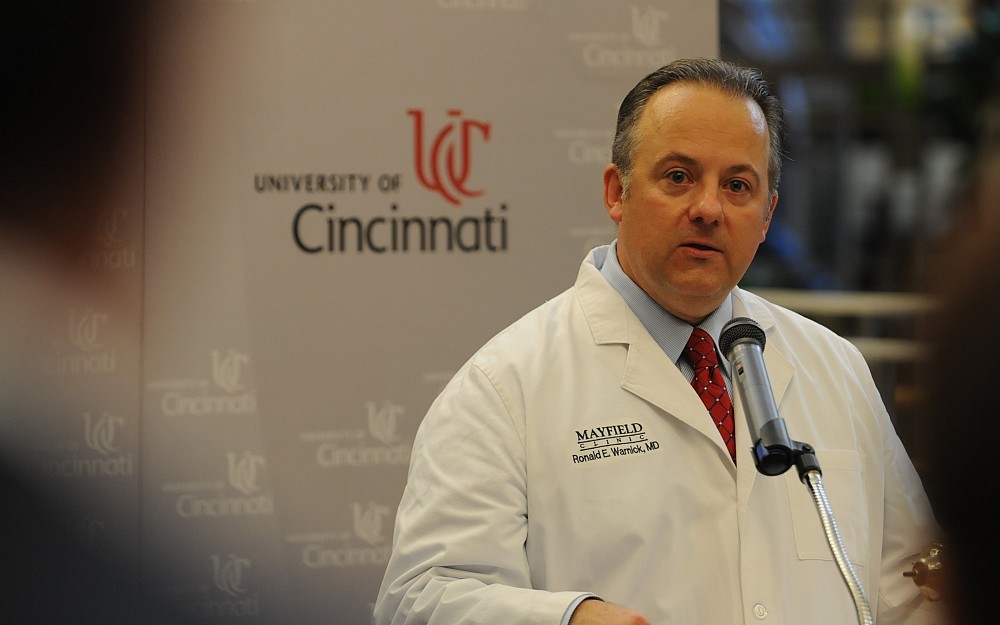
The potential adverse affects of WBRT are of concern, says Ronald Warnick, MD, professor of neurosurgery and radiation oncology at UC, director of the Brain Tumor Center and the studys principal investigator. These include acute effects, such as fatigue and hair loss, but also delayed, cognitive effects, including memory loss and personality changes. These cognitive side effects can compromise the benefit that WBRT provides.
The risk of cognitive impairment is especially undesirable because patients with a single brain metastasis can survive longer than one to two years.
The study involved a retrospective review of 72 patients who were treated with surgery and radiation seeds without up-front radiation at the Brain Tumor Center at University Hospital from 1997 to 2007. The study builds on a previous UC study of localized treatment of a single metastasis.
Warnick and his team demonstrated that, with radiation seeds, they were able to safely maintain control of the tumor at the surgical site in more than 90 percent of cases, while eliminating the need for WBRTwith its associated side effectsin all but five patients.
We initially feared that omitting WBRT would result in uncontrollable metastases elsewhere in the brain, Warnick says. However, these distant metastases were generally well controlled with surgery, stereotactic radiosurgery (the delivery of targeted beams of radiation), or WBRT.
The new study, with the addition of more patients and longer follow-up, strengthens previous results and recommendations that the use of I-125 seeds is an effective alternative to WBRT.
Sixteen months following surgical removal of the metastatic tumor and the implantation of seeds, 67 study participants (93 percent) had no recurrence of the tumor at the surgical site. Five patients developed a recurrence at the tumor resection site, while 23 patients developed metastases in another part of the brain.
The
In the end, 93 percent of the patients we studied did not require whole brain radiation and therefore were not exposed to the risks of cognitive problems and the inevitable side effect of hair loss, Warnick says.
Says Breneman: This form of treatment is another incremental advance in the work being done to prolong the lives of patients with brain metastases while preserving their quality of life. These advances have resulted in meaningful improvements in the ability of patients to fight their cancers while minimizing the intrusions that cancer treatment can impose on them and their loved ones."
Most importantly, the overall survival rate of patients treated with radiation seeds compared favorably to that of patients who had undergone whole-brain radiation therapy. Median survival for patients treated with tumor removal and radiation seeds was 14 months, while 27 percent survived two years. Previous studies have reported the median survival rate for patients who underwent tumor removal and WBRT at 10 to 12 months.
The important conclusion is that patients with a single metastatic tumor of the brain that is surgically accessible can avoid the risks of whole-brain radiation and can be effectively treated with surgery, radiation seeds, and watchful follow-up every three months, Warnick says.
More than 100,000 cases of metastatic brain cancer occur in the
Additional co-authors of the study are Christopher McPherson, MD, director of the division of surgical neuro-oncology at UC, and Michael Petr, MD, a former resident in the UC neurosurgery department. There was no outside funding source.
The UC Brain Tumor Center, under the direction of Warnick, is a multidisciplinary center which includes specialists in neurosurgery, radiology, radiation oncology, otolaryngology, internal medicine and physical medicine and rehabilitation.
Tags
Related Stories
Cancer Center plays key role in lab research, clinical trials for new pancreatic cancer drug
September 1, 2026

WLWT and WCPO highlighted the contributions of University of Cincinnati Cancer Center researchers that helped lead to the recent FDA approval of daraxonrasib, a new treatment for pancreatic cancer.
Cancer Center physician receives $150,000 New Investigator Research Grant to study treatment-resistant leukemia
September 1, 2026
The University of Cincinnati Cancer Center’s Sarah Skuli, MD, PhD, received a two‑year, $150,000 Leukemia Research Foundation New Investigator Grant to study TP53‑mutated leukemia, a treatment‑resistant subtype with very poor outcomes.
Heavy social media use linked to depression
August 31, 2026

U.S. News and World Report, Yahoo! News, MSN, USA Today and other national media highlight a new study by the University of Cincinnati and Northwestern University that found a correlation between heavy social media use and depression in adults.