UC HEALTH LINE: More Than a Lump in Your Throat, Thyroid Nodules Need More Examination

CINCINNATI―The American Thyroid Association estimates that you or someone you know has a 1 in 10 chance of developing a thyroid nodule. But as common as they are, these small growths of cells near the thyroid gland often need evaluation by a specialist to determine whether they need to be removed.
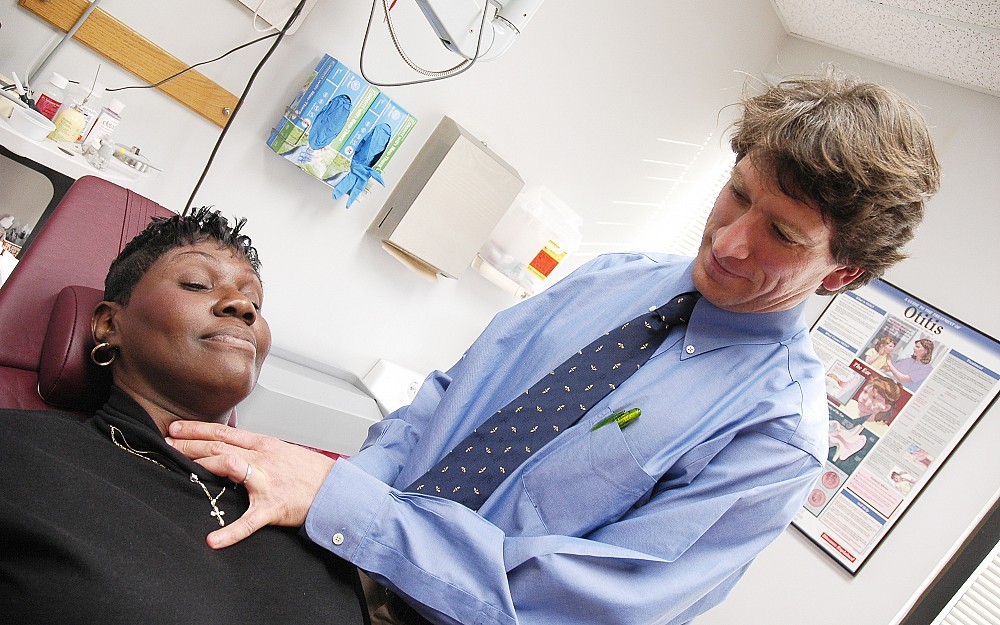
UC Health Otolaryngologist
David Steward, MD, says the majority of nodules are benign. He estimates malignancies occur in 5 to 10 percent of patients with nodules, though certain factors, like a family history of thyroid cancer or past radiation exposure, could increase the risk.
Thyroid nodules are most often detected by self-palpitation, a primary care physician or by an unrelated imagining scan. If one is detected, an ultrasound is used to further examine the thyroid to determine the nodules size and appearance as well as any suspicious features or, possibly, other associated nodules. A fine needle biopsy, performed under ultrasound guidance, may also be used to further evaluate nodules for the presence of malignancy.
Though he estimates fine needle biopsy accurately determines malignancy in 95 percent of cases, Steward says it has some limitations. Results most often come back as benign, requiring continued observation, or malignant, requiring surgery. Sometimes, however, results are indeterminate or non-diagnostic, requiring surgery to make a definitive diagnosis.
To improve the needle biopsy accuracy and avoid potentially unnecessary surgeries, Steward is participating in a multi-institutional, industry-sponsored study that sends biopsies to a lab for molecular analysis, looking for mutations associated with malignancy.
His past research has shown that cytomolecular testing for RNA and DNA mutations increases the diagnostic accuracy of fine needle biopsies, but its currently not clinically available.
The analysis helps to narrow down and fine-tune our diagnosis, he says. Sometimes the biopsies come back either benign or suspicious, but the cytomolecular analysis shows clearly that theres a mutation associated with cancer. Its hoped that in the next five to 10 years this analysis will become standard practice.
Steward is also involved with writing the current standards for thyroid nodule care. He co-authored the American Thyroid Associations Revised Thyroid Nodule and Cancer Management Guidelines, published last year. He says the new guidelines update the recommendations on which nodules to biopsy.
We used to recommend that size was the only factor, he says. Now we recognize that as our experience with ultrasound and ultrasound technology improves, the appearance of the nodules on the ultrasound can be as or more important than the size in terms of predicting whether its benign or malignant.
For patients with concerns about nodules, Steward recommends seeing a primary care physician to start with a thyroid-stimulating hormone (TSH) blood test to evaluate the function and an ultrasound to evaluate the appearance of the gland and any associated nodules. Patients may also see an endocrinologist or surgeon specializing in thyroid disorders for further evaluation.
The needle biopsy accuracy clinical trial is sponsored by VeraCyte, Inc. Steward reports no financial interest in the company.
Tags
Related Stories
Cancer Center plays key role in lab research, clinical trials for new pancreatic cancer drug
September 1, 2026

WLWT and WCPO highlighted the contributions of University of Cincinnati Cancer Center researchers that helped lead to the recent FDA approval of daraxonrasib, a new treatment for pancreatic cancer.
Cancer Center physician receives $150,000 New Investigator Research Grant to study treatment-resistant leukemia
September 1, 2026
The University of Cincinnati Cancer Center’s Sarah Skuli, MD, PhD, received a two‑year, $150,000 Leukemia Research Foundation New Investigator Grant to study TP53‑mutated leukemia, a treatment‑resistant subtype with very poor outcomes.
Heavy social media use linked to depression
August 31, 2026

U.S. News and World Report, Yahoo! News, MSN, USA Today and other national media highlight a new study by the University of Cincinnati and Northwestern University that found a correlation between heavy social media use and depression in adults.