UC, VA Researchers Awarded Grants to Study Cellular Mechanisms Behind Chronic Illnesses

CINCINNATISix researchers from the University of Cincinnati and Cincinnati Department of Veterans Affairs (VA) Medical Center have been awarded over $4 million in federal research grants to investigate chronic diseases that commonly affect veterans.
These U.S. Department of Veterans Affairs awards, called Merit Review Grants, require that researchers undergo a rigorous peer-review process, similar to that used at the National Institutes of Health (NIH).
Peter Walzer, MD, director of research at the Cincinnati VA and professor of medicine at UC, says these awardswhich will be distributed over three to five yearsare a huge accomplishment for those who earned them as well as the disciplines they represent.
Five of these grants went to PhDs, or basic scientists, as opposed to MDs, which is rare in itself, he says. The national VA research program was developed to attract high-quality physicians; thus, most of the investigatorsabout 70 percentare MDs. Basic researchers must first undergo a competitive process even before they are deemed eligible to submit grants.
In the latest round, 11 grants were submitted and six were funded. Usually, only one in five researchers will receive fundinga 20 percent success rate. It speaks highly of our researchers and the work they are doing in Cincinnati.
Researchers awarded grants include:
· Rupak Banerjee, PhD, College of Engineering
· Melanie Cushion, PhD, Division of Infectious Diseases
· George Deepe, MD, Division of Infectious Diseases
· Dan Hassett, PhD, Department of Molecular Genetics, Biochemistry and Microbiology
· Kenneth Wagner, PhD, Department of Neurology
· Susan Waltz, PhD, Department of Cancer and Cell Biology
Their studies, which range in subject matter from cardiac, pulmonary and infectious diseases to breast cancer and stroke, are looking at the step-by-step cellular development of diseases to find out why they occur and what can be done to prevent them.
All of these researchers have an interest in looking at the pathogenesis of these conditions and using this knowledge to help develop new targets and approaches to treatment and prevention, Walzer says, noting that many of these chronic conditions affect veterans but that this research also applies to the general population.
He adds that this funding creates exciting opportunities for collaboration by university and VA-based faculty that may result in more medical advancement than could be achieved by investigators working alone.
This diverse group of researchers and their specialties truly speak to the expertise present at the VA and at UC, he says. These awards provide a win-win situation for both institutions and create a standard of research excellence for not only Cincinnati but also for the Tristate.

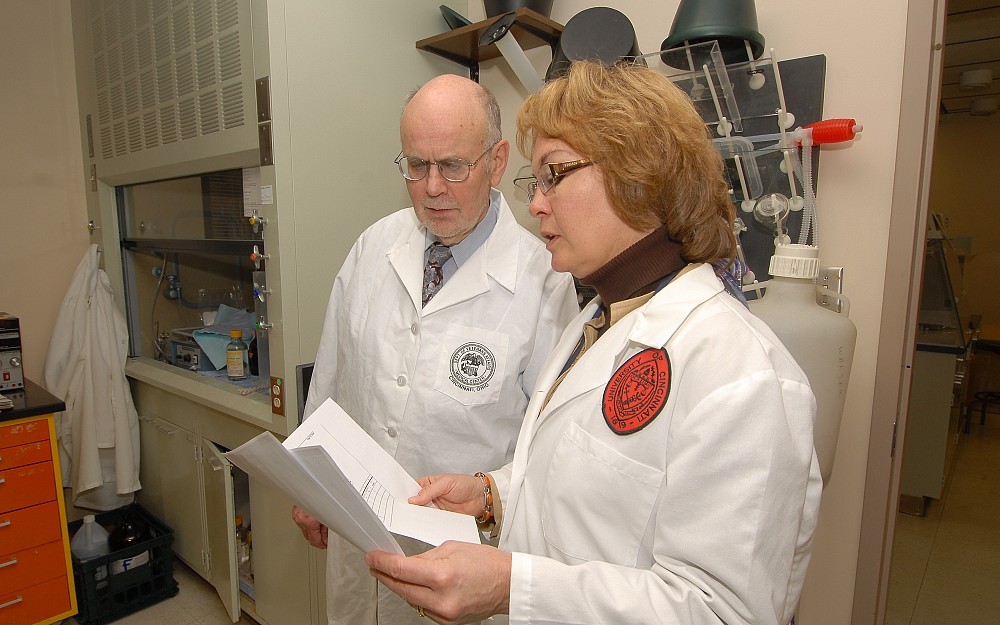
Melanie Cushion, PhD, and Peter Walzer, MD
Related Stories
Cancer Center plays key role in lab research, clinical trials for new pancreatic cancer drug
September 1, 2026

WLWT and WCPO highlighted the contributions of University of Cincinnati Cancer Center researchers that helped lead to the recent FDA approval of daraxonrasib, a new treatment for pancreatic cancer.
Cancer Center physician receives $150,000 New Investigator Research Grant to study treatment-resistant leukemia
September 1, 2026
The University of Cincinnati Cancer Center’s Sarah Skuli, MD, PhD, received a two‑year, $150,000 Leukemia Research Foundation New Investigator Grant to study TP53‑mutated leukemia, a treatment‑resistant subtype with very poor outcomes.
Engineering professor named KEEN Fellow
August 31, 2026
Dhuree Seth, assistant professor educator in the Department of Aerospace Engineering, is one of 30 engineering faculty members nationwide who were named 2026 KEEN Engineering Unleashed Fellows. The University of Cincinnati College of Engineering and Applied Science has been a partner of the Kern Entrepreneurial Engineering Network (KEEN) since 2024. Seth has been part of KEEN since she was a PhD student more than 10 years ago.