UC Health University Hospital Achieves Quality Accreditation for All Imaging Services

CINCINNATIUC Health University Hospital-based imaging services have received accreditation from the American College of Radiology (ACR) for all types of diagnostic imagingan honor UC Health holds exclusively in the Cincinnati area.
"ACR accreditation is a guarantee to patients that they will receive the benefits of unprecedented quality in imaging equipment, highly trained personnel and a stern quality control program, says Arthur Ray Morton, the senior medical physicist at University Hospital who led the accreditation review.
The accreditation applies to imaging services at University Hospital as well as two outpatient imaging centers located on the University of Cincinnati campusthe UC Health University Hospital Imaging Center and UC Health Varsity Village Imaging Center. Services include mammography, breast ultrasound, stereotactic breast biopsy, computed tomography (CT), magnetic resonance imaging, breast magnetic resonance imaging (MRI), nuclear medicine gamma cameras, positron emission tomography (PET) and ultrasound.
The Food and Drug Administration requires that all facilities providing mammography be accredited by the ACR to receive certification under the Mammography Quality Standards Act. Outpatient imaging centers offering advanced imaging modalitiesincluding nuclear medicine, MRI, PET, and CTmust achieve ACR accreditation by January 2012 in order to comply with the Medical Improvements for Patients and Providers Act. Accreditation for all other imaging modalities offered in a hospital setting is voluntary.
University Hospital was the first ACR-accredited breast imaging Center of Excellence in Cincinnati. It remains the only facility in Cincinnati accredited for breast MRI.
"This is not only about giving the best care. Its setting standards for the physicians, the technologists and the physicists that support the program to ensure those care expectations are met, if not exceeded, says Morton. "They have minimum accreditation, training, and continuing education requirements. This sets the standards for care.
ACR accreditation is a continual process and imaging facilities must reapply for the accreditation every three years. ACR-accredited facilities must maintain defined standards for the full three-year accreditation, and then go through the entire process again after the accredited term.
"The ACR sets a high threshold for qualityeverything from daily calibration to radiation dose exposure in each modality must adhere to the ACRs standards, adds Michael Regg, clinical operations manager for the University of Cincinnati Physicians radiology practice.
"When patients see the ACR accreditation seal, they know that that the site has met very high standards for equipment, personnel, and quality of images, adds Jannette Collins, MD, Ben Felson Professor and Chair of Radiology at the UC College of Medicine.
For more information on UC Health imaging centers, visit ucphysicians.com.
* This story was written by Perry Simpson, an intern in the AHC Public Relations and Communications Office.

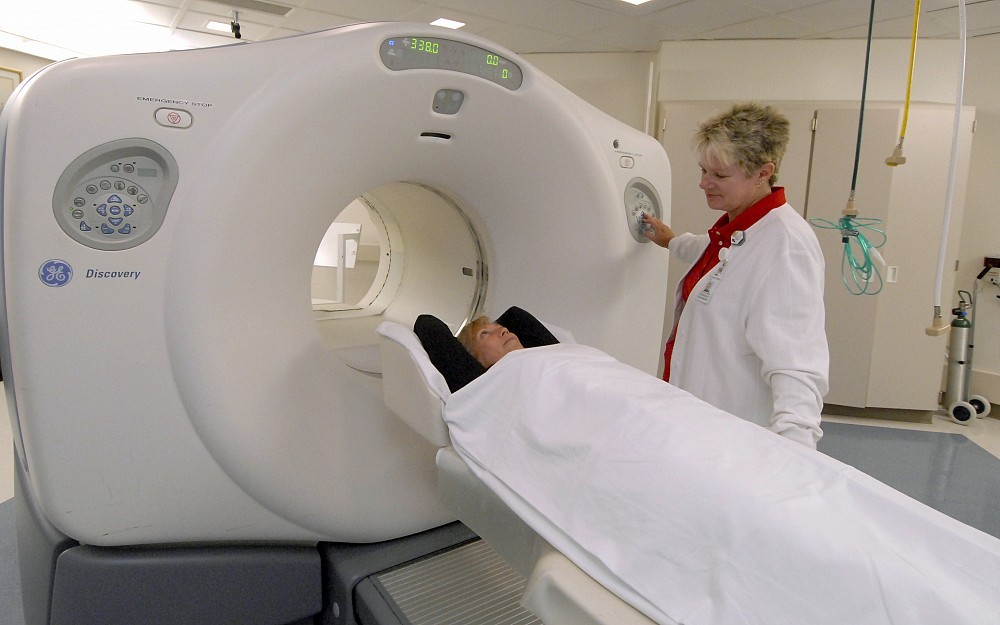
A patient undergoes an imaging test at UC Health University Hospital.

Jannette Collins, MD, will serve as chair of the UC College of Medicine s radiology department beginning Feb. 1, 2009.
Related Stories
Cancer Center plays key role in lab research, clinical trials for new pancreatic cancer drug
September 1, 2026

WLWT and WCPO highlighted the contributions of University of Cincinnati Cancer Center researchers that helped lead to the recent FDA approval of daraxonrasib, a new treatment for pancreatic cancer.
Cancer Center physician receives $150,000 New Investigator Research Grant to study treatment-resistant leukemia
September 1, 2026
The University of Cincinnati Cancer Center’s Sarah Skuli, MD, PhD, received a two‑year, $150,000 Leukemia Research Foundation New Investigator Grant to study TP53‑mutated leukemia, a treatment‑resistant subtype with very poor outcomes.
Heavy social media use linked to depression
August 31, 2026

U.S. News and World Report, Yahoo! News, MSN, USA Today and other national media highlight a new study by the University of Cincinnati and Northwestern University that found a correlation between heavy social media use and depression in adults.