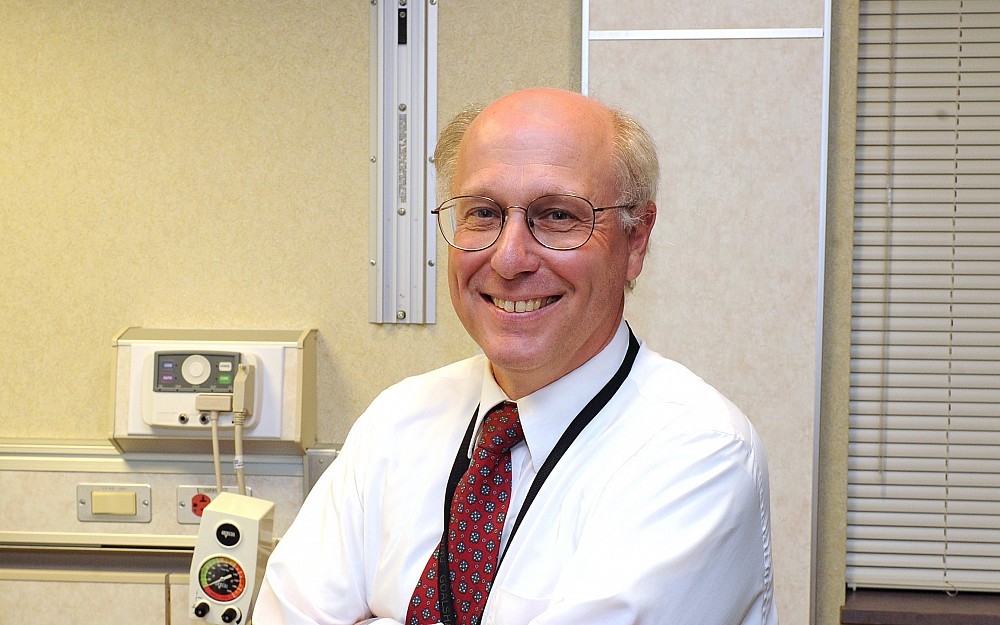
Panos Discusses Role as Associate Chief of Staff for Research at Cincinnati VA

Ralph Panos, MD, professor and associate clinical director in the division of pulmonary, critical care and sleep medicine, was recently named the new associate chief of staff for research at the Cincinnati Department of Veterans Affairs (VA) Medical Center. In addition, Panos is chief of the division of pulmonary, critical care and sleep medicine at the VA and has been the driving force behind the recent Telemedicine ICU implementation at the VA. Below, he discusses his new role.
What made you decide to take on the role of associate chief of staff (ACOS) for research at the VA?
"About a year ago, I put together a proposal to establish a Network of Dedicated Enrollment Sites center based at the Cincinnati VA. In the preparation for that proposal, I talked with many VA investigators and was very impressed and excited by their enthusiasm and collegiality. Although the proposal was not fundedit was the eighth site and only seven were fundedI enjoyed the opportunity to meet and interact with the VA researchers, and when the ACOS for research position was announced, I applied.
"I approached this position with apprehension because Peter Walzer had been the ACOS for research at the Cincinnati VA for over 20 years, and I knew it would be nearly impossible to follow his legacy.
What will your duties in this role entail?
"The ACOS for research plays a key role in the administration and organization of all research efforts at the Cincinnati VA. Under Peter Walzer, the Clinical Research Unit had been established in collaboration with UC as one of only a handful of clinical research centers based in VA hospitals nationally. In addition, the level of funding for research had done very well.
"The ACOS for research works with a dedicated staff to administer grants and assist investigators with the regulatory requirements to pursue clinical and basic science research endeavors. In the current funding environment with more proposals and lower total research dollars, the competition is fierce. Assisting researchers with the needed support during this period, getting new investigators established, maintaining current investigators research projects and becoming more involved with the VA, National Institutes of Health and other multicenter trials are all future goals. In addition, the VA will be funding a new research building with animal care facilities, wet bench space, clinical areas and administrative offices that will help propel the Cincinnati VA to the next echelon of research.
How do you feel to be in this new role?
"The application process was competitive with excellent applicants, and I was surprised and honored to be selected. I look forward to the challenges and rewards of this position.
What are your goals are enhancing research interactions between UC and VA? Why is this important?
"Collaboration and synergy between UC and the VA will enhance and augment the ability of researchers to obtain and sustain research funding. Nearly all VA researchers are members of the UC faculty, so the VA provides another source of resources for these investigators. The research environments at the two institutions are slightly different but complementary so enhanced communication and interaction will hopefully amplify each others research endeavors.
Tags
Related Stories
Cancer Center plays key role in lab research, clinical trials for new pancreatic cancer drug
September 1, 2026

WLWT and WCPO highlighted the contributions of University of Cincinnati Cancer Center researchers that helped lead to the recent FDA approval of daraxonrasib, a new treatment for pancreatic cancer.
Cancer Center physician receives $150,000 New Investigator Research Grant to study treatment-resistant leukemia
September 1, 2026
The University of Cincinnati Cancer Center’s Sarah Skuli, MD, PhD, received a two‑year, $150,000 Leukemia Research Foundation New Investigator Grant to study TP53‑mutated leukemia, a treatment‑resistant subtype with very poor outcomes.
Heavy social media use linked to depression
August 31, 2026

U.S. News and World Report, Yahoo! News, MSN, USA Today and other national media highlight a new study by the University of Cincinnati and Northwestern University that found a correlation between heavy social media use and depression in adults.