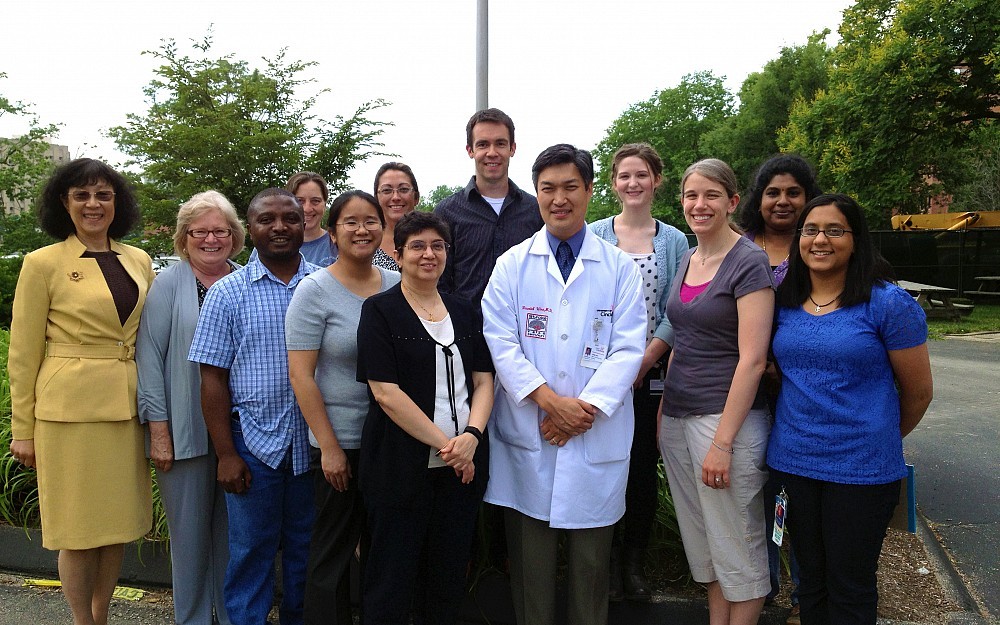
Center for Environmental Genetics Announces Career Development Awards

The Center for Environmental Genetics (CEG), housed in the UC Department of Environmental Health, has announced its annual Career Development Awards.
The Career Development Programs objective is to increase understanding and the quality of environmental health science research at UC and affiliates. To achieve this goal, the Career Development Program actively seeks promising physician scientists, basic scientists and translational researchers who can use guidance in crossing the interface between their clinical discipline and basic research in environmental health sciences to build bidirectional, transdisciplinary research careers.
The Career Development Program, headed by Grace LeMasters, PhD, Department of Environmental Health, and Daniel Woo, MD, Department of Neurology and Rehabilitation Medicine, has chosen the 2013 CEG New Investigator Scholars (NIS) and Next Generation Biomedical Investigator (NGBI). Each fellow will receive funds to conduct pilot research, thesis, postdoctoral or related research, or for professional development activities related to their research and research mentoring toward their transition toward better understanding of the interface between environment exposures and molecular, genetic and epigenetic health impact.
This years 2013 CEG New Investigator Scholars are:
Robyn Amos-Kroohs, a graduate student in the Molecular and Developmental Biology Graduate Program at Cincinnati Childrens Hospital Medical Center, who will complete her dissertation research on the interaction of manganese, iron deficiency and stress during brain development, under the mentorship of Michael Williams, PhD, Department of Pediatrics.
Vinicius Carreira, DVM, a postdoctoral National Institute of Environmental Health Sciences (NIEHS) fellow in the Department of Environmental Healths Gene-Environment Interactions Training Program. He will attend the Jackson Laboratory workshop on the pathology of mouse models for human disease. He is mentored by Alvaro Puga, PhD, of the Department of Environmental Health, and is applying his veterinary pathology expertise to a number of toxicology studies.
Laurie Davenport, PhD, postdoctoral NIEHS fellow in Gene-Environment Interactions Training Program, who will bridge departments between Environmental Health and the Division of Neurology at Cincinnati Childrens with her work on behavioral and inflammatory effects of intranasally administered silver nanoparticles. She is co-mentored by Mary Beth Genter, PhD, Department of Environmental Health, and Charles Vorhees, Department of Pediatrics.
Esmond Geh, PhD, postdoctoral NIEHS fellow in Gene-Environment Interactions Training Program, Division of Allergy and Immunology, who will investigate the functional interaction between cyanobacterial toxins and their co-expressed immunogenic peptides. He is co-mentored by Jonathan Bernstein, Department of Internal Medicine, Division of Immunology, Allergy and Rheumatology, and Tesfaye Mersha, PhD, Department of Pediatrics.
Heidi Hsieh, a graduate student in Environmental Genetics and Molecular Toxicology, Department of Environmental Health, who will conduct studies of the mechanism of zinc toxicity in olfactory neurons, as part of her PhD dissertation. She is mentored by Genter.
Vinothini Janakiram, PhD, a postdoctoral fellow in the Department of Environmental Health. She will use the CEG cores to study how in utero exposure of low-dose bisphenol A and high fat reprograms rat prepubertal mammary gland. Her work in transcriptome profiling will be mentored by Shuk-mei Ho, PhD, Jacob G. Schmidlapp Professor and Chair, Department of Environmental Health.
Abby Johnson, a graduate student in Environmental Genetics and Molecular Toxicology, Department of Environmental Health. She will use the CEG cores to study vitamin D signaling in the mammary gland microenvironment: elucidating an unknown paracrine inhibitory growth factor. She is mentored by Susan Waltz, PhD, Department of Cancer Biology, and Genter.
Eric Kettleson, PhD, postdoctoral NIEHS fellow in Molecular Epidemiology and Childrens Environmental Health, Department of Environmental Health, who will present data from his 2012 CEG NIS award at a major environmental health conference hosted by the International Society for Environmental Epidemiology. He will also attend a workshop on indoor microbesexposure assessment and health effects, taught by international experts. Tiina Reponen, PhD, Department of Environmental Health, is his mentor.
Shilpa Shah, DO, a fellow in the Cincinnati Childrens Division of Critical Care Medicine who is also completing a masters degree in the Clinical and Translational Research Program. Her CEG award will help support sample analysis for the investigation of procalcitonin trends during the treatment of suspected infection under the mentorship of Derek Wheeler, MD, Department of Pediatrics.
Samrat Yeramaneni, a graduate student in the Cincinnati Childrens Division of Epidemiology and Biostatistics who is conducting his dissertation on secondhand smoke exposure and neuromotor effects in Appalachian children, under the direction of Erin Haynes, DrPH, Department of Environmental Health.
The 2013 Next Generation Biomedical Investigator is Pheruza Tarapore, PhD. She was appointed to research assistant professor in the Department of Environmental Health in 2011. The CEG will support her use of core facilities to study the effects of high-fat diets and bisphenol A on testis spermatogenesis in collaboration with Ho, her mentor. Her second mentor for this project, as well as her mentor for a Department of Defense New Investigator Award, is Divaker Choubey, PhD, Department of Environmental Health. This is Tarapores second year as a CEG NGBI. She has published five manuscripts since receiving her first CEG award.
Since its inception in 2007, the CEG Career Development Program has supported 29 NIS fellows and 12 NGBIs. Most of the awardees have continued on career tracks that include the role of environment and genetic variability on health.
Tianying Wu, MD, PhD, was a CEG NGBI, with awards in both 2007 and 2008. With support from the Career Development Program, she successfully submitted an NCI K07 career development grant to study global and specific oxidation pathways related to prostate cancer, and is co-investigator on three NIH grants. Tolly Epstein, MD, was a CEG NIS in 2008 and 2009. She was appointed to assistant professor, Immunology, in 2010, and received a CEG Pilot Project grant in 2011. CEG support provided preliminary data for a successful KL2 Research Scholars grant from the Center for Clinical and Translational Science and Training.
Nurturing career development also benefits the CEG. For example, 2008-09 NIS awardee Nicholas Newman, DO, completed his masters degree in clinical and translational research and is now the physician project leader of the CEG Community Outreach and Education Core, where he translates CEG scientific findings into information needed by pediatricians and other clinicians.
The CEG is supported by P30-ES06096 from the NIEHS, and is directed by Ho. More information is available at http://www.eh.uc.edu/ceg/.
Tags
Related Stories
On-site training in Speech & Hearing Clinic sets UC’s programs apart
August 27, 2026
At the University of Cincinnati’s Speech & Hearing Clinic, Doctor of Audiology and Speech-Language Pathology graduate students gain real-world experience while providing free speech and hearing services to the community.
Funding expands UC research into weight gain side effects of bipolar medication
August 26, 2026
University of Cincinnati researchers have been approved for funding by the Patient-Centered Outcomes Research Institute (PCORI) to expand the implementation of healthy lifestyle interventions and metformin prescription to help manage weight gain in overweight or obese youth taking second-generation antipsychotic medications.
One in four NFL players had CTE at death
August 25, 2026

Forbes cites research on concussions and football helmets by the University of Cincinnati in a report that found one in four NFL players had brain damage at death.