Stress-Induced Depression Exacerbates Parkinson's, Research Indicates

CINCINNATIChronic stress-induced depression exacerbated an experimental model of Parkinsons disease, researchers at the University of Cincinnati (UC) have shown.
The research underlines the link between Parkinsons and depression, the researchers say, and shows that chronic stress can be a complicating factor in progression or severity of the disease.
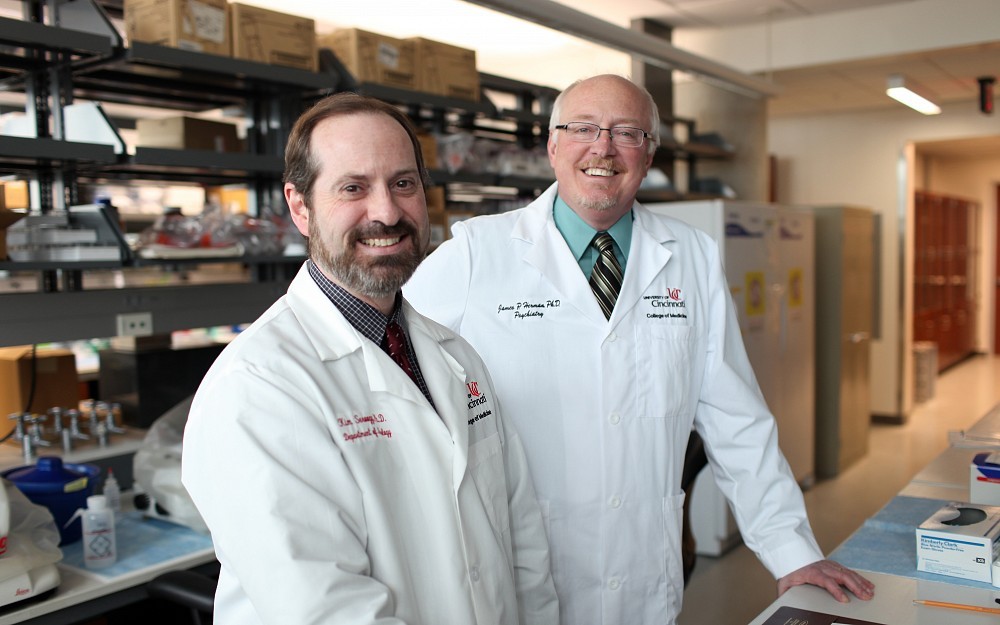
The findings were published online ahead of print in Molecular Psychiatry, a leading scientific journal that is part of Nature Publishing Group. The lead researchers were Kim Seroogy, PhD, professor and vice chair of basic research in UCs neurology and rehabilitation medicine department and director of UCs Neuroscience Graduate Program, and James Herman, PhD, professor of psychiatry and behavioral neuroscience and director of UCs Network for Neuroscience Discovery. Ann Hemmerle, PhD, a postdoctoral researcher in Seroogys lab, was first author of the article.
Parkinsons disease is a degenerative neurological disorder involving the death of dopamine-producing cells, or neurons, deep within the brain. Depression is highly prevalent in Parkinsons disease, previous research has found, and stress was long ago hypothesized to contribute to the neuropathology of Parkinsonspossibly by increasing the vulnerability of dopamine cells to degeneration.
Seroogy and Herman, however, observed that research was lacking on co-morbidity of Parkinsons and depressionin other words, does stress-induced depression contributes to the development of Parkinsons, and would it also make Parkinsons worse once it already has developed?
"Studies have shown that up to 50 percent of Parkinsons patients experience debilitating depression, so its a huge quality of life issue, Seroogy says. "In fact, many people with Parkinsons complain more of depression symptoms than they do of the actual disease symptoms.
"Our research indicates that adverse life stress on top of Parkinsons disease could be negatively modifying the disease itself.
Parkinsons disease is a chronic and progressive movement disorder, meaning that symptoms continue and worsen over time. It develops when certain cells in a region of the brain begin to die. These cells produce a chemical called dopamine that is responsible for transmitting signals within the brain that contribute to the coordination of movement.
The cause of Parkinsons disease is unknown, and there is no known cure. Treatment options such as medication and surgery are used to manage its symptoms, which include shaking, rigidity, slowness of movement and difficulty walking.
Nearly 1 million people in the U.S. are living with Parkinson's disease, according to the Parkinsons Disease Foundation.
"In addition to its critical role in movement, dopamine is very important in modifying how you feel about the world, Herman says. "Dopamine is considered to be hedonicit gives pleasure and reward. So the loss of dopamine in Parkinsons may very well be affecting the regions of the brain that control the ability to appreciate pleasure and reward, and by doing that could be hitting both the depression circuits and the motor circuits.
In conducting their research, Seroogy and Herman examined rodents that were stressed in a variety of ways, such as being placed briefly in a cold room or a crowded setting. With chronic variable stress, the rodents never knew what form the stress would take or when it was coming, recreating the notion of helplessness in individuals with Parkinsons disease. A lesion to one side of the brain provided a model of Parkinsons disease in some of the rodents.
"When we combine chronic variable stress with experimental Parkinsons, more cells die, they die faster, and the rodents behavior worsens, Seroogy says. (The behavior is measured by observing and recording the rats natural exploratory behavior.)
The next step, Seroogy and Herman say, is to further investigate the mechanisms of how stress interacts with Parkinsons disease, particularly looking at glucocorticoid hormones that balance the stress response. Moreover, these findings underscore the importance clinically of screening and treating Parkinsons patients for depression.
The research resulted from a collaboration of two UC labs: the Selma Schottenstein Harris Laboratory for Research in Parkinsons, directed by Seroogy, and the Stress Neurobiology Laboratory, directed by Herman and based at UCs Reading Campus. The Selma Schottenstein Harris lab is affiliated with the Gardner Family Center for Parkinsons Disease and Movement Disorders at the UC Neuroscience Institute, one of four institutes of the UC College of Medicine and UC Health.
The study was funded by grants from the National Institutes of Health, the Gardner Family Center, the Sunflower Revolution, the Davis Phinney Foundation, the Morris Braun Foundation and the Parkinsons Disease Support Network of Ohio, Kentucky and Indiana. The authors report no conflicts of interest.
Related Stories
Cancer Center plays key role in lab research, clinical trials for new pancreatic cancer drug
September 1, 2026

WLWT and WCPO highlighted the contributions of University of Cincinnati Cancer Center researchers that helped lead to the recent FDA approval of daraxonrasib, a new treatment for pancreatic cancer.
Cancer Center physician receives $150,000 New Investigator Research Grant to study treatment-resistant leukemia
September 1, 2026
The University of Cincinnati Cancer Center’s Sarah Skuli, MD, PhD, received a two‑year, $150,000 Leukemia Research Foundation New Investigator Grant to study TP53‑mutated leukemia, a treatment‑resistant subtype with very poor outcomes.
Heavy social media use linked to depression
August 31, 2026

U.S. News and World Report, Yahoo! News, MSN, USA Today and other national media highlight a new study by the University of Cincinnati and Northwestern University that found a correlation between heavy social media use and depression in adults.