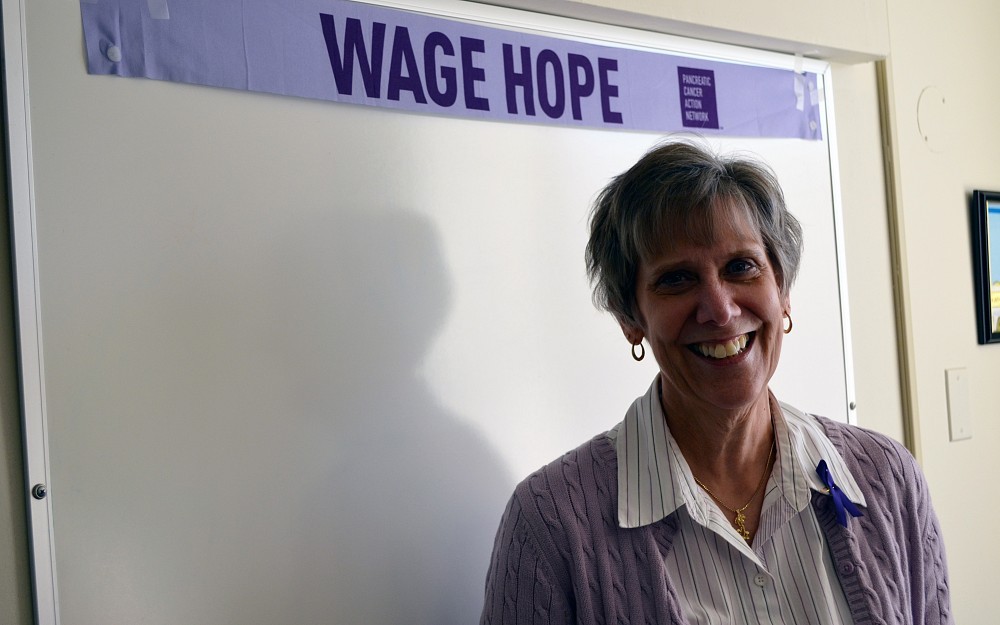
Lung, Pancreatic Cancer Survivor Stresses Need for Awareness This November

November, the month in which we celebrate what were thankful for, now means that and more for Geri Rowan, 60.
Its the month where she can help educate others on lung and pancreatic cancers, both of which shes experienced firsthand.
"I am a nine-year lung cancer survivor and a one-year pancreatic cancer survivor, she says. "Im so lucky.
It was a routine follow-up scan ordered because of her previous lung cancer diagnosis that led to the discovery of dilated biliary ducts.
"They ordered endoscopies and MRIs and did several biopsies, which kept coming back inconclusive, she says. "My physicians kept telling me that they thought it was pancreatic cancer, but I didnt believe them. To me, at that time, pancreatic cancer was a death sentence. I couldnt believe that I had it.
Rowans surgeon, Syed Ahmad, MD, director of the University of Cincinnati Pancreatic Disease Center, which is part of the UC Cancer Institute, a professor and division chief of surgical oncology in the Department of Surgery at UC and a UC Health surgeon, decided that a pancreaticoduodenectomy, or a Whipple procedure (named for the surgeon who first performed it), was needed.
The procedure involves removal of the "head" of the pancreas next to the first part of the small intestine (duodenum). It also involves removal of the duodenum, a portion of the common bile duct, gallbladder and sometimes part of the stomach. Afterward, surgeons reconnect the remaining intestine, bile duct and pancreas.
"That is when the cancer was foundat the head of the pancreasand then, I believed them, she says.
Chemotherapy and radiation were ordered following the surgery. Olugbenga Olowokure, MD, assistant professor in the Division of Hematology Oncology and an oncologist within the UC Cancer Institute, is part of Rowans care team.
"I finished up with treatment in April and had my last scans in August, she says. "All is looking good, and Im truly starting to feel like myself again and carry on with my life.
Rowan says she wants others to know that pancreatic cancer is no longer a death sentence.
"I completed the PurpleStride walk at the end of September, and I think it just really hit home that people are beating this disease, she says. "It really inspired me to get involved and to raise awareness about a disease that causes so much fear. You can survive this now.
"Everyone says that after surviving Stage IV lung cancer and Stage I pancreatic cancer, God must have a plan for me. I truly believe that you have to be positive and say, Im going to fight this. I have a great support system, a great group of co-workers, a great health care team and along with them and prayers, Im doing well.
Tags
Related Stories
Cancer Center plays key role in lab research, clinical trials for new pancreatic cancer drug
September 1, 2026

WLWT and WCPO highlighted the contributions of University of Cincinnati Cancer Center researchers that helped lead to the recent FDA approval of daraxonrasib, a new treatment for pancreatic cancer.
Cancer Center physician receives $150,000 New Investigator Research Grant to study treatment-resistant leukemia
September 1, 2026
The University of Cincinnati Cancer Center’s Sarah Skuli, MD, PhD, received a two‑year, $150,000 Leukemia Research Foundation New Investigator Grant to study TP53‑mutated leukemia, a treatment‑resistant subtype with very poor outcomes.
Heavy social media use linked to depression
August 31, 2026

U.S. News and World Report, Yahoo! News, MSN, USA Today and other national media highlight a new study by the University of Cincinnati and Northwestern University that found a correlation between heavy social media use and depression in adults.