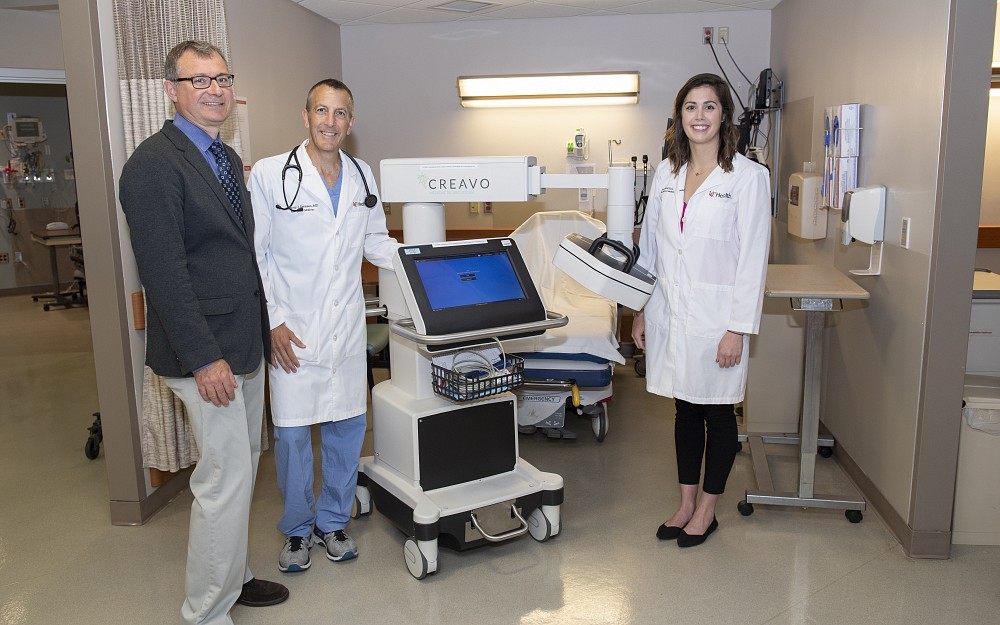
UC-Led Research to Examine Accuracy of Magnetocardiograph

Acute Coronary Syndrome (ACS) occurs when the blood supplied to the heart muscle is suddenly blocked, including heart attacks and angina. A magnetocardiograph (MCG) is a device used to measure and record the hearts magnetic field, and in a new study, could help doctors better diagnose ACS.
The University of Cincinnati (UC) will lead the multi-center observational study seeking to validate the diagnostic accuracy of VitalScan, a mobile MCG, in the treatment of acute coronary syndrome (ACS). The study will focus on rule-out capability for patients who present to the emergency department with chest pain symptoms consistent with ACS. Creavo, the maker of VitalScan, is the sponsor of the study.
"UC had a pre-existing relationship with the sponsor through our former department chairman (Brian Gibler, MD). Creavo then engaged ACS thought leaders in the United States, says Greg Fermann, MD, professor in the Department of Emergency Medicine, and chief investigator of the study. "Weve done biomarker work in ACS and novel device work, and so they reached out to us and asked if we could study it in our patient population.
In the United States each year, between eight and 10 million patients are taken to emergency departments with signs or symptoms consistent with ACS.
"Early detection and initiation of therapy improves outcomes for ACS patients, while failure to diagnose the condition can lead to death or permanent disability for the patient, says Fermann. "Because of the high-risk nature of the condition and the intolerance of the U.S. medical system to errors, emergency clinicians have adopted a conservative approach to the workup of patients with suspected ACS.
Patients will enroll in the study from the emergency department or a cardiac observation unit and will undergo routine clinical assessment. The goal is to enroll 720 adult patients who present to the emergency department with symptoms consistent with ACS and who are willing and able to give written informed consent to be part of the study.
An independent adjudication committee will evaluate whether or not the correct decision was made regarding the rule-out and rule-in of ACS for each patient by reviewing all available emergency department and/or any inpatient medical records.
"The rule-out capability allows us to not necessarily tell patients they dont have a disease, but that they are probably not going to have a bad outcome in the next four to six weeks. In that time frame, we can get patients back to their doctors and have further studies if theyre still symptomatic, says Fermann.
A similar trial is being conducted in the United Kingdom, where more than 700 subjects have been enrolled. Fermann says its important when any novel diagnostic device such as a magnetocardiograph is studied that the research looks at a large enough subject population and then researchers have to replicate those results or study them in a different population and see if its possible to reproduce the same outcome.
"We dont know the results of the U.K. trial yet, and we should not before our study is complete, says Uwe Stolz, PhD, research associate professor in the Department of Emergency Medicine and statistician for the study. "We will be blinded to them so that our results and their results are truly independent.
Fermann says another factor in this study is reducing health care costs to patients.
"Anything that makes health care more streamlined in terms of time or money spent in the emergency department provides some strategic advantages, says Fermann. "This device has the potential to do that. As an academic health center, University of Cincinnati Medical Center is an ideal environment to study promising devices like this.
The estimated enrollment period is 12 months across five sites with patient follow-up at three months. Sites in addition to UC are: Mayo Clinic in Rochester, Minnesota, Baylor College of Medicine in Houston, Vanderbilt University in Nashville, Tennessee and Wake Forest University in Winston-Salem, North Carolina. The clinical study length is estimated to be approximately 16-18 months to allow for final data clean-up processing and analysis.
Fermann says no one on his team, including Richard Ryan, MD, professor and vice chairman of the Department of Emergency Medicine and the site principal investigator, is a shareholder of Creavo and they will not be compensated in any form regardless of the result of the study.
Related Stories
Cancer Center plays key role in lab research, clinical trials for new pancreatic cancer drug
September 1, 2026

WLWT and WCPO highlighted the contributions of University of Cincinnati Cancer Center researchers that helped lead to the recent FDA approval of daraxonrasib, a new treatment for pancreatic cancer.
Cancer Center physician receives $150,000 New Investigator Research Grant to study treatment-resistant leukemia
September 1, 2026
The University of Cincinnati Cancer Center’s Sarah Skuli, MD, PhD, received a two‑year, $150,000 Leukemia Research Foundation New Investigator Grant to study TP53‑mutated leukemia, a treatment‑resistant subtype with very poor outcomes.
Heavy social media use linked to depression
August 31, 2026

U.S. News and World Report, Yahoo! News, MSN, USA Today and other national media highlight a new study by the University of Cincinnati and Northwestern University that found a correlation between heavy social media use and depression in adults.