
Gout treatment may aid patients with congenital heart disease
UC cardiologist says pilot study shows promise, but a larger trial is needed

A drug used to treat gout, probenecid, may improve heart function in individuals with a particular heart defect, according to results from a small pilot study run by a University of Cincinnati researcher.
Jack Rubinstein, MD, associate professor in the UC College of Medicine and UC Health cardiologist, conducted a randomized double-blind trial which included eight participants who had palliative surgery to correct a condition of the heart known as congenital univentricular circulation. Each participant received probenecid or a placebo during a 12-week period.
As part of the study, Rubinstein and co-investigators at Cincinnati Children’s Hospital recruited patients to receive either probenecid or a placebo for four weeks followed by a four-week period without medication. They were then required to undergo another four weeks of alternate treatment. All patients were assessed at baseline immediately preceding the initial use of probenecid or the placebo. This included symptom reporting, heart imaging and exercise testing to determine aerobic capacity and endurance.
The study findings are available online in the scholarly journal Pediatric Cardiology.
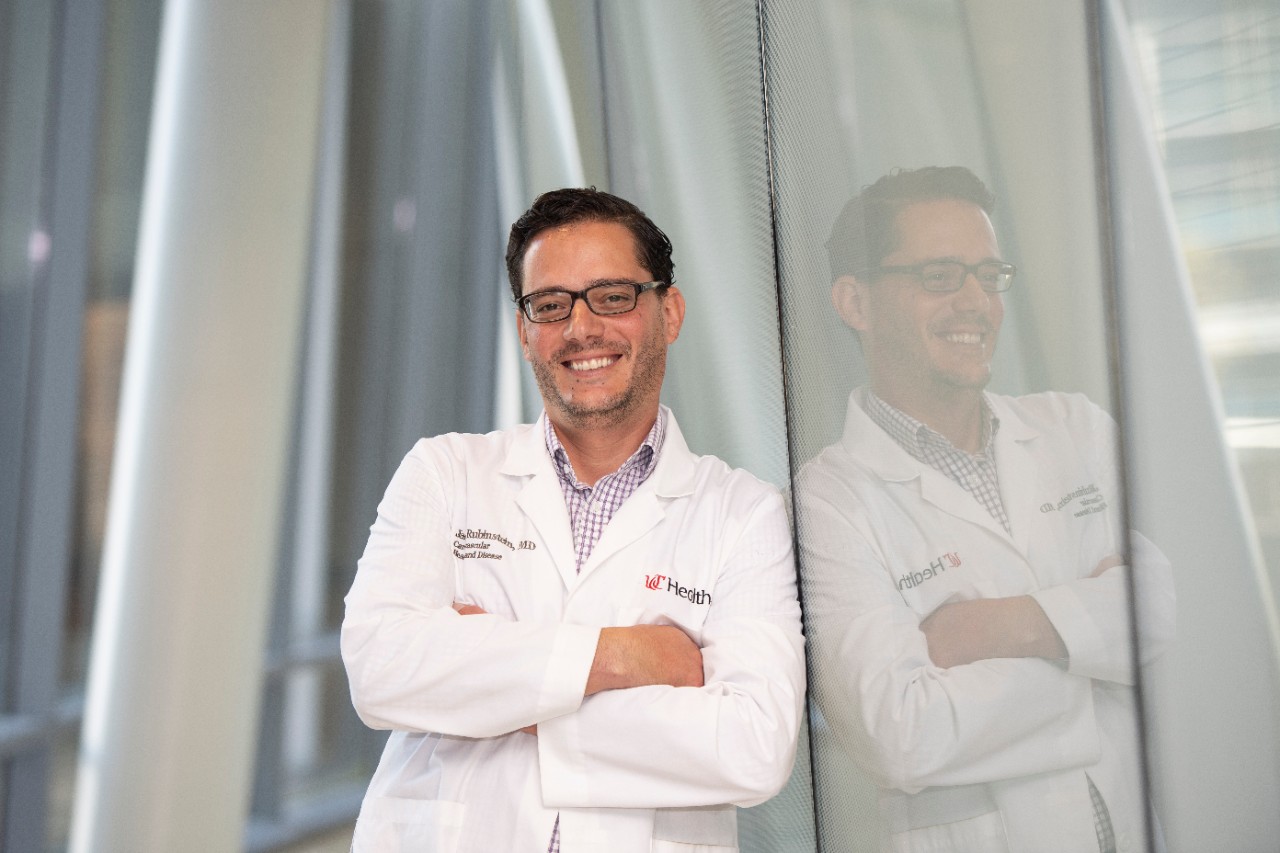
Jack Rubinstein, MD, shown in the UC College of Medicine. Photo by Colleen Kelley/UC Creative + Brand
“Heart function in participants along with their symptoms improved as a result of the pilot study,” says Rubinstein. “Heart contractility was better. It wasn’t a huge increase but enough for us to be able to detect it. They ran better and their heart pumped better. We observed a small change, partially because there were a small number of people involved.”
“We can repurpose this medicine, long used to treat gout, to improve how the heart works for kids with univentricular circulation without any adverse effects,” says Rubinstein. “The next step is a larger study to prove we can make it work safely in the long term.”
Probenecid has been shown in recent years to positively influence cardiac function via effects on the Transient Receptor Potential Vanilloid 2 (TRPV2) channel in cardiomyocytes, explains Rubinstein. Researchers observed an improvement in cardiac function and exercise performance with probenecid in patients with a functionally univentricular circulation.
This study also reported work with colleagues at the University of Colorado that showed that patients with single ventricle physiology had higher levels of TRPV2 in their hearts, while collaborators at Oslo University Hospital reported a novel mechanism through which probenecid may particularly be helpful in this patient population.
Univentricular heart (UVH) is a severe congenital cardiac malformation characterized by one functional chamber. The clinical manifestations include congestive heart failure, failure to thrive, cyanosis, hypoxemia and neurodevelopmental disabilities.
Other co-authors on this study including Jessica Woo, PhD, UC research professor of pediatrics; Anastacia Garcia, Children’s Hospital Colorado; Tarek Alsaied, MD, UC assistant professor of pediatrics and Cincinnati Children’s Hospital Medical Center physician; Ryan Moore, MD, UC assistant professor of pediatrics and Cincinnati Children’s physician; Amanda Sammons, Cincinnati Children’s researcher; Wayne Mays, Cincinnati Children’s researcher; Shelley Miyamoto, MD, Children’s Hospital Colorado; Gruschen Veldtman, MD, Cincinnati Children’s physician; and Jia Li, Per Kristian Lunde, Martin Laasmaa and William Louch, all of Oslo, Norway.
This study was funded by American Heart Association Award #17GRNT33400014 (Co-funded by The Children’s Heart Foundation, J.R, J.G.W, and G.V).
No conflicts of interests were declared by authors of the study.
Impact Lives Here
The University of Cincinnati is leading public urban universities into a new era of innovation and impact. Our faculty, staff and students are saving lives, changing outcomes and bending the future in our city's direction. Next Lives Here.
Stay up on all UC's COVID-19 stories, read more #UCtheGood content, or take a UC virtual visit and begin picturing yourself at an institution that inspires incredible stories.
Related Stories
UC's Anita Afzali, MD, receives American College of Gastroenterology International Leadership Award
October 27, 2026
The University of Cincinnati's Anita Afzali, MD, receives the American College of Gastroenterology's 2026 International Leadership Award for advancing global digestive health education, research and partnerships.
UC Foundation celebrates 2026 philanthropy winners
October 23, 2026
The University of Cincinnati Foundation recognized its Outstanding Philanthropic Volunteer Award honorees at the George Rieveschl Recognition Dinner on October 22, 2026.
AI breast cancer survival model from Cancer Center could improve accuracy and personalize care
October 23, 2026
UC Cancer Center researchers, including lead author Wedad Alatebi, developed a deep learning survival model for breast cancer that combines detailed clinical and genetic information, potentially offering physicians a more accurate tool to guide treatment decisions.