UC Alumni Association launches new series exploring health inequities

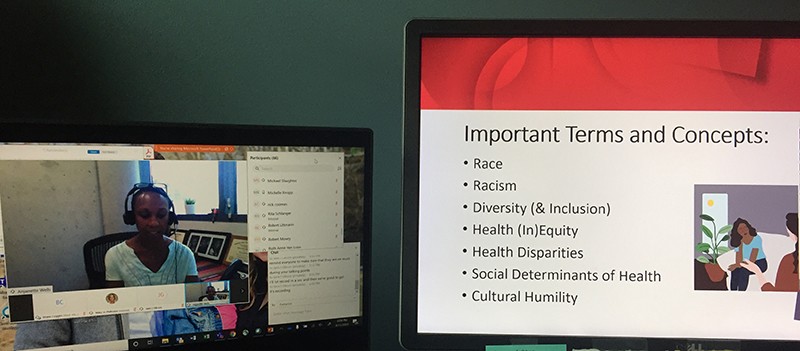
As the world reckons with the COVID-19 pandemic, many other public health crises have become increasingly apparent in cities across the nation. Throughout the upcoming school year, the University of Cincinnati Alumni Association’s Academic Health Center engagement team will present a webinar series that explores these crises with an attempt to understand the causes and consequences of health inequities. On Aug. 13, UC faculty members Barbara Tobias, MD '87, and Anjanette Wells, PhD, LISW kicked off the series with “Understanding Health Inequities in Greater Cincinnati and America.” Moderated by alumna Jami Gibson, MSN '12, CNP, the first session of five provided an overview of fundamental concepts of health inequities, shared goals for achieving equity through opportunities to be healthy, and discussed challenges for underrepresented minorities to find trusted healthcare providers.
“Over the past 30 years or so, there has been more evidence-based research showing that racial health disparities are due to racism. And even more recently, research has shown that health disparities don’t only effect poor African Americans, but they also cut across class lines,” shared Dr. Wells. “Black Americans are two times more likely to die of COVID-19, and even before the current crisis, data shows that black Americans face higher levels of heart disease, stroke, and maternal mortality.” Dr. Wells further explained that health equity means that everyone has a fair and just opportunity to be healthier, which requires moving obstacles to health such as poverty and discrimination.
One approach to increasing awareness and move towards greater opportunities for equity is through cultural humility, an ongoing process of openness and self-reflection about our own biases. “Cultural humility requires us to look within and be open to others’ perspectives and experiences, allowing ourselves to be shaped by every encounter we have,” says Dr. Wells.
Dr. Barbara Tobias discussed research findings from a study supported by Interact for Health as part of a multifaceted initiative implemented by the Academic Health Center at the University of Cincinnati that addressed factors that drive health care workforce diversity. The initiative was part of the Urban Universities HEALTH program, sponsored by the Coalition of Urban Serving Universities and the Association of American Medical Colleges from 2013-17.
Key questions in the study asked why disparities exist and how do challenges in finding a trusted provider exacerbate those disparities for underrepresented minority patients. Their research found that patient care improves when patients and physicians share a common background or language, and racial and ethnic diversity among health professionals has been shown to improve access and quality to better meet the health needs of an increasingly diverse population.
As the Greater Cincinnati community continues to experience health inequities and a lack of trust, Dr. Tobias suggests, “Our academic health center is uniquely positioned to help train the next generation of healthcare providers. In order to set an example for our region around equitable care and to begin to earn trust as a provider, we need to approach the sacred space of healing with cultural humility and intention.”
View a recording of “Understanding Health Inequities in Greater Cincinnati and America.”
Join us for the second session in the series on Thursday, Nov. 5 entitled, “Exploring Our Patients’ Contexts: A History of Anti-Black Racism in Cincinnati” and presented by Anna Goroncy, MD. Register here.

Jennifer Theiss
Senior Director, Alumni Engagement, College of Medicine
Related Stories
Co-op broadens horizons for architectural engineer
August 17, 2026
UC architectural engineering graduate Jeremy Ackley turned his co-op rotations with CMTA, a national engineering consulting firm in Texas, into a full-time role, showcasing the University of Cincinnati’s national co-op footprint.
UC scholarship honoring a family’s matriarch continues
August 17, 2026
“I get chills thinking about what she means to our family,” says Norma Wellman Cobb’s grandson, Thomas Beach, reflecting on how his grandmother’s perseverance and unwavering belief in the power of education shaped generations.
UC co-op earnings climb to $99.5 million
August 17, 2026
University of Cincinnati co-op students earned $99.5 million in 2025-26, a 5.69% increase, with 9,614 co-op enrollments and 1,798 employers across top industries.