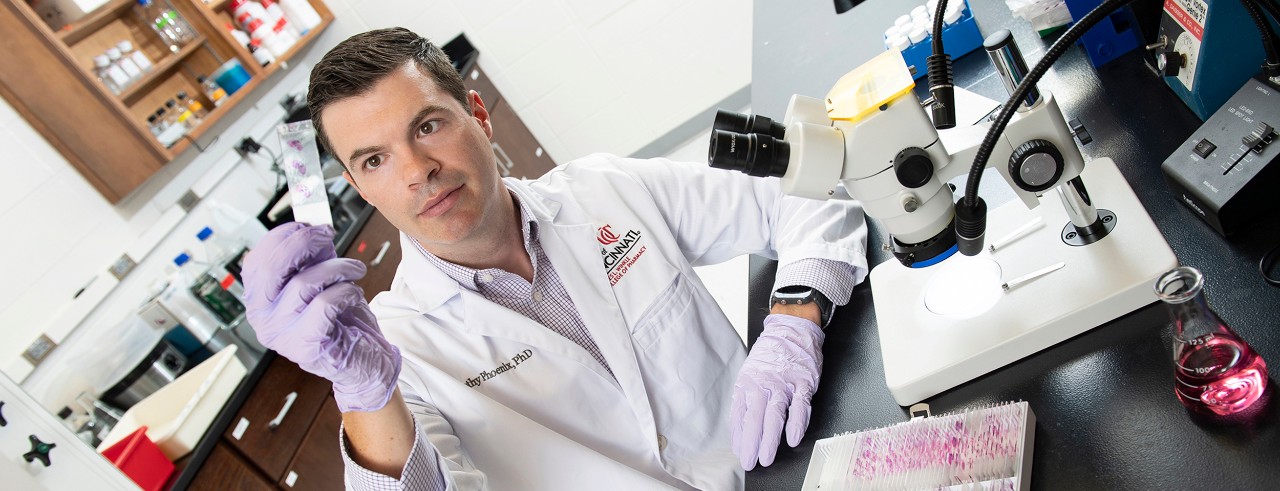
UC researchers received federal grant for pediatric brain tumor study

Researchers at the University of Cincinnati (UC) James L. Winkle College of Pharmacy and Cincinnati Children’s Hospital Medical Center have received a grant from the Department of Defense (DoD) to study pathways of drug delivery to pediatric brain tumors—specifically pediatric brain tumors known as Diffuse Intrinsic Pontine Glioma (DIPG).
According to the National Institutes of Health, DIPG typically affects children 4 to 9 years of age. Children progressively lose muscle control as the tumor grows diffusely in the pons, which is a region deep inside the brain that connects the brain to the spinal cord. Due to its delicate and difficult to reach location, surgical removal is not an option, and radiation alone remains the standard of care. Despite radiation treatment, children usually succumb to the disease within nine months, and less than 1 percent survive longer than five years.
Recent advances in defining the genetic landscape of these tumors provides new hope, but obstacles remain for therapies.
“The field has made significant progress over the past decade in understanding the genetics that drive brain tumor development and growth. This provides an exciting opportunity to attack these tumors with new targeted therapies, but unfortunately, the vast majority of these drugs do not penetrate into the brain,” says Timothy Phoenix, PhD, principal investigator on the three-year, $577,200 Career Development Grant.
At present, Phoenix says, toxic drugs often have to be given at very high doses in order to have any prospect of adequate amounts crossing the blood-brain barrier.
The study, titled “Defining and Targeting the Blood-Brain Barrier in Pediatric Glioma Subgroups,” will provide a basic understanding of tumor-blood vessel interactions, and identify potential differences between brain tumors that grow in different locations. In addition, Phoenix will examine if manipulating blood vessel Wnt signaling, a regulator of vascular permeability and drug penetration he identified prior to coming to UC, will improve drug penetration and response in a model of DIPG he has developed in the lab.
Increasing drug penetration into brain tumors is key to developing new, effective treatments and improving overall long-term survival, says Phoenix.
Phoenix was recruited to UC in 2017, with dual funding by Winkle College of Pharmacy and Cincinnati Children’s, and his work as a new faculty member is being mentored for this study by Nancy Ratner, PhD, a UC professor of pediatrics and program leader for the Cancer Biology and Neural Tumors program at the Cincinnati Children’s.
Figuring out how tumors interact with this natural blood-brain barrier will greatly inform choices of pharmacologics,” says Ratner, an expert in nervous system tumor biology and tumor genetics.
Cincinnati Children’s has ranked No.2 in the nation among Honor Roll hospitals in U.S.News & World Report's 2018-2019 Best Children’s Hospitals ranking, and No.1 in the cancer subspecialty.
Related Stories
UC, NKU renew longstanding partnership supporting Army ROTC cadets
August 26, 2026
The University of Cincinnati Army ROTC and Northern Kentucky University (NKU) have renewed a longstanding partnership that supports students preparing to become Army officers and leaders in their communities. The universities formalized the renewed agreement during a signing event Aug. 11 at NKU.
A new year, a shared purpose: President Pinto welcomes Bearcats to UC’s 208th fall
August 24, 2026
President Neville G. Pinto welcomes students, faculty and staff back to UC's 208th academic year.
Back to School 2026: UC remains a destination campus
August 24, 2026
The University of Cincinnati welcomes its largest first-year class and a record share of first-generation students for fall 2026, reinforced by affordability initiatives, co-op opportunities and new academic offerings across all campuses.