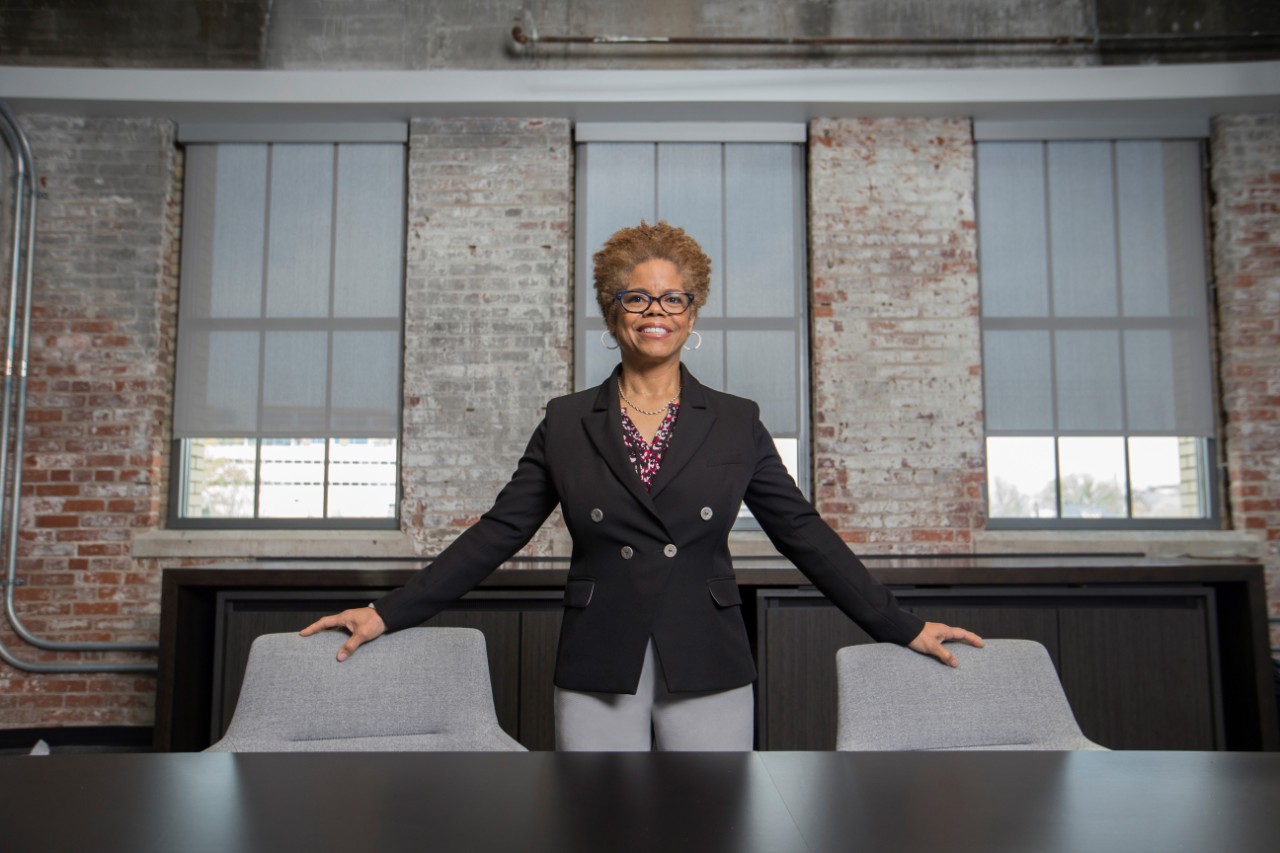
Uncommon career path leaves UC dean anxious to promote endless possibilities

By Deb Rieselman
Verna Williams had been appointed University of Cincinnati College of Law dean only 11 months earlier, so she was still partially feeling her way around on March 12 when the university announced that nearly all students, staff and faculty had to abandon campus (including residence halls) in two days’ time. Plus, faculty had to create online lesson plans ASAP, while students prepared to study from home through the rest of the semester.
Everyone’s head and hands were more than full. Even though Williams had been interim dean for two years prior, she had no list of tips for either shutting down an entire college or halting the spread of an international pandemic.
Even as details were piling up in her brain, she still had the presence of mind to call college staff on the phone after the lockdown was initiated. “It was a real friendly phone call,” notes Sherry English, director of law college relations. “She wanted to check on us, find out how we were doing and ask if we needed anything. She was basically calming people’s fears and letting us know we weren’t alone.”
Unfortunately, one of English’s newer colleagues, who didn’t know Williams well, grew more concerned when he found the dean’s message on his phone. He automatically feared the worst, which led him to call English for advice.
In her best PR manner, English tried not to laugh as she explained that the dean’s call was the furthest thing from what he was dreading. At the same time, she acknowledged that such mass phone calls were uncommon occurrences for most bosses.
Williams, however, is far from common, which explains her rather unusual career journey.
I got the sense that getting a law degree could open a lot of doors for me in a lot of different areas — not necessarily just in the courtroom.
Dean Verna L. Williams
Oddly enough, her initial plans never involved getting a graduate degree, applying for law school, becoming a faculty member or accepting a dean’s position. In fact, she readily admits that she believed the dean’s career was the worst job on any college campus.
Things began to change as reality caught up with her.
First of all, her undergraduate degree from Georgetown University in Washington, D.C., was in Spanish. She graduated cum laude, but long before commencement, she believed that her career choices would be quite limited.
“I had a lot of angst about what I was going to do as a Spanish major and how I was going to get a job,” she confesses. “I freaked out a lot, but I stuck with the major and graduated.”
Then she spent three years sampling employment opportunities and considering appropriate graduate degrees. Her initial post-grad move was journalism. “I got a one-year position as a reporter trainee in D.C., but I didn’t like having to ask strange people questions. I didn’t realize until then that I’m pretty introverted.”
While she looked for alternatives, she jokingly told people, “I applied for a job as writer on 'Nightline' (ABC’s late-night news program), and while I was waiting for that, I got a job as a paralegal at Arnold and Porter. I still haven’t heard from ‘Nightline.’”
Arnold and Porter is a giant law firm with nearly 1,000 lawyers practicing in 14 offices around the globe. She had landed employment in the firm’s D.C. location.
Ultimately, her paralegal choice was a blessing. Being around so many lawyers — and aspiring lawyers — opened her mind to law school. “I got the sense that getting a law degree could open a lot of doors for me in a lot of different areas — not necessarily just in the courtroom.”
Next, she needed to narrow about 200 law schools down to one. Her friends furnished sound guidance on the task. “Since I am an African American, they suggested I go to the best law school I could get into because my opportunities as a black student would be limited.
“I applied to the nation’s six top law schools. All of them accepted me, and I decided to select Harvard. Credentials from Harvard would help level the playing field, my friends thought.”
Considering how Williams’ life unfolded since graduation suggests that those friends were on to something:
Michelle Obama as a friend — In her first year at Harvard Law School, Verna asked a fellow student named Michelle Robinson if they might be partners in the moot court competition. They were both 1Ls and knew few people, so Verna simply picked someone she thought was really smart and fun. And her pick was smart enough to say “yes.” The pairing was great, and they became lifelong friends.
In fact, the law dean still remembers when Michelle called to tell her she had met Mr. Right and was in love. Attending the wedding in Chicago. Learning that Barack had decided to run for president. And the call when Michelle invited her to help document her time in the White House. Over the course of eight years, Williams traveled to the White House several times to work on the project that would evolve into the bestselling book, “Becoming.”
When the 448-page book was published in Nov. 13, 2018, Michelle had written a heartfelt acknowledgement to Verna inside:
The hectic pace of my life as First Lady left little time for traditional journaling. That is why I am so grateful to my dear friend, Verna Williams. I relied heavily on the roughly 1,100 pages of transcripts resulting from our biannual recorded conversations during our White House years.
In its first 15 days, the book sold 2 million copies. Then it was published in 31 languages and quickly became the No. 1 bestseller in Britain, Germany, France, Italy, Holland, Spain, Denmark, Norway, Finland and Greece, announced publisher Penguin Random House.
National Women’s Law Center leader — Williams served as the vice president and director of educational opportunities at the D.C. nonprofit organization, which is considered a leader in landmark legal and public policy advances that dramatically improved lives of women and their families. She remained there for about eight years.
Supreme Court litigator — As a Women’s Law Center VP, Williams was lead counsel and successfully argued before the U.S. Supreme Court in the case of Davis vs. Monroe County Board of Education, which established that educational institutions have a federal duty to respond to and address complaints of student-to-student sexual harassment.
Co-directing Law and Women’s Studies — Getting to co-direct the joint-degree program at UC was really a selling point for attracting Williams to join the faculty. Furthermore, the joint program was the first such program in the country. “Given my background in women’s rights,” she says, “I was attracted to the possibility of growing that program and building a cadre of attorneys that would focus on gender issues.”
Center for Race, Gender, and Social Justice co-founder — In keeping with her passion for social justice, Williams was thrilled to work with two other professors (Emily Houh and Kristin Kalsem) to co-found and co-direct the Center for Race, Gender, and Social Justice at the College of Law. Last November, Judge Nathaniel Jones’ name was added to the center, two months before he died. Naming the center was “a proud moment” for Williams because Jones was an attorney, judge and law professor “who was on the front lines of civil rights litigation in the ’50s, ’60s and ’70s,” she pointed out. The expanding center has also added a domestic violence clinic, the Freedom Center Journal and, most recently, a research arm.
Early on, I realized that I really loved this job...Anything can happen in this position.
Dean Verna L. Williams
Looking at the big picture
Today, has any part of Williams’ trepidation over accepting the dean’s job come back to haunt her?
“I was wrong,” she simply states. “I thought the job involved negotiating with the faculty, who are all independent. They do their own things. I just saw that as an exercise in herding kittens.”
Her opinion quickly changed. “Early on, I realized that I really loved this job. I like the fact it requires involvement in so many different things. Anything can happen in this position.
“I believe in the college. I have a lot of pride in it, and I want our alumni to feel pride. I want our students to feel they are part of something bigger. We have a rich and impressive history.”
Established in 1833, the college is the fourth oldest continuously operating law school in the country — right behind Harvard, University of Virginia and Yale. The college’s Urban Morgan Institute for Human Rights was the first human-rights institute to be endowed at an American law school. Furthermore, the college is a founding member of the Association of American Law Schools.
“Each of those is a big deal,” Williams proudly proclaims. “I feel very privileged to have this position — not just to be a dean, but to be a dean at the University of Cincinnati College of Law. I want our students to feel that they are part of that legacy, too.”
Williams has been considering a variety of future projects: diversifying the student body, making the law school more inviting to first-year students, developing a pipeline program with universities that have higher in-state tuition than UC’s out-of-state tuition, and generating models for redevelopment that ensure cities remain diverse.
Throughout the interview, Williams made it clear that “making a difference” is one of her lifelong goals. She mentioned the phrase frequently because it so closely aligns with her career. “The goal of this profession is serving the public,” she insists. “We’re a public institution. We have an obligation to improve the law. We affect society. In important ways, lawyers are guardians of democracy. I think it’s a wonderful profession.
Her daughter and husband agree.
David Singleton is a local attorney who shares his wife’s passion for social justice. He also graduated from Harvard Law, has served as the executive director of the Cincinnati-based Ohio Justice and Policy Center since 2002, practiced law for three years at the Legal Action Center for the Homeless in New York City and is honored to be a tenured professor at Northern Kentucky University’s Chase College of Law.
Their daughter attends Brown University with the goal of going to law school. Her parents did not push her into that direction. “But we are so proud of her,” her mom adds.
Verna is also proud of David, of course. And her students, and her faculty. Life has given her much to appreciate these days.
She sums it up like this: “Success is doing a job one loves, living a life filled with love from family and friends, and having good health to enjoy this life. I feel very successful.”
Featured image at top of Verna Williams/Joseph Fuqua II/UC Creative + Brand
Tags
Related Stories
Bidirectional link between oral, kidney health calls for patient education, access
August 4, 2026

Despite growing awareness of the connection between oral health and chronic health conditions, patient awareness and access to dental care remain limited, according to University of Cincinnati experts who recently spoke with Healio | Nephrology News & Issues.
'Be human in it': UC College of Medicine welcomes Class of 2030 at 31st White Coat Ceremony
August 4, 2026
The University of Cincinnati College of Medicine welcomed 185 first-year medical students in the Class of 2030 at the 31st annual White Coat Ceremony.
The subtle changes in hearing you should never ignore
August 4, 2026

It’s easy to dismiss changes in hearing as minor. But as The Washington Post recently reported, these symptoms could also signal a medical emergency that many people don’t recognize — known as sudden sensorineural hearing loss, a rapid decline in hearing that occurs suddenly or over a few days.