Yahoo: Hankook Tire presents ‘Design Innovation 2020,’ a proposal for the future
Global tire maker works with UC on a vision for future driving and innovation in mobility

Yahoo Finance reports on leading global tire maker Hankook Tire's "Design Innovation 2020" project in collaboration with the University of Cincinnati.
Launched in 2012, "Design Innovation" is Hankook’s R&D project held every two years in collaboration with UC's College of Design, Architecture, Art, and Planning, which the company designates as have one of the world’s leading design schools. Through joint research, the project puts forward a vision for the future of driving and develops solutions that tackle today’s challenges. The design work is featured on Hankook's YouTube page.
Under the theme "urban reshaping," professors and industrial design students from DAAP's Myron E. Ullman, Jr. School of Design focused on the transformation of cities by reconfiguring mobility as part of living spaces rather than a traditional stand-alone purpose. As cities become more interconnected, the futuristic concepts feature augmented automation infrastructure, cutting-edge eco-friendly technology, autonomous driving and artificial intelligence to help create more sustainable mobility and cleaner and more efficient cities.
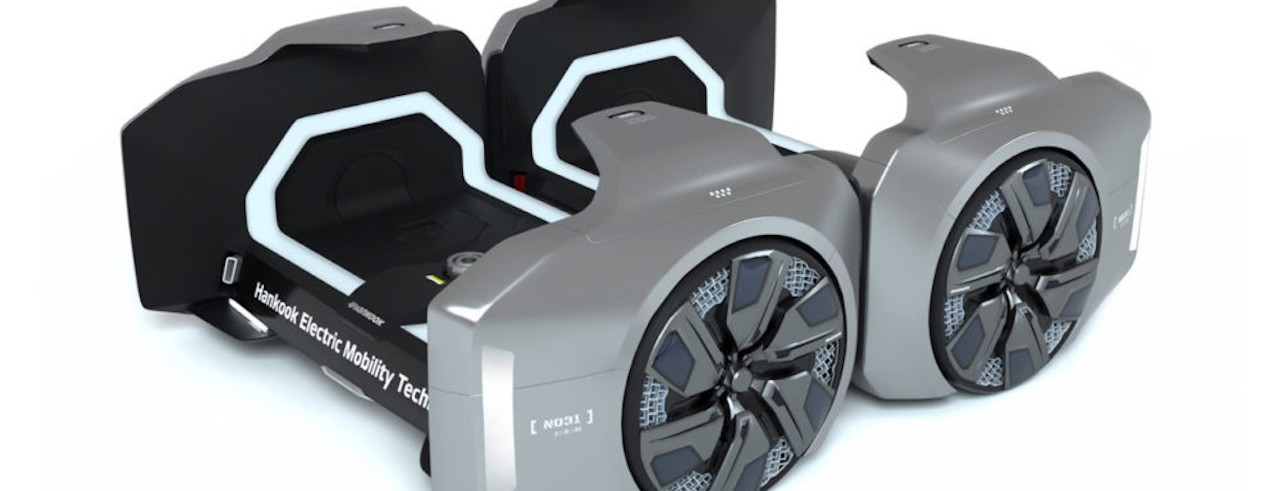
Featured image at top: UC students helped design this modular, platform-based tire concept, the "Hankook Platform System (HPS)-Cell." Photo/Hankook
Related Stories
The future, decoded. UC scholars reveal what’s next
May 20, 2026
The University of Cincinnati’s NEXT Innovation Scholars presented Gen Z-fueled insights on possible future trends at the Futures Forum 2026. Here’s what they see ahead.
Materials scientist gains valuable research experience
May 20, 2026
The opportunities at the College of Engineering and Applied Science are what attracted Ananth Balasubramanian to the University of Cincinnati. He came to UC as a master's student and after two years, transitioned to a direct PhD program in materials science and engineering. Here, he works in the Digital Fabrication Laboratory and recently was named Graduate Student Engineer of the Month by CEAS.
6 ways starting a GLP-1 medication could affect your emotions
May 20, 2026

When patients first start taking a glucagon-like peptide-1 (GLP-1) medication, they probably expect to feel full. But they might not anticipate how it can influence their emotions. The medications act on the stomach and the brain, said Malti Vij, MD, a University of Cincinnati adjunct associate professor in the College of Medicine's Department of Internal Medicine and a diplomate of the American Board of Obesity Medicine.