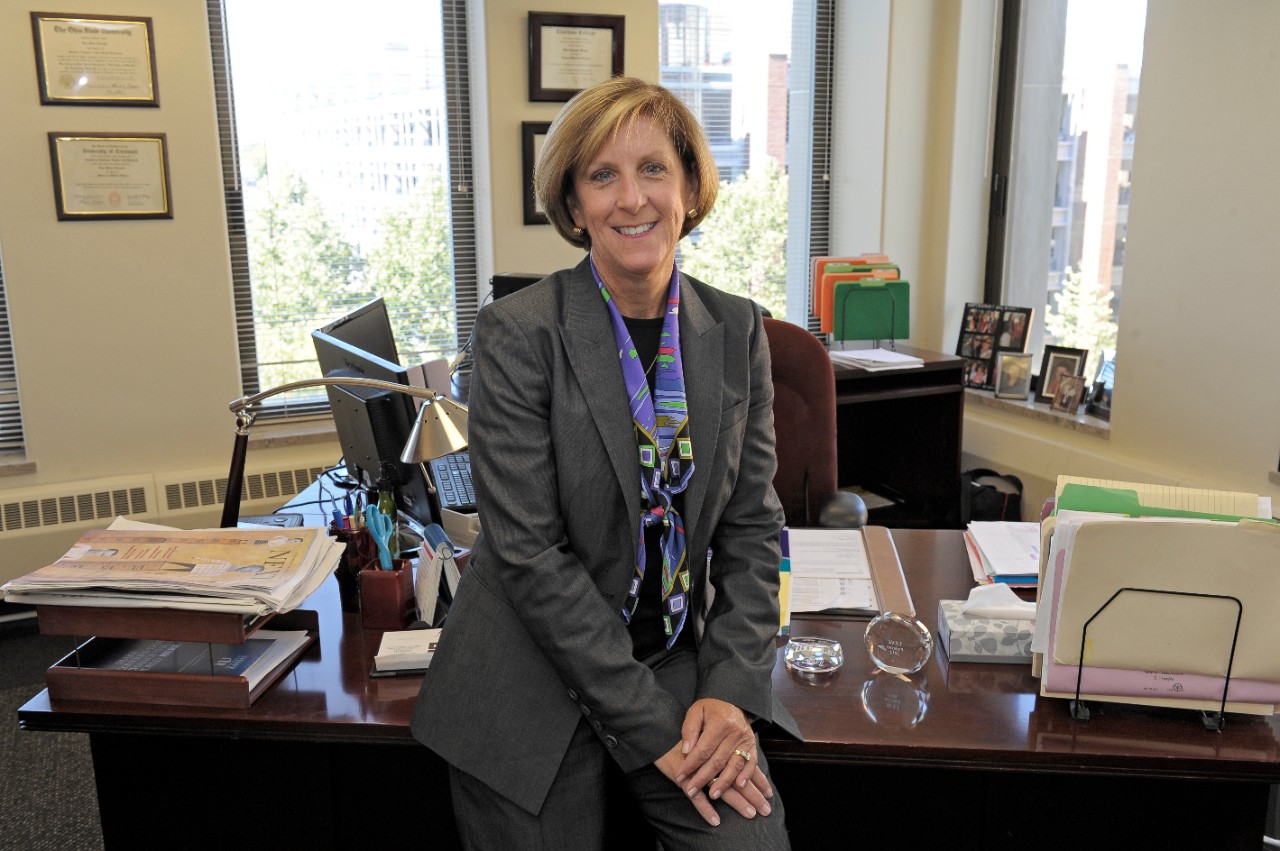
Message from the Dean: Connections 2020
Dean Tina Whalen writes a message to alumni and friends of the college
Dear CAHS Alumni & Friends:
This past year has been unprecedented in many ways. We started the academic year by moving into our wonderful new building, celebrating our ribbon cutting, and enjoying the multifunctional spaces that were specifically created for interdisciplinary activities. We held a number of alumni and friend meet and greets to provide many of you with the opportunity to see our new space and catch up with the faculty in your respective disciplines.
The college experienced business as usual until the pandemic became our reality in mid-March. The university closed at that time and sent everyone home to complete spring semester at a distance. On March 21, all clinical practicums were halted, and our faculty went into overdrive to find alternative ways to successfully complete spring and summer semesters online. In order to give our students the very best experience possible, the college purchased a number of specialized software programs to allow for virtual training through simulated case studies, online anatomy dissections, and online exam simulators; we also added pieces of hardware technology to make content streaming in the virtual realm more interactive for our students.
Our faculty and staff’s quick and creative adaptations will result in 1,006 CAHS students graduating across the spring, summer, and fall semesters. I’m happy to report that very few students’ timeline to degree was delayed due to the COVID-19 interruption. The college is so very fortunate to have dedicated faculty and staff who are so committed to facilitating student success that even in a pandemic, our graduation rates were unaffected.
The college was able to restart clinical practicums in May 2020. To date, over 350 of our students completed practicum experiences this summer or are engaged in them this fall. We started fall semester on August 24 in a hybrid fashion. Only 11% of our courses (those requiring lab-based skills) are being held with face-to-face interaction to maintain a low population density and prevent further spread of the virus through the UC community. Planning is underway for spring semester utilizing a similar hybrid approach to scheduling as fall.
The college continues to grow in enrollment, our largest enrollment in history occurred this fall (3,057). This is a 6% increase over fall 2019. The pandemic has pointed out the importance of health care providers and more and more students are aware of and selecting our professions for future careers.
Highlights from this year include:
Inclusion
19.9% of students self-reported as a student of color.
Impact
Raised $471,772 through a combination of legacy gift, endowed scholarships, and current use fund donations.
Innovation
Total Research Funding Awarded: $3.79 million
In closing, I hope to you enjoy this newest edition of Connections; due to COVID-19 we are choosing to do this in a digital format. I hope that you and your family are staying healthy, and more importantly, successfully managing through this highly unusual time. I’m sorry I can see you in person in the near future, but I am always available by phone or email if you have any comments, ideas, or opportunities to share. We hope to conduct a virtual town hall the spring semester to keep you updated about the college’s activities and accomplishments across this academic year.
Sincerely,
Tina F. Whalen, EdD, DPT, MPA, PT
Dean, Professor
Related Stories
The subtle changes in hearing you should never ignore
July 24, 2026

It’s easy to dismiss changes in hearing as minor. But as The Washington Post recently reported, these symptoms could also signal a medical emergency that many people don’t recognize — known as sudden sensorineural hearing loss, a rapid decline in hearing that occurs suddenly or over a few days.
President Pinto Announces UC's new Vice President for Research
June 16, 2026
President Neville Pinto announces appointment of Dr. Loren Wold as UC's next Vice President for Research.
UC hosts regional summit on the future of healthcare education
May 29, 2026
The University of Cincinnati College of Allied Health Sciences recently welcomed educators, clinicians and healthcare leaders from across the region for the Association of Schools Advancing Health Professions (ASAHP) 2026 Regional Summit focused on preparing workforce-ready healthcare graduates.