WVXU: UC observatory could help protect drinking water
UC assistant professor Reza Soltanian is studying water pollution

WVXU spoke to a University of Cincinnati hydro-geologist about a project to study how river pollution affects underground sources of drinking water.
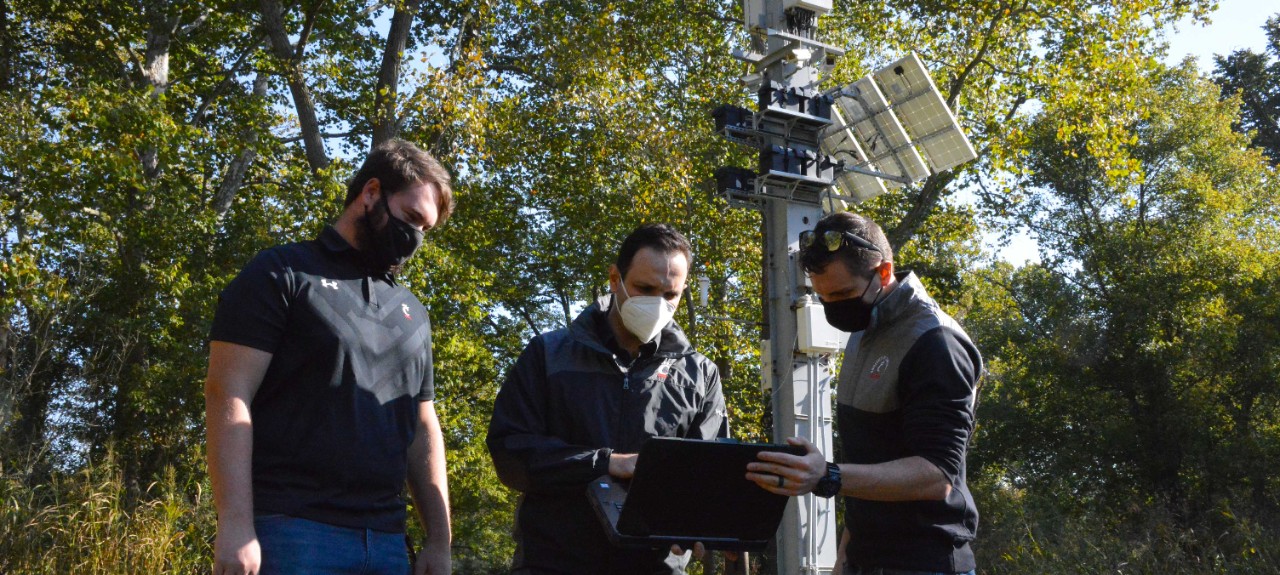
UC College of Arts and Sciences assistant professor Reza Soltanian and his students spent the summer installing new sensors at the Theis Environmental Monitoring and Modeling Site along the Great Miami River in Crosby Township.
With new monitoring wells and sensors, UC has created one of the most sophisticated water-monitoring projects of its kind in partnership with Duke Energy and Great Parks of Hamilton County. It can monitor pollution and track the flow of river water into the ground – a source of drinking water for more than 2 million people in southwest Ohio.
"We're trying to monitor all the chemicals coming from the Great Miami Valley Watershed that drains into the Ohio River," Soltanian said.
Postdoctoral researcher Corey Wallace is working on the project through a National Science Foundation grant.
"This is kind of flagship site. If we can show the capabilities of all these different sensors and technologies, our hope is they can apply them to other critical zones around the country to get a better understanding of what's going on in their groundwater," Wallace told WVXU.
"What we are finding as we are doing our research is you have to have a concrete, real-time measurement of the things happening in the water," Soltanian said.
For example, the observatory has the ability to track a pollution plume if a spill occurs upstream, he said.
Likewise, the observatory can track and transmit data on pollution and water flow even when the entire site along the river is underwater, which happens occasionally during spring floods.
Featured image at top: UC student Tyler McGarr, left, UC assistant professor Reza Soltanian and postdoctoral fellow Corey Wallace check a live feed of data streaming from UC's Theis Environmental Monitoring and Modeling Site. Photo/Michael Miller

UC assistant professor Reza Soltanian is helping to understand how rivers influence drinking water at UC's groundwater observatory. Photo/Michael Miller
Related Stories
6 ways starting a GLP-1 medication could affect your emotions
May 20, 2026

When patients first start taking a glucagon-like peptide-1 (GLP-1) medication, they probably expect to feel full. But they might not anticipate how it can influence their emotions. The medications act on the stomach and the brain, said Malti Vij, MD, a University of Cincinnati adjunct associate professor in the College of Medicine's Department of Internal Medicine and a diplomate of the American Board of Obesity Medicine.
Inaugural AI Symposium in Finance & Accounting explores the investment landscape
May 19, 2026
The Johnson Investment Institute hosted the first-ever AI Symposium in Finance & Accounting on May 8 at Lindner Hall, welcoming industry leaders from national firms, academics from leading universities, and emerging finance and accounting talent.
From humanoids to drones, UC 1819 Innovation Hub debuts AI + Robotics Summit
May 18, 2026
eGateway Capital and the University of Cincinnati’s 1819 Innovation Hub and Digital Futures co-hosted the region’s inaugural summit: The Future of Commerce: AI + Robotics Summit, focused on artificial intelligence and robotics.