Forbes: Drones may become next big thing in health care
Forbes highlights UC's telehealth drone project

Forbes highlighted the work of four inventors at the University of Cincinnati who are exploring new technology in telehealth.
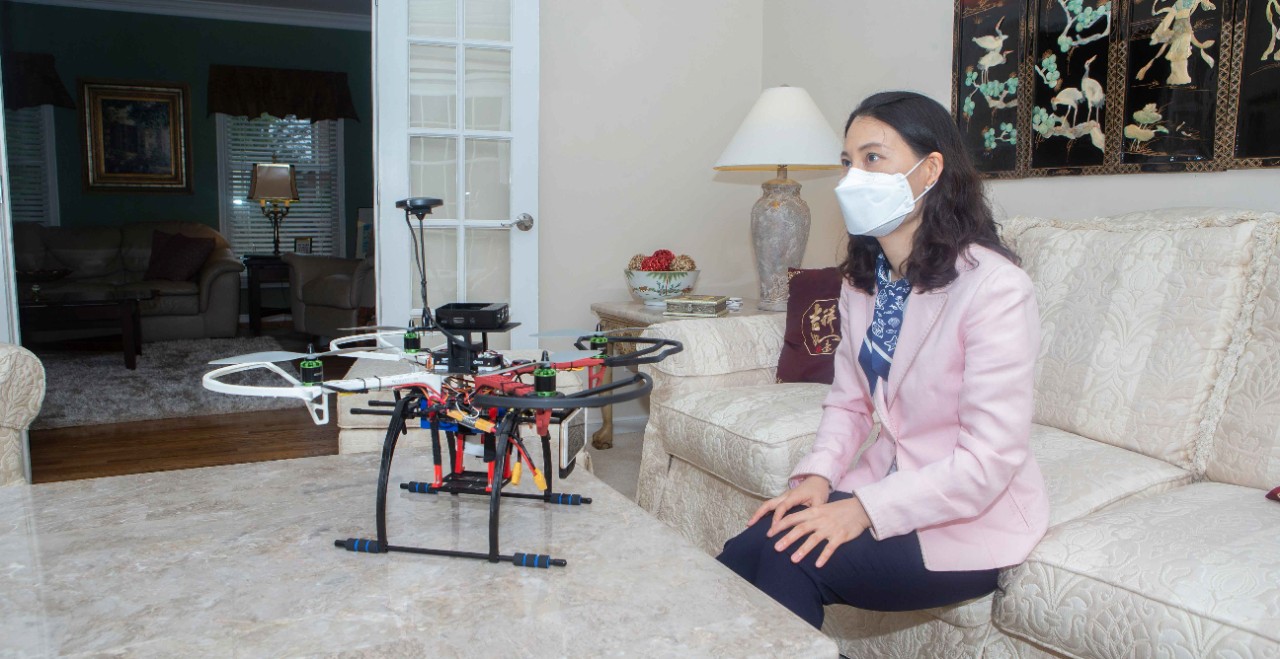
Inventors Victoria Wangia-Anderson, Manish Kumar, Seung-Yeon Lee and Debi Sampsel from three colleges at UC collaborated to develop a semi-autonomous drone that can be dispatched right to people’s homes. The drones are big enough to carry medicine or medical supplies but small enough to maneuver the tight confines of a home using navigational algorithms developed by UC engineers.
Still in development, the drone has cameras and a display screen so patients can talk to health care professionals from the comfort of their home. The prototype carries a waterproof box the size of a small first-aid kit to deliver medical supplies or collect self-administered lab tests.
"Drones have displayed incredible promise in various aspects of clinical care. One of the most profound applications has been the use of drones for telehealth and virtual care, as envisioned by University of Cincinnati researchers last year," Forbes contributor Sai Balasubramanian wrote.
"The value impact of this is momentous, as it provides an opportunity to expand care to otherwise hard-to-reach patients and potentially resolve the significant access-to-care issues plaguing modern day health care."
The researchers in UC’s College of Nursing, College of Allied Health Sciences and College of Engineering and Applied Science secured a UC Office of Research grant to develop a prototype to test the feasibility of dispatching a telehealth care delivery drone to a patient's home to provide health assessments or medical interventions.
Featured image at top: Seung-Yeon Lee, an associate professor of nutrition sciences in UC's College of Allied Health Sciences, sits across from a telehealth drone that allows patients to talk face-to-face to health care professionals from the comfort of their home. Photo/Joseph Fuqua II/UC Creative + Brand
Related Stories
These teeny spiders are social media stars
August 28, 2026

The New York Times turned to a University of Cincinnati professor to explain the appeal of jumping spiders on social media.
An internal divide among unions on AI impacts the Wisconsin gubernatorial race
August 28, 2026

Anne Lofaso, a professor in the Donald P. Klekamp College of Law at UC, spoke with Wisconsin Public Radio, about the schism among unions over AI and whether it is a plus, a negative, or somewhere in between when looking at job creation.
On-site training in Speech & Hearing Clinic sets UC’s programs apart
August 27, 2026
At the University of Cincinnati’s Speech & Hearing Clinic, Doctor of Audiology and Speech-Language Pathology graduate students gain real-world experience while providing free speech and hearing services to the community.