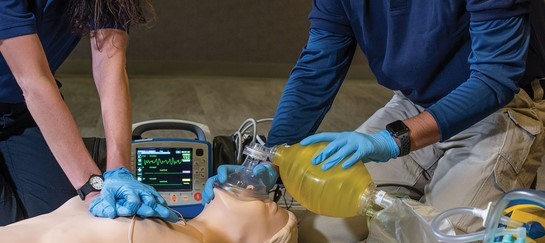
UC Nursing joins first cohort of innovative, competency-based CPR training
National League for Nursing’s program prepares students to improve cardiac arrest outcomes

University of Cincinnati (UC) College of Nursing has been accepted in the first cohort of the National League for Nursing (NLN) Change Agent for the Resuscitation Quality Improvement (RQI) program, an innovative competency-based training for high-quality cardiopulmonary resuscitation (CPR) and improved patient outcomes developed by the American Heart Association (AHA).
Nurses play an instrumental role in the management of in-hospital cardiac arrest and are often the first on the scene to identify the need for and to initiate CPR, the single biggest determinant of and the last chance for survival in a cardiac arrest emergency. Despite this knowledge, research illustrates that not all nurses are competent in CPR skills, as they decline within three to six months following conventional training.
To prepare the next generation of nurses to maximize lifesaving resuscitation competence and improve cardiac arrest outcomes, the NLN has partnered with the AHA and Laerdal Medical to offer the RQI program at no cost to nursing schools. This innovative, digital model uses realistic eSimulation patient cases and a mobile Simulation Station for quarterly psychomotor skills activities that help healthcare providers retain life-saving CPR skills.
“As an early adopter of technology and innovation in nursing education, we are glad to be one of the first colleges in the country to offer this opportunity for hands-on practice to our students, so they can graduate ready to provide safe, quality care to all,” says Denise Gormley, PhD, RN, FAANP, interim dean of the UC College of Nursing.
In the United States, only 25% of patients survive an in-hospital cardiac arrest; just 10% survive out-of-hospital emergencies. High-quality CPR is the single highest determinant of survival from cardiac arrest.
Tags
Related Stories
Bidirectional link between oral, kidney health calls for patient education, access
August 4, 2026

Despite growing awareness of the connection between oral health and chronic health conditions, patient awareness and access to dental care remain limited, according to University of Cincinnati experts who recently spoke with Healio | Nephrology News & Issues.
'Be human in it': UC College of Medicine welcomes Class of 2030 at 31st White Coat Ceremony
August 4, 2026
The University of Cincinnati College of Medicine welcomed 185 first-year medical students in the Class of 2030 at the 31st annual White Coat Ceremony.
The subtle changes in hearing you should never ignore
August 4, 2026

It’s easy to dismiss changes in hearing as minor. But as The Washington Post recently reported, these symptoms could also signal a medical emergency that many people don’t recognize — known as sudden sensorineural hearing loss, a rapid decline in hearing that occurs suddenly or over a few days.