
UC model predicts how racial makeup of neighborhoods will change
Machine-learning algorithm proves 86% accurate in one test

A map created by researchers at the University of Cincinnati can predict with surprising accuracy how the racial makeup of neighborhoods will change.
UC College of Arts and Sciences geography professor Tomasz Stepinski created a machine-learning algorithm to predict in fine detail how neighborhoods will become more or less segregated in the next 10 years.
Stepinski, who works in UC’s Space Research Institute for Discovery and Exploration, analyzed data collected by the U.S. Census Bureau every decade. They mapped the data by racial composition in the high resolution of 300-meter squares called cells.
The algorithm had to be “trained” to interpret the data from two census years spaced 10 years apart. The algorithm also examined individual cells in relation to those around them.
“The name ‘machine learning’ suggests there’s something magical about it, but it’s just more powerful statistics,” Stepinski said.
Stepinski validated his algorithm by comparing its predictions to actual data from the 2010 and 2020 censuses and found it was up to 86% accurate.
“Our hypothesis that you can predict the class of a cell in 10 years based on the previous two classes and surrounding classes was correct,” he said. “It’s not perfect, but you can see it’s pretty good.”
The study was published in the journal Machine Learning with Applications.
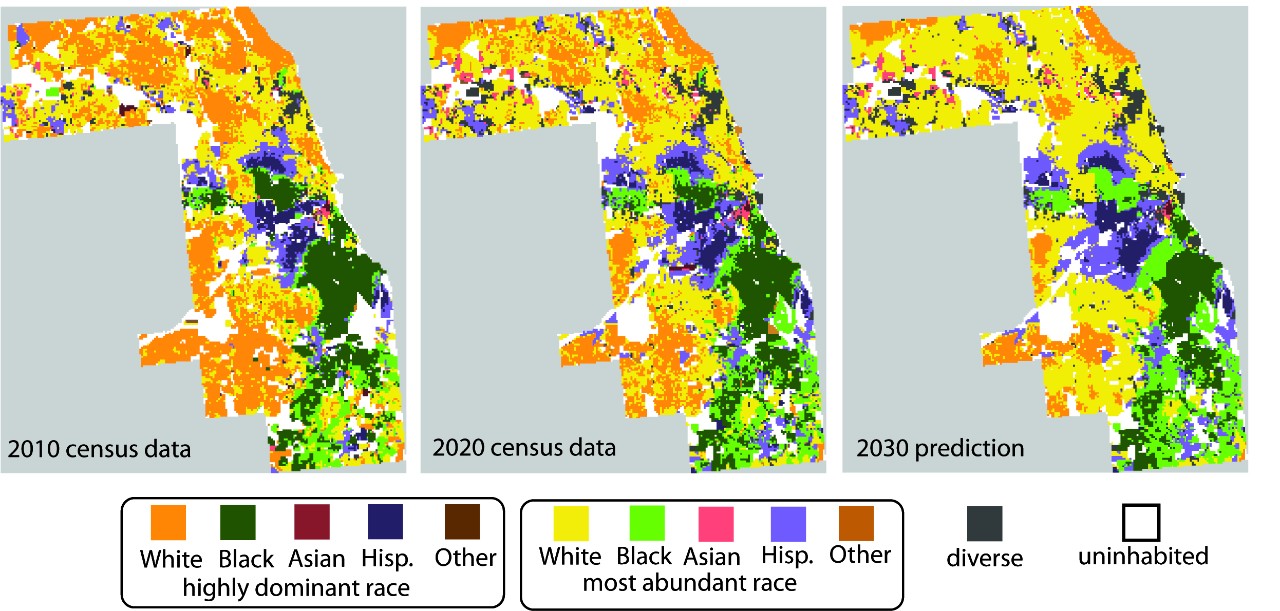
Three maps of Cook County, Illinois, show the racial composition of neighborhoods in 2010 and 2020 based on U.S. Census data and UC's predictive map showing increasing diversity in some segregated neighborhoods in 2030. Graphic/Tomasz Stepinski
Stepinski and co-author Anna Dmowska, an assistant professor in the Department of Geoinformation at Adam Mickiewicz University in Poland, applied their algorithm to Chicago’s Cook County, Illinois, considered one of most racially segregated places in America.
UC’s map showed that many neighborhoods dominated by white and Black populations will become less segregated by 2030 with less noticeable changes in neighborhoods dominated by Hispanic and Asian American populations.
Stepinski said researchers in Chicago have conducted pioneering sociological research on race, ethnicity and gentrification using Cook County as their model. The sprawling, heavily populated county also provides a good model to study the algorithm because it still has many segregated neighborhoods despite trending toward greater racial and ethnic diversity over the last 50 years, he said.
I leave the why to someone else. But I can imagine what’s happening.
Tomasz Stepinski, UC geography professor
Stepinski also applied the algorithm to Houston, Texas, and Los Angeles and San Francisco in California with similar success.
“The ability to predict demographic changes is essential from a scientific point of view and for policymakers, city development, etc.,” co-author Dmowska said.
“As shown in the paper, the predictive maps are pretty accurate and show how the area might look in the next 10 years,” she said.
Stepinski said the predictive maps could be used to help schools or governments plan for more services such as Spanish-speaking classrooms or interpreters. It also could help sociologists understand the driving forces behind the changing demographics of neighborhoods.
“My interest is not sociological. My specialty is computation,” Stepinski said. “I leave the why to someone else. But I can imagine what’s happening.”
Stepinski said younger generations are often likely to remain in nearby neighborhoods if they remain in an area at all. And if one particular racial population declines in an area, others typically fill the void.
“It’s diffusion,” Stepinski said. “So in Cook County you have a Hispanic population that is growing faster than the white population. They’re going to move close by. They’re not going to move far from home.”
Michael Chavarria, executive director of the nonprofit HOPE Fair Housing Center in Illinois, said he was surprised by the map’s predictive accuracy.
“One incredibly powerful thing it does is affirm the narrative that people don’t have as much control over where they live as decision makers think they do,” he said.
“People think segregation is the result of individual choices. And some people might choose to live in places where everyone looks like them,” Chavarria said. “But the idea that an algorithm can predict where people live shows there are other factors that control these decisions. That tells me that the choice about where we live isn’t rooted in full agency.”
In Cook County’s case, Chavarria said the snapshot view the predictive map affords might suggest that some neighborhoods in Cook County are becoming less segregated. But it might also merely capture the transition from one type of segregated neighborhood to another just as segregated.
“Seeing these neighborhoods change could just be a precursor to more segregation,” Chavarria said.
Olivia Cobbins, an investigator with the Cook County Human Rights Commission, said it’s important to examine racial segregation in the context of issues such as housing discrimination or public services.
“Chicago has a history of racial discrimination, redlining and inequalities towards African Americans,” she said.
Cobbins said policies and laws must keep up with changing demographics to ensure equal opportunities to everyone.
“Public officials and society have a moral responsibility and obligation to provide justice, equality and equity and to ensure public assistance and decent, affordable housing is available to those in need.”
Featured image at top: UC geography professor Tomasz Stepinski developed an algorithm that uses U.S. Census Bureau data to predict how the racial composition of neighborhoods will change in 10 years. Photo/Mauro Mora/Unsplash
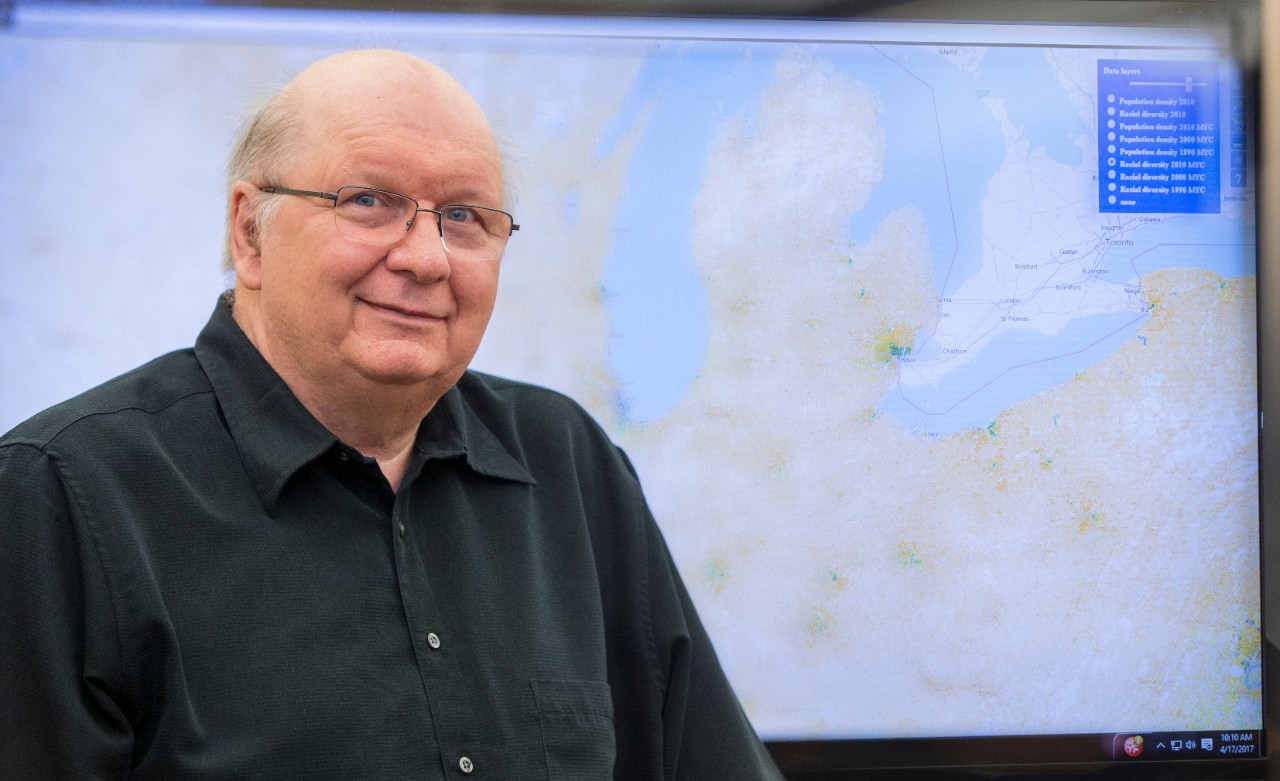
UC geography professor Tomasz Stepinski creates novel maps that help improve our understanding of the world. Photo/Andrew Higley/UC Marketing + Brand
Next Lives Here
The University of Cincinnati is classified as a Research 1 institution by the Carnegie Commission and is ranked in the National Science Foundation's Top-35 public research universities. UC's graduate students and faculty investigate problems and innovate solutions with real-world impact. Next Lives Here.
Related Stories
'There's a strong community here:' UC transfer student finds place in College of Arts and Sciences
October 23, 2026
This week marks National Transfer Students Week, and the College of Arts and Sciences celebrated those students Thursday. Olivia White, assistant director of recruitment, said around 13-15% of students at UC are transfer students, and with that comes its own set of challenges.
AI breast cancer survival model from Cancer Center could improve accuracy and personalize care
October 23, 2026
UC Cancer Center researchers, including lead author Wedad Alatebi, developed a deep learning survival model for breast cancer that combines detailed clinical and genetic information, potentially offering physicians a more accurate tool to guide treatment decisions.
UC aerospace engineer leads global computational fluid dynamics taskforce
October 21, 2026
The American Institute of Aeronautics and Astronautics' CFD 2030 Integration Committee has announced the formation of the Computational Fluid Dynamics (CFD) Vision 2045 Team, a multi-institution working group tasked with defining where the field of computational fluid dynamics should be by 2045 to align with the changing and evolving needs of the aerospace industry. The University of Cincinnati's Prashant Khare, Bradley Jones professor and head of the Department of Aerospace Engineering, is leading this specialized group.