
Spectrum News: UC students, professor take part in Mars mission
UC scientists look for evidence of ancient life on Mars

Spectrum News spoke to a University of Cincinnati geology student and her professor about helping NASA look for evidence of ancient life on Mars.
UC College of Arts and Sciences doctoral students Andrea Corpolongo and Desirée Baker and associate professor Andy Czaja serve on the science team that is using the Perseverance rover to explore a former river delta on Mars.
Czaja helped NASA decide where on Mars to send the rover for the best chance to find evidence of ancient life. They chose Jezero Crate where they hope to find evidence of ancient bacterial life when Mars had surface water and a thicker atmosphere conducive to life.
Now he and his students are part of a team of scientists that decide where to send the rover each day and what to examine with its complex suite of sensors and sample collectors. The rover will collect various promising rock samples that will be brought back to Earth during a future mission.
“It's very exciting. It's amazing to get the opportunity to get the first views of our neighboring planet. Every time I log in and look at some of the pictures from Mars, I’m one of the first people to begin interpreting the rocks that we see,” she said.
Czaja said what they find might tell us just how easy or hard it is for any planet to support life.
“We can learn about the history of Mars, about the geologic history, what Mars was like as a planet billions of years ago early in its history, how much water it had and how long that water persisted on the surface, and how and why the planet changed from what we think it used to be,” Czaja told Spectrum News. “We used to think it looked more like earth. It was wetter and warmer and it’s now an extremely cold, dry planet.”
Featured image at top: An artist's rendering of the Perseverance rover on Mars. Photo/NASA/JPL-Caltech
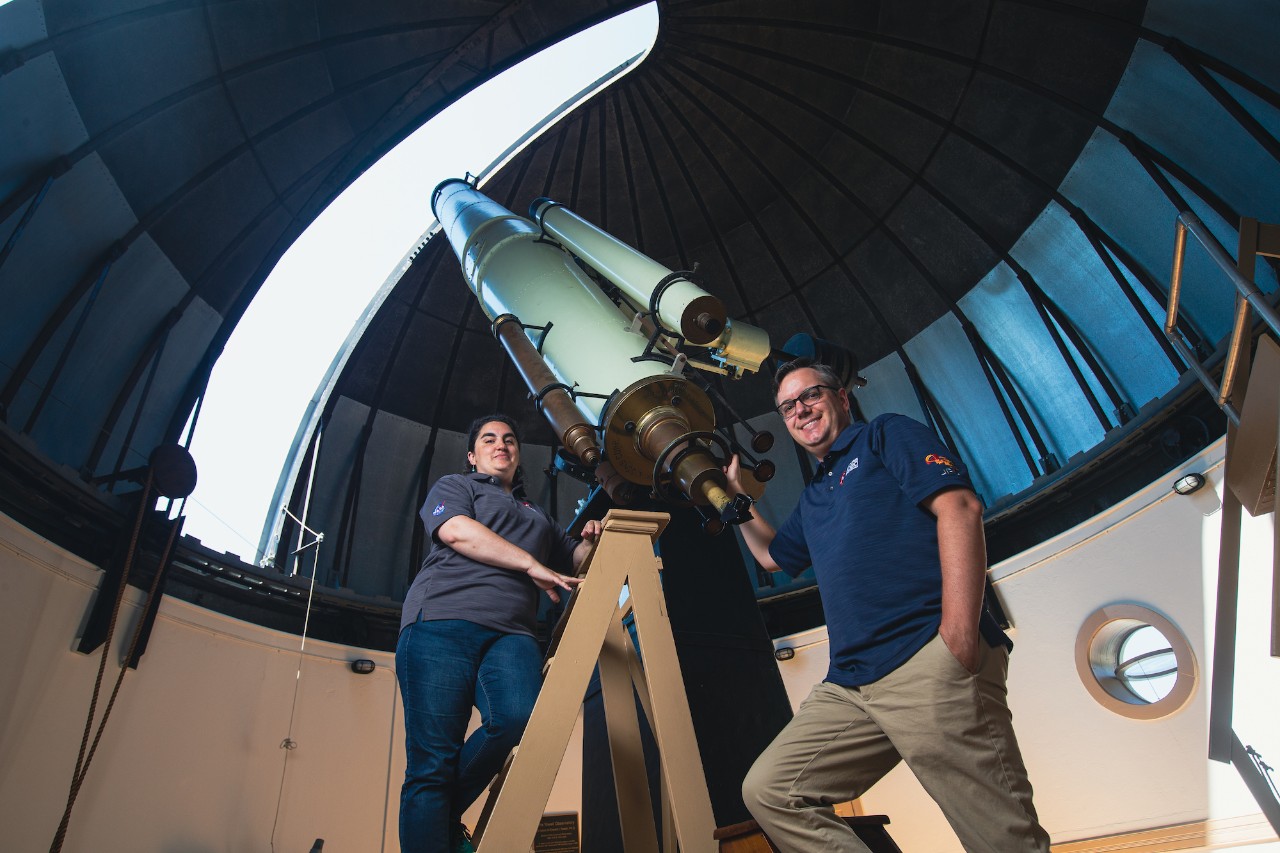
UC doctoral student Andrea Corpolongo and UC associate professor Andy Czaja are part of the science team exploring Mars with the Perseverance rover. Here they pose with a telescope at the Cincinnati Observatory. Photo/Andrew Higley/UC Marketing + Brand
Related Stories
'There's a strong community here:' UC transfer student finds place in College of Arts and Sciences
October 23, 2026
This week marks National Transfer Students Week, and the College of Arts and Sciences celebrated those students Thursday. Olivia White, assistant director of recruitment, said around 13-15% of students at UC are transfer students, and with that comes its own set of challenges.
UC expert explains potential impact of Pennsylvania’s new vape product law
October 22, 2026

UC professor Ashley Merianos speaks to the Pittsburgh Post-Gazette about Pennsylvania’s new vape law, youth vaping prevention, enforcement challenges and possible unintended consequences.
Still the top ‘cat
October 20, 2026

The University of Cincinnati Bearcat mascot was voted Cincinnati’s favorite mascot in a Cincinnati Enquirer reader poll, earning 45.1% of the vote and topping other local favorites.