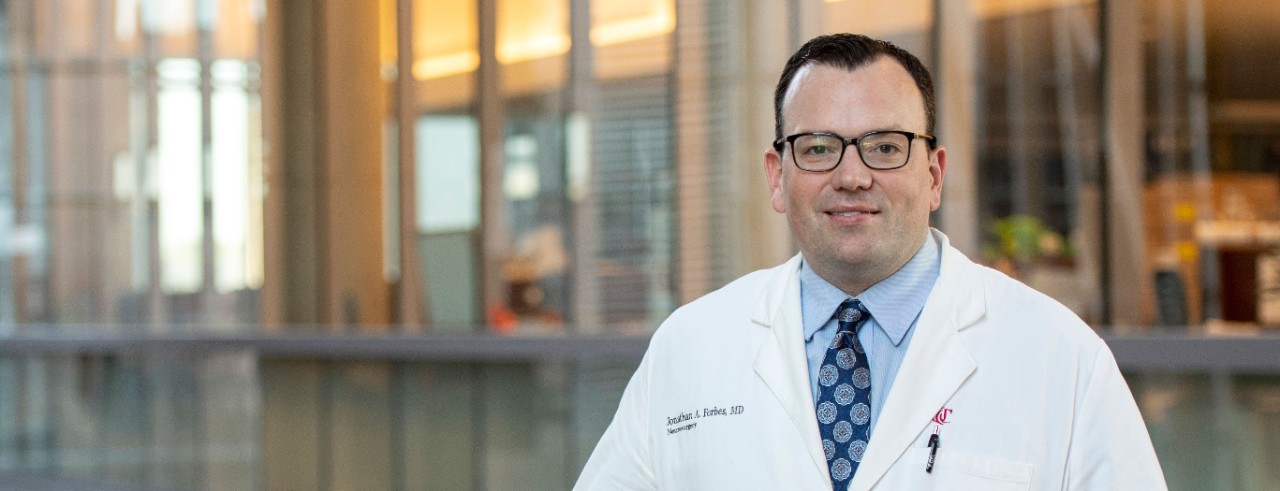
Forbes named a finalist for CNS Innovator of the Year
Freeware application could provide low-cost cranial implants throughout the world

Jonathan Forbes, MD, assistant professor in the Department of Neurosurgery, has been named one of three finalists by the Congress of Neurological Surgeons for 2022 Innovator of the Year.
Forbes will make a presentation at the CNS 2022 Annual Meeting in San Francisco on Oct. 10 about his work on a freeware application that creates patient-specific cranial implants using 3D printer technology. His presentation is “Towards Global Availability of Low-cost, Hermetically Precise, Patient-specific Cranial Implants: Creation of the CranialRebuild Freeware Application.”
Attendees at the CNS annual meeting will vote on the three finalists and a Top Innovator will be named Oct. 11.

Jonathan Forbes, MD, assistant professor in the Department of Neurosurgery, holding a cranial implant made from a mold using 3D printer technology.
“I felt both humbled and honored to be named as a finalist for the CNS Innovator of the Year. In particular, I was proud of our research team, including UC engineering professor Dr. Sam Anand, former UC medical student Alice Xu, and UC engineering students Omkar Ghalsasi and Vysakh Venugopal, who committed countless hours to making this technology work. This recognition would not have been possible without their talent and commitment.” Forbes says.
Using an entry-level 3D printer, the freeware application CranialRebuild can provide neurosurgeons in developing countries with access to patient-specific cranial implants (PSCIs) at a small fraction—about 1% —of the cost of what is typically paid in the United States with comparable cosmetic precision, Forbes says.
“Patient-specific cranial implants are especially important to neurosurgical care when it’s necessary to remove a portion of a patient’s skull, such as with a procedure known as a decompressive craniectomy, which is used to relieve high intracranial pressures,” Forbes explains. “When the original flap is not available for reimplantation in developing countries, rudimentary methods such as bending of 2-D titanium mesh or raw molding with bone cement are often used to reconstruct the calvarium. These rudimentary methods can predispose patients to cosmetic deformity or problems with wound healing, which I witnessed firsthand during time spent deployed.”
CranialRebuild analyzes the patient’s CT images and produces a virtual model of the patient’s skull with the defect. It then generates a 3D contour of the cranial implant that will be needed for precise reconstruction. The program creates a virtual model of a negative of this implant, which can then be printed in polycarbonate. The polycarbonate mold is subsequently sterilized and used to contour bone cement into a cosmetically precise patient-specific cranial implant in the operating room. The implant remains with the patient for the rest of their life.

A close-up of a cosmetically precise patient-specific cranial implant from a mold produced by the CranialRebuild freeware application. The application was developed by Jonathan Forbes, MD, and colleagues.
Forbes developed the idea for the application when he returned to the U.S. from Afghanistan after serving there for six months in 2014 as a neurosurgeon with the U.S. Air Force. While in Afghanistan, he treated a number of patients who suffered from suboptimal cosmesis and wound complications—sometimes many years after decompressive craniectomy. At the UC College of Medicine, Forbes began working with Anand, Xu (Class of 2022), Ghalsai, Venugopal, former medical student Abhijith Matur, MD, Class of 2020, and engineering student Manish Aryal to develop the application. Forbes says that in the U.S. poly-ether-ether-ketone (PEEK) patient-specific cranial implants, which are the preferred method of reconstruction when autologous implants are not available, have an average cost of $12,600. An implant in the U.S. made using a 3D printer costs approximately $3,750, or just 30% of a PEEK implant. In the developing world, the cost is approximately $175, or about 1% of the PEEK implant in the U.S., he says.
“Importantly, we expect this technology will advance the quality of neurosurgical care provided to patients who have undergone decompressive craniectomy worldwide. It offers the additional potential benefit of helping to reduce health care expenditures in the United States,” Forbes says.
The software application is scheduled for official release next month.
Photos by Colleen Kelley/UC Marketing + Brand
Related Stories
These teeny spiders are social media stars
August 28, 2026

The New York Times turned to a University of Cincinnati professor to explain the appeal of jumping spiders on social media.
On-site training in Speech & Hearing Clinic sets UC’s programs apart
August 27, 2026
At the University of Cincinnati’s Speech & Hearing Clinic, Doctor of Audiology and Speech-Language Pathology graduate students gain real-world experience while providing free speech and hearing services to the community.
Designing with cancer patients' needs in focus
August 27, 2026
Kristina Shin is designing garments that prioritize the comfort, function and confidence of breast cancer patients, addressing a need often overlooked by traditional fashion.