
Popular Science: Clever cockatoos carry around toolkits
UC biologist explains how birds use tools to solve complex problems

Popular Science turned to a University of Cincinnati biologist to explain how some birds use multiple tools to solve complex problems.
Elizabeth Hobson, an assistant professor of biology in UC's College of Arts and Sciences, talked about the Goffin's cockatoo, a bird native to Indonesia that uses a variety of tools to pry open hard nuts or to reach food hidden in tree cavities.
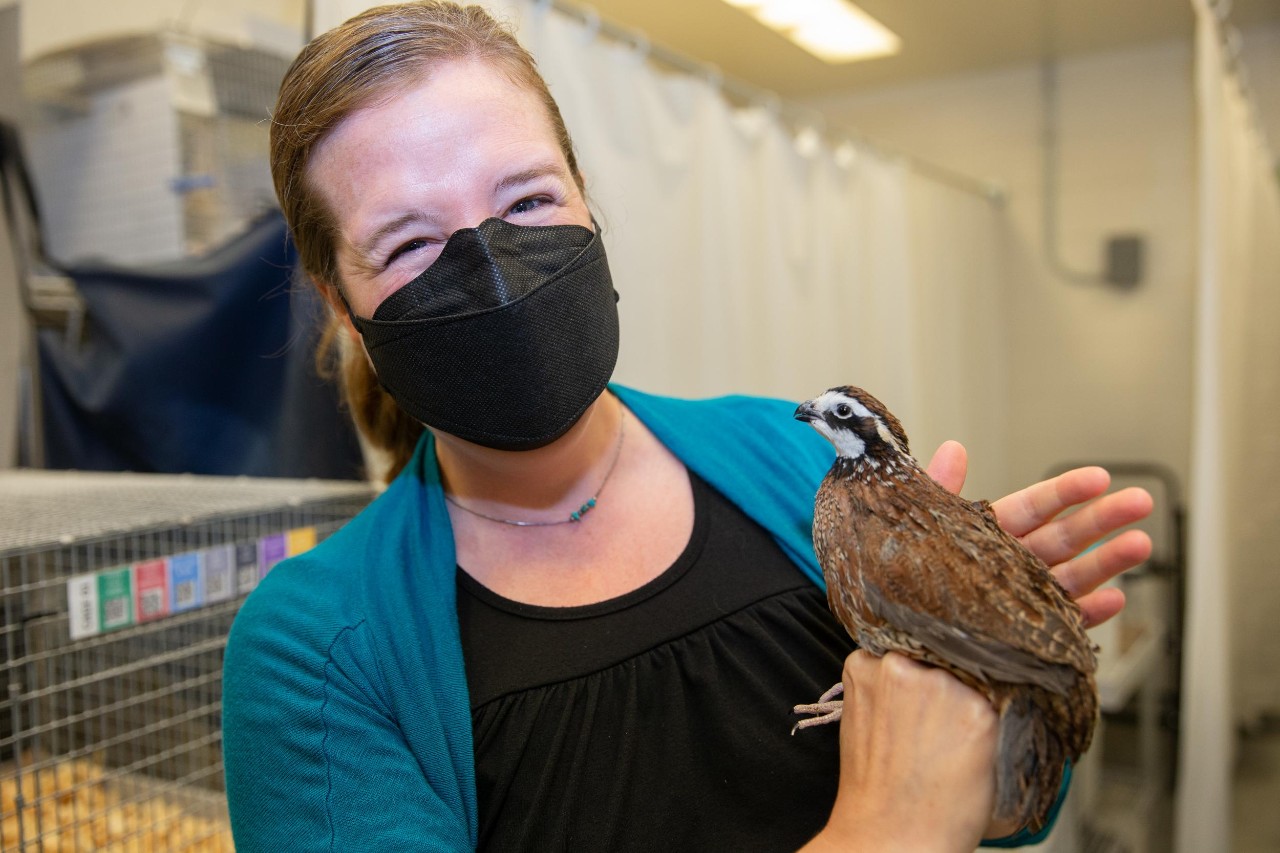
UC Assistant Professor Elizabeth Hobson studies the behavior of bobwhite quail in her biology lab. Photo/Andrew Higley/UC Marketing + Brand
In a study published in the journal Current Biology, researchers from the University of Veterinary Medicine Vienna found that cockatoos presented with a problem in a lab setting could adapt tools to particular uses. In experiments, researchers gave cockatoos a pointy stick to pierce a paper membrane protecting a nut and a flexible straw to drag it to them through a narrow tube.
Perhaps not surprisingly, most of the birds easily succeeded in the timed trials.
In another experiment, the researchers gave the birds tools on one side of a flight cage that could help them solve a problem at the other side. The researchers found the birds simultaneously carried both tools with them to solve the problem and efficiently reach their food reward.
Hobson was not part of the study but has examined the complex social behaviors of birds such as monk parakeets and little blue penguins.
She told Popular Science that this kind of anticipatory thinking is an important skill birds use in the wild where they encounter challenging obstacles on a daily basis.
“It fleshes out more details about what the cockatoos are capable of in terms of tool use, and builds on recent documentation of tool use in this species in the wild,” Hobson told Popular Science.
Read the Popular Science story.
Featured image at top: A cockatoo carries two tools with it to solve a puzzle efficiently. Photo/University of Veterinary Medicine Vienna

UC Assistant Professor Elizabeth Hobson spoke to Popular Science about the surprising problem-solving abilities of birds. Photo/Andrew Higley/UC Marketing + Brand
Related Stories
UC climbs to No. 3 in the nation for co-ops and internships in 2027 U.S. News rankings
September 22, 2026
In U.S. News & World Report’s 2027 Best Colleges rankings, the University of Cincinnati rises to No. 3 in the nation for co-ops and internships — No. 1 among public institutions — and posts gains in undergraduate business, computer science and psychology.
AI is going to change all our lives
September 21, 2026

UC College of Arts and Sciences Assistant Professor Kelly Merrill Jr. tells the Columbus Dispatch that AI is becoming engrained in every aspect of health care.
President Pinto’s 2nd glow party brings first-year Bearcats together
September 20, 2026
UC President Neville Pinto and team hosted the second annual Bright Beginnings glow party for first-year students