Pennsylvania news: Personalized treatment for deadly blood and bone marrow cancer

WFMZ-TV in Allentown, Pennsylvania recently highlighted the University of Cincinnati's John Byrd and the Beat AML study testing personalized treatment for patients with acute myelogenous leukemia.
“Although it has one name there are probably 15, 20 different types of AML. Before, when people were diagnosed with AML, they would come in and everybody would be treated the same way,” said Byrd, MD, a University of Cincinnati Cancer Center researcher, chair of the Department of Internal Medicine at the UC College of Medicine and the chief medical officer of the Beat AML study.
Using genetic sequencing, researchers are identifying what drives each patient's disease and personalizing treatments accordingly.
“Once a medicine gets approved in one indication, it can potentially be applied to a lot of other types of cancers that have that same mutation, but might be in a different part of the body,” Byrd said.
The Beat AML trial is unique because it a master trial studying multiple drugs at the same time.
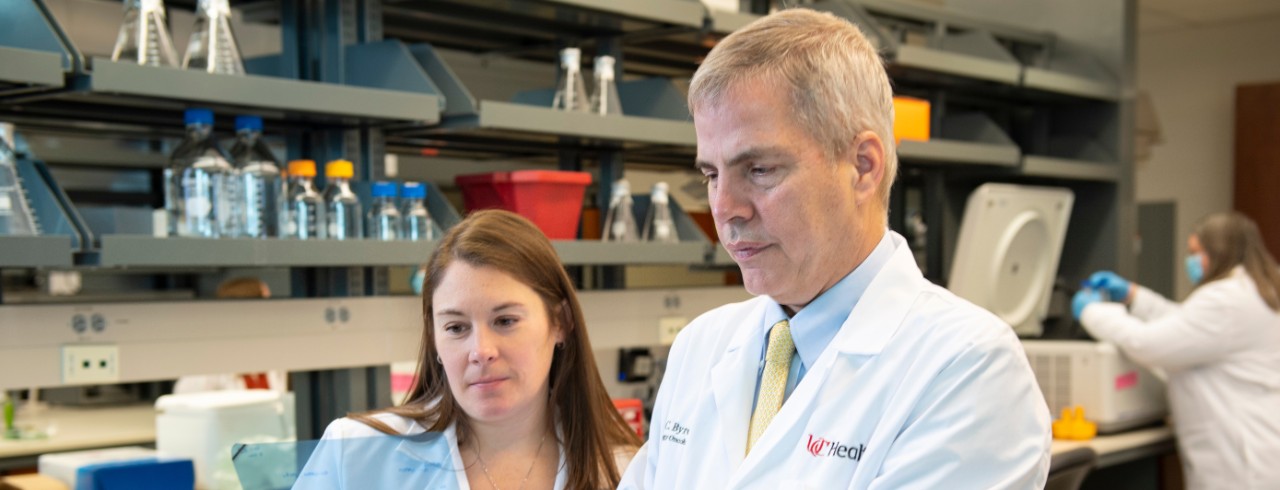
Featured photo at top of Erin Hertlein, PhD, left, and John Byrd, MD, working in the lab. Photo/UC Foundation.
Related Stories
Her book drive is changing literacy in Cincinnati
August 31, 2026

WCPO highlights a nonprofit dedicated to childhood literacy that has offers co-op positions to UC students.
Heavy social media use linked to depression
August 31, 2026

U.S. News and World Report, Yahoo! News, MSN, USA Today and other national media highlight a new study by the University of Cincinnati and Northwestern University that found a correlation between heavy social media use and depression in adults.
These teeny spiders are social media stars
August 28, 2026

The New York Times turned to a University of Cincinnati professor to explain the appeal of jumping spiders on social media.