Neurology Today: How and where artificial intelligence works for stroke detection

Nearly every industry is wrestling with how artificial intelligence (AI) will affect its future, and the area of stroke imaging and care is no exception.
Achala Vagal, MD, vice chair of research and professor of radiology in UC’s College of Medicine and a UC Health neuroradiologist, was one of several experts who discussed this topic with Neurology Today.
“As powerful as AI is, I don't think it can ever replace the human expert,” Vagal said. “We cannot take AI as gospel. I call it augmented intelligence: it's one more tool to help us help our patients.
“For me, the paradigm shift is that we have our desktop PACS workstations for viewing images, but the decision-making and communication about triaging the patient is happening on a different platform, on the phone,” Vagal continued. “We radiologists need to stay actively involved with the rest of the stroke team in interpreting and confirming what the AI is saying.”
Read the Neurology Today article.
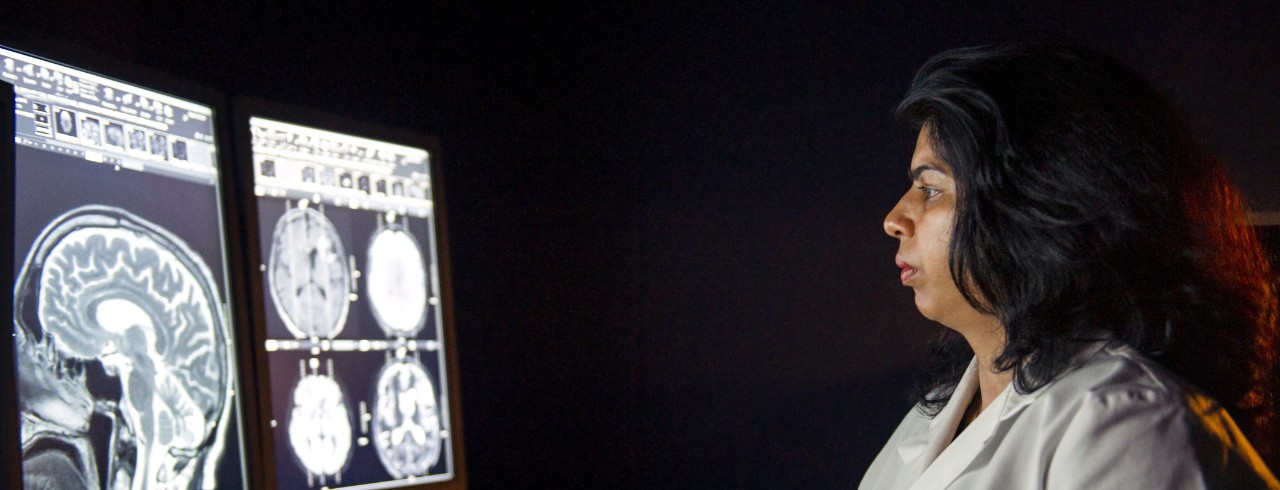
Featured photo at top of Achala Vagal looking at brain scans. Photo/Colleen Kelley/UC Marketing + Brand.
Related Stories
Supreme Court takes another look at Title IX
May 22, 2026

Anne Lofaso, a professor in the University of Cincinnati Donald P. Klekamp College of Law, spoke with Bloomberg Law for a story about the Supreme Court reviewing whether Title IX may allow workers to sue for job bias.
'T. rex of the sea' discovered in Texas
May 22, 2026

UC Associate Professor Takuya Konishi talks to the Dallas Morning News about a new species of mosasaur found in Texas.
UC structural biologists are first in world to visualize key cell protein
May 22, 2026
University of Cincinnati College of Medicine structural biologists are the first in the world to visualize a key cell protein as part of recently published research in the journal Cell Reports.