
UC Makerspace simplifies 3D printing
Bringing your designs to life

At the UC Ground Floor Makerspace, students and faculty can harness the power of 3D printing to bring their imaginations to life.
Working with various materials from basic plastics to high performance composites, a range of objects from everyday practical items to awe-inspiring works of art can be made using 3D printers.
Located inside the 1819 Innovation Hub, the Makerspace shares the process needed for anyone wishing to bring their digital designs to life.
3D printing 101
Inside the Makerspace, along with a variety of 3D printers offering unique features and capabilities, are technical staff who provide advanced support and guidance. Once your design is complete, they'll handle everything, from managing the automated print queue to optimizing your design and operating the 3D printer.
"We match the appropriate 3D printer model needed for any project based on size, quantity and materials," Gabrielle Stichweh, Makerspace prototyping technician, said. "No certification class is required, but anyone wishing to print an object needs a stereolithography (STL) file, which you can create or upload from ready-made files available online."
The Makerspace offers the following 3D printing technologies to suit various needs:
- Fused Deposition Modeling (FDM): a desktop model using thermoplastic filaments melted through a nozzle and applied layer by layer until the pattern is complete.
- Stereolithography (SLA): uses a highly precise laser to cure liquid resin into hardened plastic for a wide range of objects needing refined and isotropic features, such as mechanical parts.
- Industrial FDM: for larger, more demanding prototypes using durable materials such as carbon fiber and for small batch production.
Members can easily access the membership portal to upload their STL files to the 3D printing queue. Makerspace staff optimize and process prints and notify members of completion.
We match the appropriate 3D printer model needed for any project based on size, quantity and materials.
Gabrielle Stichweh Makerspace prototyping technician
Fun-ctional designs
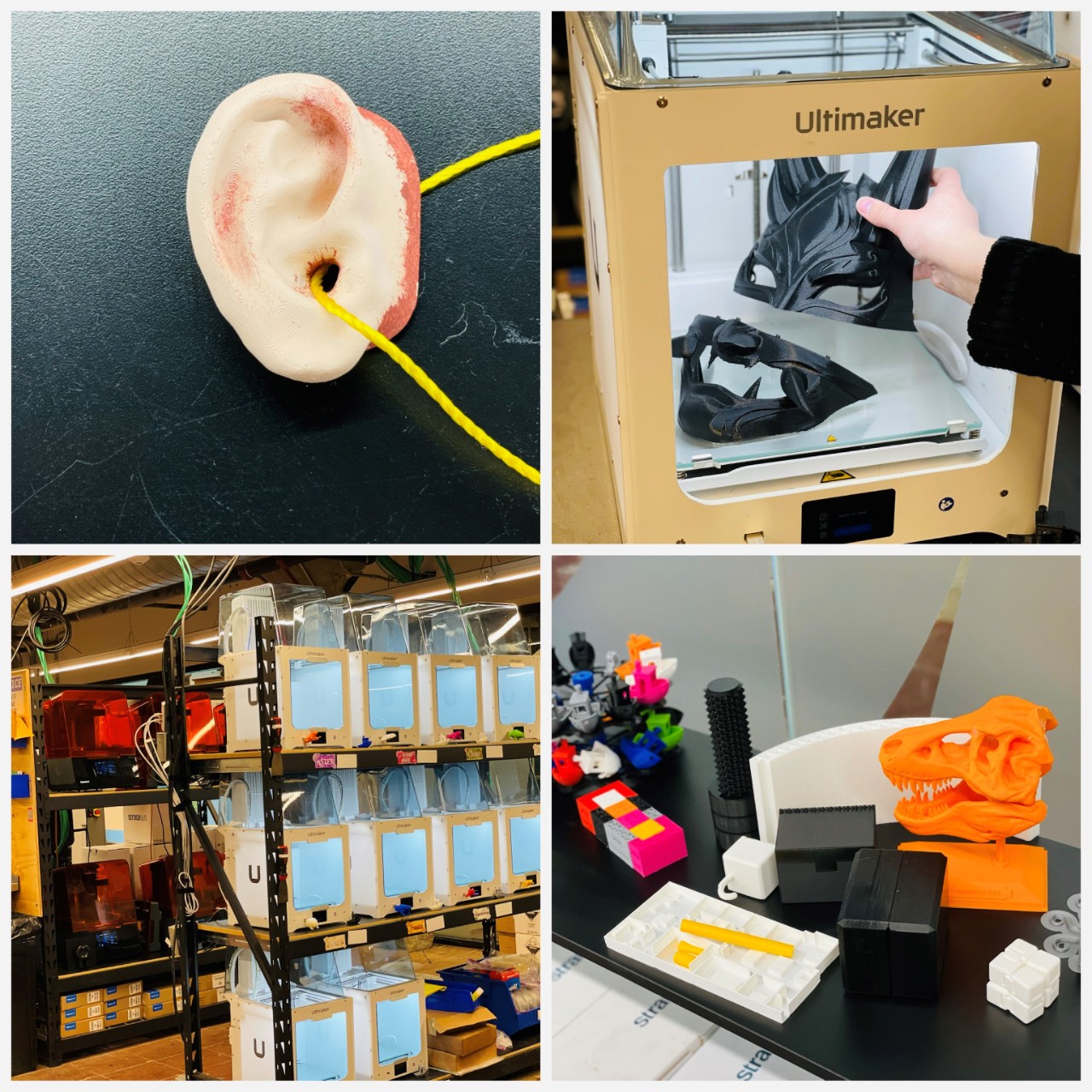
Ideas come to life using various 3D printers inside the UC Groundfloor Makerspace. From capstone projects and machine prototypes to cosplay masks, staff at the Makerspace match your needs with the appropriate 3D printer. Photos/Diana Lara
Here are just a few examples of the many things that can be created using 3D printing:
- Prototypes of new products, parts or components that allow designers and engineers to test and refine their design before moving into full production
- Intricate and detailed sculptures, home decor and other artistic works from small figurines to larger installations
- Custom prosthetics and orthotics that provide affordable, personalized options for people after illness, injury or surgery
- Cosplay prototypes using customized wearable costume parts from ears, body armor, masks and beyond
Scope of makers
A variety of students, faculty, staff and community members routinely use the Makerspace to turn their visions into tangible work. They include:
- Architecture students or architects needing parts for scale models
- Theater majors or professionals requiring design sets for a stage production
- Electrical or biomedical engineers looking to create parts for a device
- Industrial designers developing new products
- Cosplay enthusiasts crafting tailored parts, for instance, ears for a costume
While 3D printing has come a long way in accessibility and user-friendliness, it still requires skill and expertise to ensure successful results, Stichweh said. The Makerspace staff has a wealth of knowledge and experience and is always on hand to help make your digital designs come to life, she said.
Featured image at top: A UC student models a 3D printed cosplay mask. Photo/Diana Lara
UC Groundfloor Makerspace
Watch a quick video about 3D printing in the UC Groundfloor Makerspace
Learn more about the UC Groundfloor Makerspace and the 1819 Innovation Hub
Related Stories
Medical devices exec touts UC co-op
October 15, 2026

UC College of Engineering and Applied Science alumnus Adam Hauke talks to Medium about the speed of innovation in developing new medical devices. Hauke is global director of product strategy & innovation at Gentherm Medical. He earned a doctorate and bachelor's degree in biomedical engineering from UC.
1819 leaders share innovation insights at StartupCincy Week 2026
October 13, 2026
Entrepreneurship and innovation experts from the University of Cincinnati’s 1819 Innovation Hub shared tips throughout StartupCincy Week 2026. Discover their thoughts, predictions and tips.
Cincinnati entrepreneurs on the rise, with UC’s help
September 23, 2026
Eight startup companies recently graduated from the University of Cincinnati’s Venture Lab, showcasing newfound business skills and publicly proving their readiness to scale.