
Local 12: New research could help treat cocaine use disorder by targeting brain
UC researcher takes novel approach to studying addiction

For more than 50 years, the conventional wisdom in the field of research in cocaine use has been that people take cocaine based on the theory of the drug providing positive reinforcement to the user.
New research out of the University of Cincinnati shows that a pharmacological equation disproves that concept and could spark a major shift in that field of research. Local 12 produced a story about the study, interviewing lead researcher Andrew Norman, PhD, of the Department of Pharmacology and Systems Physiology at the UC College of Medicine.
Norman's research about how people get hooked on cocaine is different than how most researchers see it. He said it’s that the drug reinforces pleasure centers in the brain. “It may be pleasurable, it may induce positive effects, but that isn’t the reason why animals or people will take it,” said Norman.
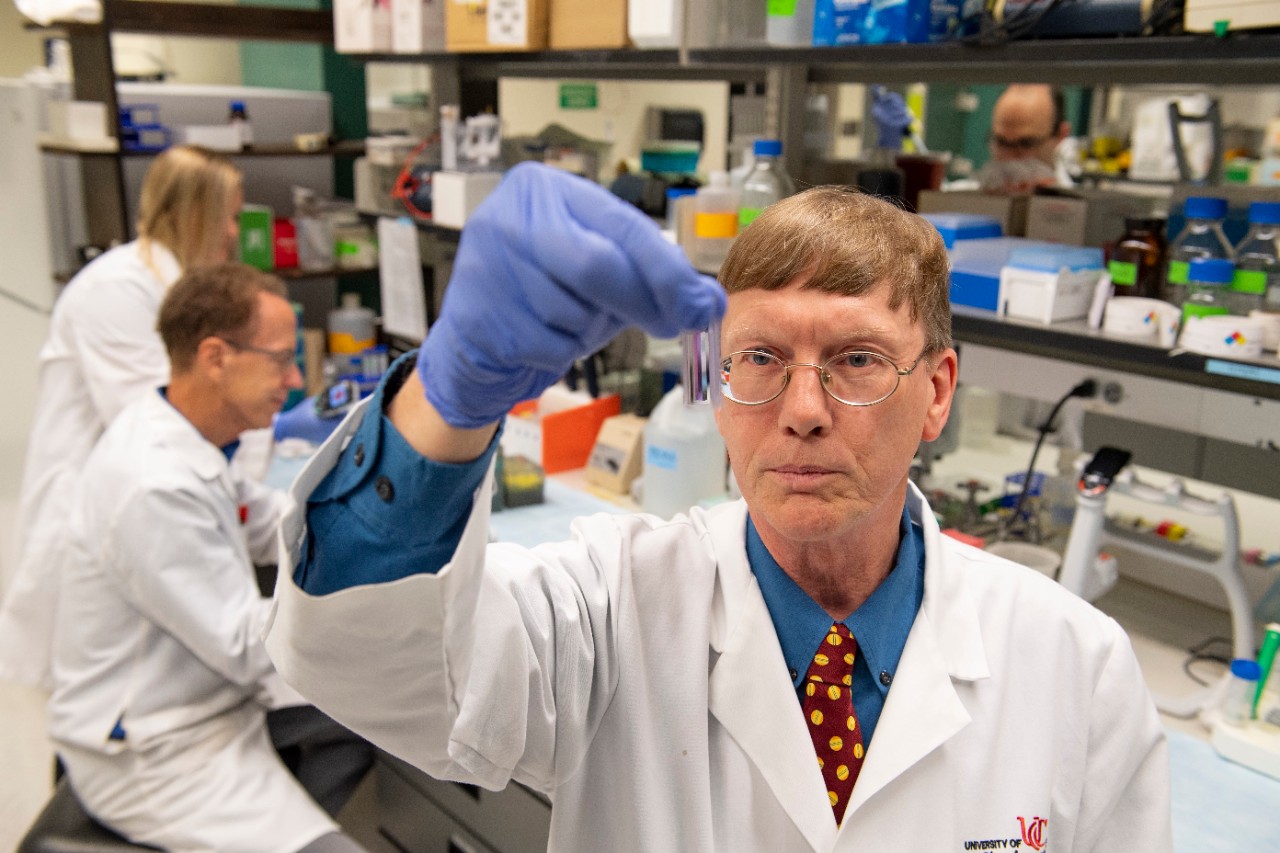
Andrew Norman, PhD, of the Department of Pharmacology and Systems Physiology/Photo/Colleen Kelley/UC Marketing + Brand
Instead, his lab experiments show it’s because of the effect of the drug itself.
“And so, it doesn’t matter whether you want the cocaine or not. It will drive the behavior, just like all drugs do. There is no choice in pharmacology,” Norman said.
He said much like sleeping pills, if a person takes them, he or she will fall asleep whether they want to or not.
“The drug is exerting its effect, and that is a fundamental departure from the standard way of looking at it, where it’s a choice whether we take the drug or not,” Norman said.
To interrupt that process, Dr. Norman’s team has developed a treatment. He hopes to soon test it in human trials. It would target and reduce concentrations of the drug at the site of action in the brain. That will hopefully lead to reduced use and long-term addiction recovery. This also likely has implications for other drugs.
Read more about Norman's addiction research here.
Lead photo/Nur Ceren Demir/iStock
Next Lives Here
The University of Cincinnati is classified as a Research 1 institution by the Carnegie Commission and is ranked in the National Science Foundation's Top-35 public research universities. UC's graduate students and faculty investigate problems and innovate solutions with real-world impact. Next Lives Here.
Related Stories
UC Foundation celebrates 2026 philanthropy winners
October 23, 2026
The University of Cincinnati Foundation recognized its Outstanding Philanthropic Volunteer Award honorees at the George Rieveschl Recognition Dinner on October 22, 2026.
AI breast cancer survival model from Cancer Center could improve accuracy and personalize care
October 23, 2026
UC Cancer Center researchers, including lead author Wedad Alatebi, developed a deep learning survival model for breast cancer that combines detailed clinical and genetic information, potentially offering physicians a more accurate tool to guide treatment decisions.
UC expert explains potential impact of Pennsylvania’s new vape product law
October 22, 2026

UC professor Ashley Merianos speaks to the Pittsburgh Post-Gazette about Pennsylvania’s new vape law, youth vaping prevention, enforcement challenges and possible unintended consequences.