
Leading the way
Anyinke Atabong, Post-MSN Certificate '17

It is perhaps no surprise that Anyinke “Anyi” Atabong started her own clinic focused on mental health and wellness. Early in her career as an emergency department nurse, she felt a pull toward patients with psychiatric needs.
“My colleagues started realizing this and would say, ‘Those are Anyi’s patients,’ and I would say, ‘Yeah, you give them to me. I’ll take care of them.’”
In that same environment, Atabong recognized a need for more specialized mental health care and resources. She went on to earn a Master of Science in Family Nursing and, while providing primary care and occupational health care to patients of all ages, she continued to see mental health challenges.
“That’s when I realized, wow, this mental health thing is really serious,” she says.
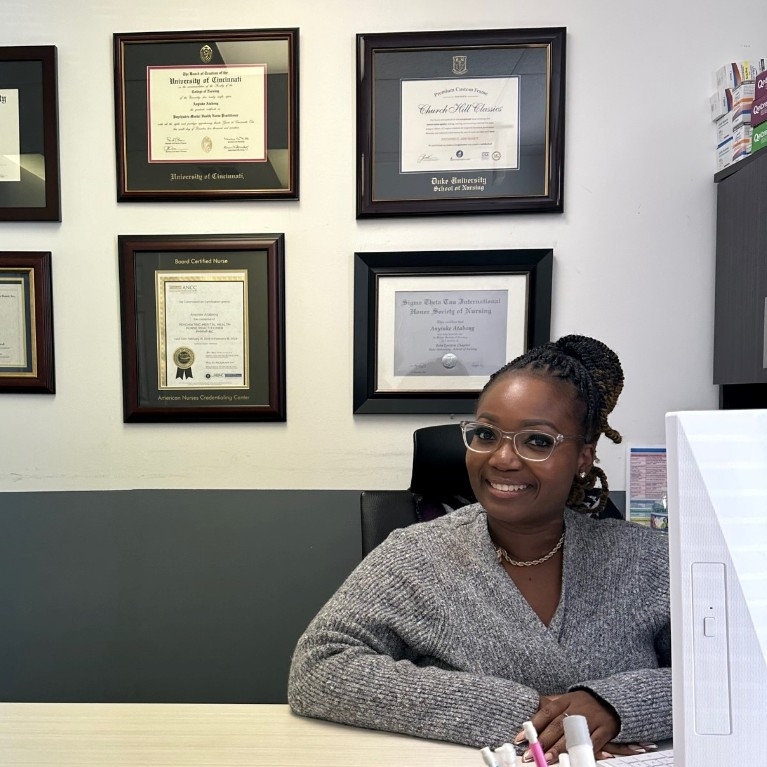
Atabong went back to school again, this time to UC, to earn a Post-Master’s Certificate in Psych-Mental Health Nursing. Afterward, she worked in community care clinics, including one for medically underserved populations, building her experience in mental health care. Still, starting her own clinic was not in her plan, but a relative with experience opening health care practices floated the idea. Years later, when he approached her again, she took him up on it.
“Having my own practice is actually better for me, because I get to do what I want the way I want and, [it] allows us to focus on each patient as much as needed” she says.
Atabong’s clinic, based in Crofton, Maryland, opened in 2019 and employs two psych-mental health nurse practitioners and a psychotherapist, in addition to several graduate nursing students she precepts. Her clinic offers mental health services, substance abuse disorder treatment and weight loss counseling for patients who gain weight as a side effect of their prescriptions. She also prescribes medical marijuana for chronic pain management as an alternative to opioids.
As a person of color and the daughter of immigrants — her parents came to the U.S. from Cameroon, Africa — Atabong is familiar with the cultural norms that impact mental health, especially in Black communities.
“There’s a lot of stigma, and that’s a barrier that I’m really trying to penetrate and break,” she says.
In the long term, Atabong hopes to return to Africa to work on mental health-related projects. She and her siblings lived there as young adults, completing high school in Cameroon at the insistence of their parents, who wanted them to understand and appreciate their lineage.
“That’s how, he would say, we bring flavor to the world,” she says.
Related Stories
From hobbyist photographer to professional educator
October 9, 2026

DAAP alum and photographer HATSUE studied communication design after a pivot in high school from a track toward veterinary school. Today, they teach photography at 1001 Colors white working as an artist and curator in Cincinnati.
UC researcher to launch national study with $2.5 million NIH grant
October 9, 2026

A University of Cincinnati researcher has received a $2.5 million National Institutes of Health grant to conduct research during the next five years. Natalie Kreitzer, MD, a University of Cincinnati College of Medicine physician-researcher, received an R01 independent research grant from the NIH's Eunice Kennedy Shriver National Institute of Child Health and Human Development. The funding will support a test program for caregivers of patients with traumatic brain injury, as reported by the Cincinnati Business Courier.
Lighting up the skyline for Blink
October 9, 2026
A team of University of Cincinnati College-Conservatory of Music students designed “Echoes of Light,” a music-and-light installation on Ohio’s largest mural for BLINK, Cincinnati’s massive public light and art festival.