
Who was the first man on the moon?
USA Today highlights historic moonwalk by astronaut-turned-UC professor

USA Today highlighted the short list of people, all American, who have set foot on the moon, including the first, who left NASA to teach aerospace engineering at the University of Cincinnati.
Neil Armstrong was the first of just 12 people to walk on the moon as part of the Apollo missions between 1968 and 1972. An estimated 650 million people around the world watched as Armstrong took that historic first step with his famous line, “That's one small step for man; one giant leap for mankind.”
Armstrong and astronaut Edwin “Buzz” Aldrin spent 21 hours exploring the moon's surface, collecting moon rocks and taking photos while astronaut Michael Collins orbited in the command module above them.
NASA's Artemis missions in 2025 will send astronauts back to the moon for orbiting and eventual landing on the lunar south pole. The landing crew will include a Japanese astronaut.
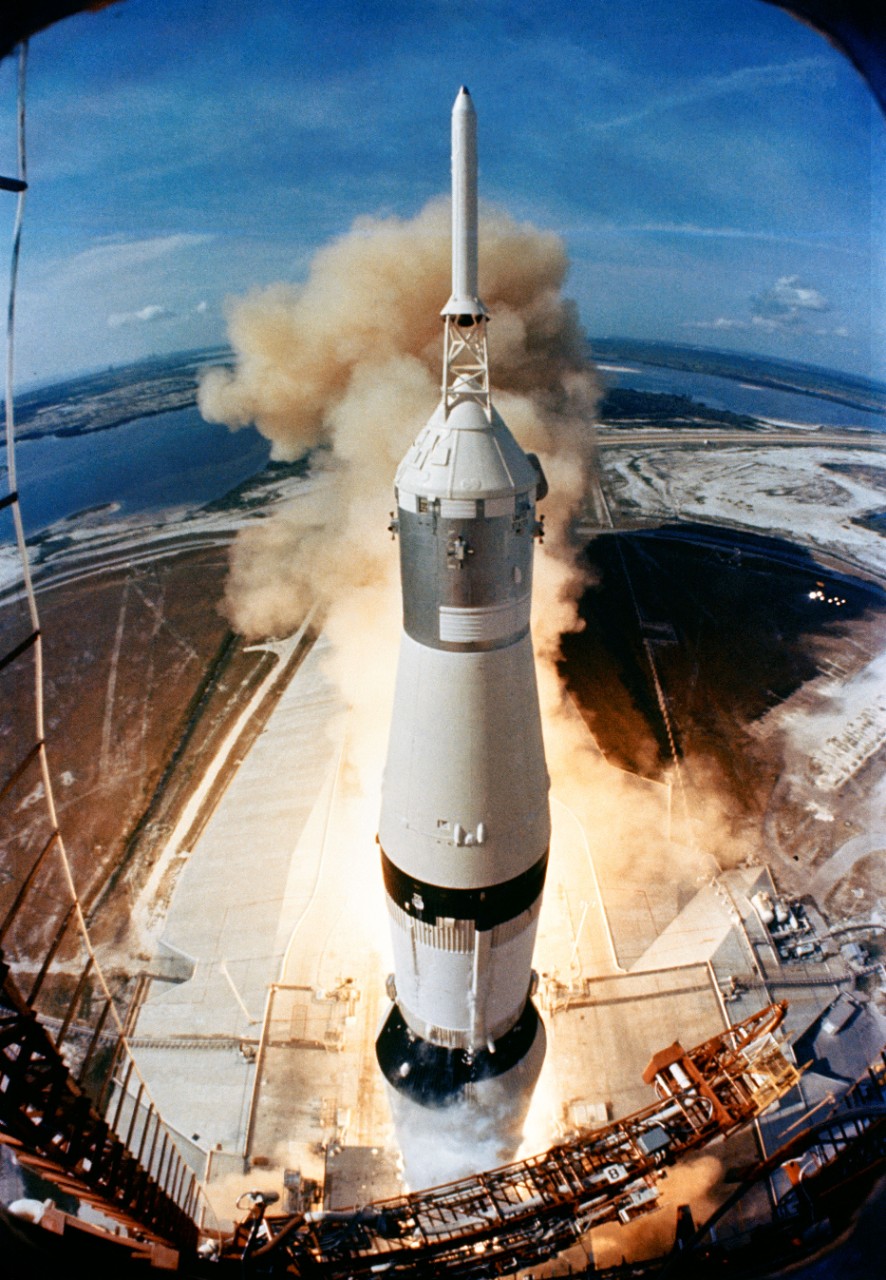
A Saturn V rocket takes off from Kennedy Space Center in Florida in 1969 during the Apollo 11 mission. Photo/NASA
Just 12 people have walked on the moon:
- Neil Armstrong
- Edwin “Buzz” Aldrin
- Charles “Pete” Conrad
- Alan Bean
- Alan Shepard Jr.
- Edgar Mitchell
- David Scott
- James Irwin
- John Young
- Charles Duke
- Eugene Cernan
- Harrison Schmitt
The astronauts of Apollo 11 spent eight days in space during their historic moon mission. Artemis 2 scheduled in 2025 will send four astronauts farther in space than anyone has ever traveled as they return to the moon for a wide orbit.
Artemis 3 will last a month, sending four astronauts back to the moon where they will dock with a new space station called Gateway. Two astronauts will land on the moon and spend seven days conducting science experiments.
Future Artemis missions will expand the moon's space station in preparation for more crewed missions.
Featured image at top: Neil Armstrong captures a selfie in the visor of astronaut Buzz Aldrin on the surface of the moon. Photo/NASA
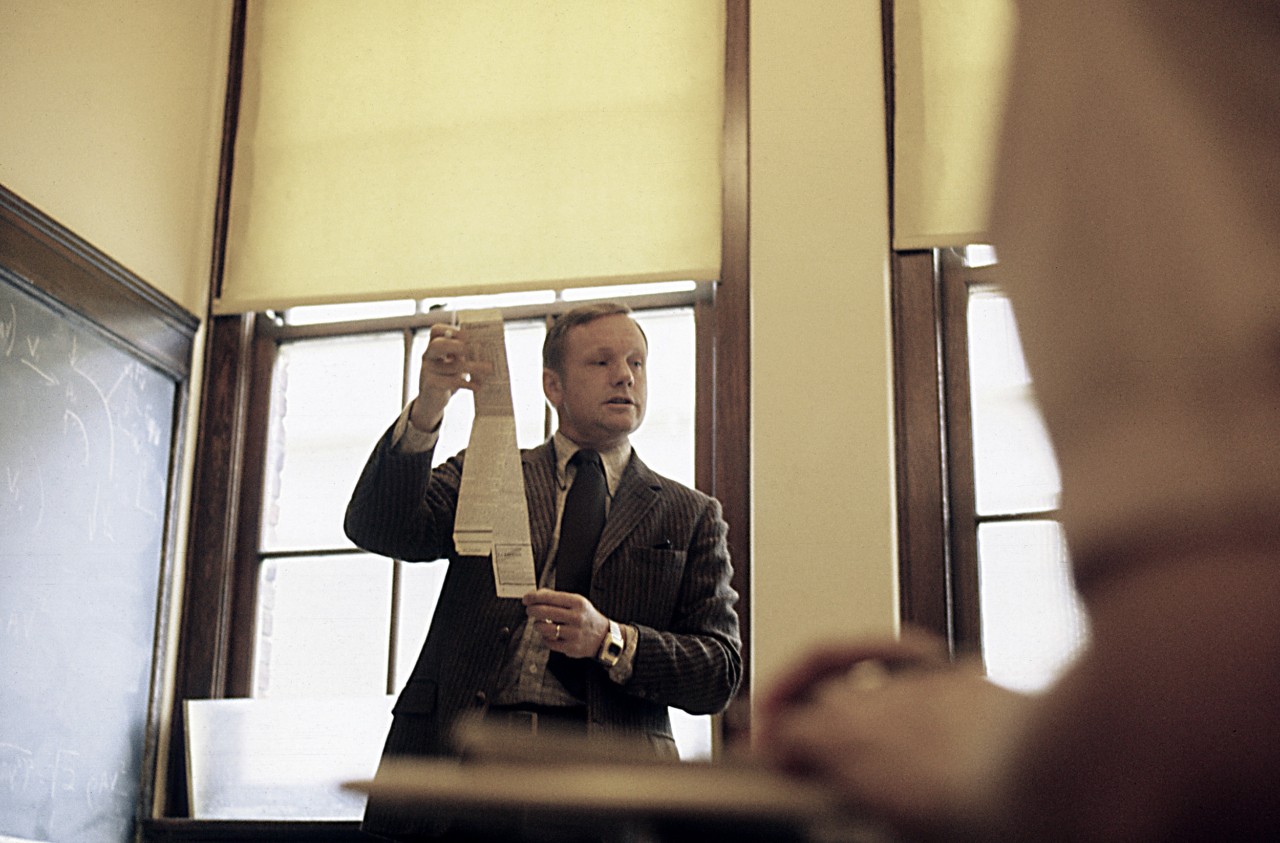
UC College of Engineering and Applied Science Professor Neil Armstrong teaches in his aerospace engineering classroom. Photo/UC Marketing + Brand
Related Stories
UC 1819 Innovation Hub ranked No. 23 in Top 100 Best Workplaces for Innovators by Fast Company
September 10, 2026
UC 1819 Innovation Hub is nationally ranked as one of the top 100 Best Workplaces for Innovators.
UC student ties his own world record in competitive speedcubing
September 10, 2026

Speedcuber's Digest highlighted University of Cincinnati computer science student's two-time 2x2 speedcubing world recor.d At a recent competition in Mississippi, Sujan Feist recorded a 0.86 second average, tying the previous world record, which he set.
Record enrollment continues at the University of Cincinnati
September 9, 2026
The University of Cincinnati recorded its largest enrollment ever in fall 2026 with more than 54,400 students, driven by record first-year enrollment, growth at UC Blue Ash and rising College Credit Plus participation.