
Some Ohio counties have multiple congressional districts
UC expert talks about impact of redistricting in Ohio

The Ohio Capital Journal asked a University of Cincinnati Professor David Niven to explain why congressional districts in Ohio cut many counties in half.
At least a dozen of Ohio's 88 counties have multiple congressional districts.
“There are certain places like Columbus that are too big to fit into a congressional district,” UC College of Arts and Sciences Professor David Niven told the Ohio Capital Journal. “You have to split them.”
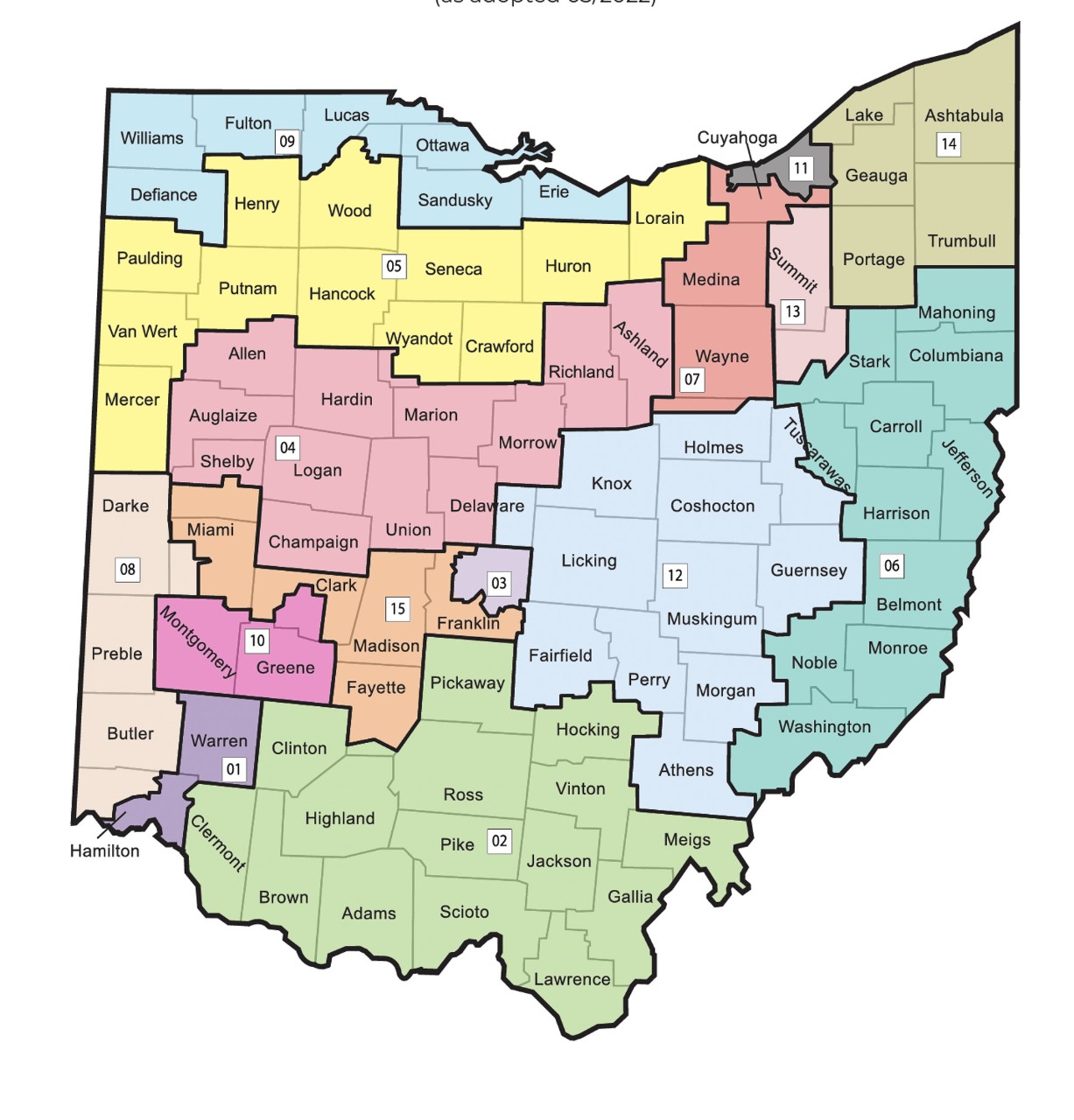
Ohio's congressional map. Graphic/Ohio Secretary of State's Office
Neighborhoods around UC and in the rest of Eastern Hamilton County lie in the 1st Congressional District. Hamilton County also shares the 8th Congressional District.
The congressional map can create some confusion. Voters sometimes come to the wrong polling location to cast a ballot when congressional districts split counties, Democratic Party Chairwoman Gail Garbrandt told the Ohio Capital Journal.
“It’s very natural for people to assume that we’re all in the same districts together,” Niven said.
This confusion might discourage some voters from participating in elections at all, Garabrandt said.
Congressional maps are redrawn periodically to adjust for each state's changing population after the 10-year census. But political parties are often accused of drawing the maps to give them a political advantage called gerrymandering.
Ohio's new congressional maps give Republicans an advantage in roughly two-thirds of the state's districts.
Ohio voters in November will decide whether to create a new redistricting commission composed of Republicans, Democrats and independents. Lobbyists, political consultants and elected officials would be ineligible to serve on the commission.
Read the Ohio Capital Journal story.
Featured image at top: UC School of Public and International Affairs Professor David Niven spoke to the Ohio Capital Journal about congressional redistricting. Photo/Andrew Higley/UC Marketing + Brand
Related Stories
Will Ohio's gas tax suspension lower prices at the pump?
October 2, 2026

University of Cincinnati economist Gary Painter weighs in on how both consumers and oil companies will benefit from Ohio's gas tax suspension.
UC Speech & Hearing Clinic serves patients while acting as training site
September 30, 2026

The University of Cincinnati's Speech & Hearing Clinic provides graduate students in audiology and speech-language pathology with hands-on experience while delivering care to patients across the region. Located on the university's medical campus, the clinic serves patients of all ages and was recently featured on Spectrum News 1 Ohio.
UC economist warns of higher heating costs this winter
September 30, 2026

David Brasington explains why home heating will cost so much this winter and how to save money.