UC ornithologist sounds alarm about loss of Cincinnati bird population
Feral cats, glass windows and loss of habitat are likely culprits, researcher says

WVXU highlighted a long-term research project at the University of Cincinnati that has recorded an alarming decline in bird numbers in Greater Cincinnati.
UC College of Arts and Sciences Professor Ronald Canterbury has been catching and placing numbered bands on birds for more than 35 years to study their migration, habitat needs and population.

Ronald Canterbury. Photo/Andrew Higley/UC Marketing + Brand
He told WVXU that his ongoing study has found that many bird species are in sharp decline, echoing findings by researchers elsewhere that the United States has lost 3 billion birds since 1970.
Each summer Canterbury has set up mist nets a few times a week at places like UC's Center for Field Studies and Great Parks of Hamilton County to catch and band birds. He records data on the species, age, sex, weight and wing lengths of the birds he catches and places a uniquely numbered band on one leg that can help track their migration, age and movements if they are recaptured.
The population trends he has observed are alarming, he said.
“Birds are in big decline,” he told WVXU. “I don't catch nearly as many as I did 20 or 30 years ago. Twenty years ago I would trap 50 to 70 birds (in a day). Nowadays the numbers are more like 10 to 20. Most species are declining, and we know that from many other forms of research.”
Canterbury said there are several likely reasons, including habitat loss, predation by feral cats and glass windows, which kill hundreds of millions of birds each year, according to the U.S. Fish and Wildlife Service.
He said we need to protect more open spaces, not just for birds but for other animals as well.
“You're saving much more than the bird sometimes,” he said. “You might be working on a cerulean warbler, but if you go down the food web, you're going to be saving a white-footed mouse on the ground, an owl that would eat that mouse, insects and all kinds of things.”
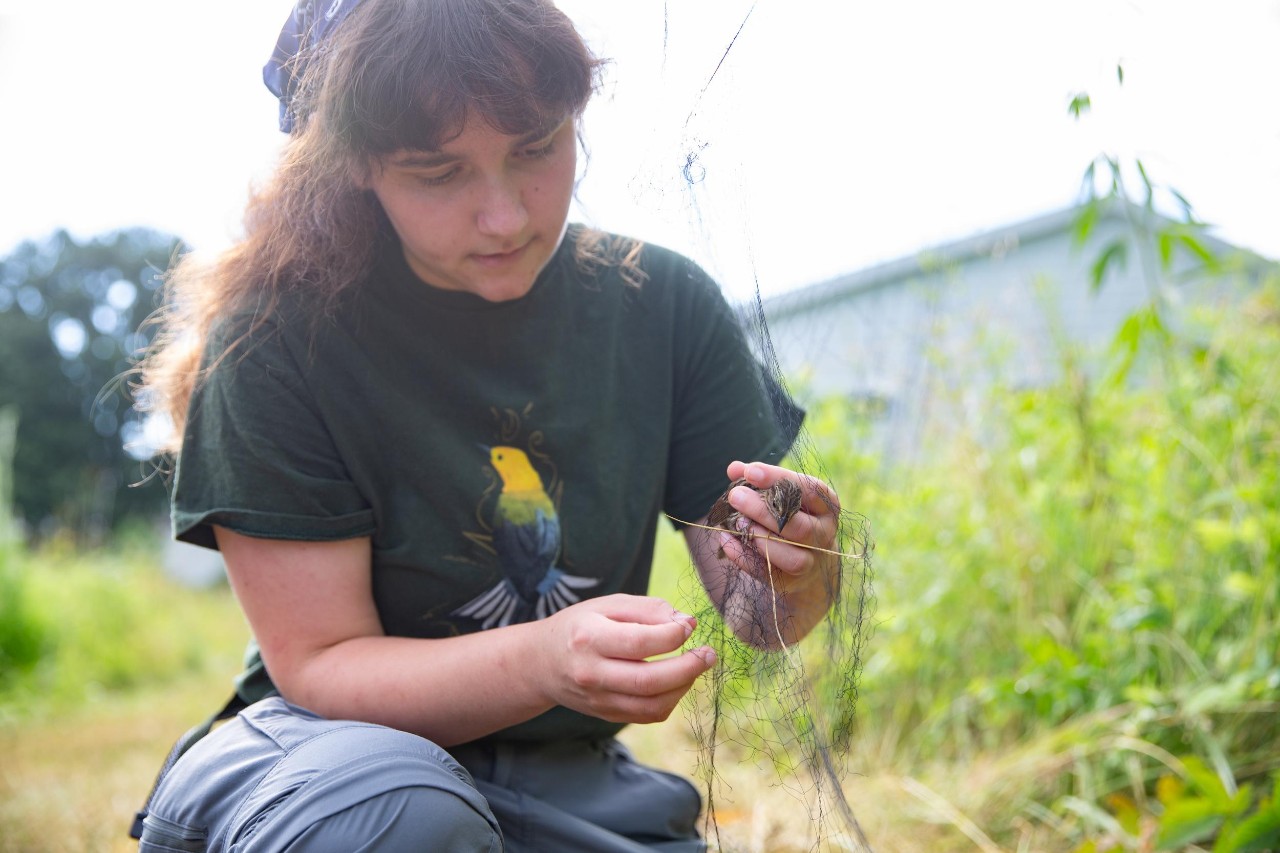
Featured image at top: UC Professor Ronald Canterbury's students learn to band birds at UC's Center for Field Studies. Photo/Andrew Higley/UC Marketing + Brand

Naomi Moore holds a common yellowthroat she banded at UC's Center for Field Studies. She came to UC to get bird banding experience from Professor Ronald Canterbury. Photo/Andrew Higley/UC Marketing + Brand
Related Stories
DAAP appoints Joseph Heathcott as new associate dean for research
August 27, 2026
DAAP appoints new associate dean for research Joseph Heathcott, who will bring a nationally recognized voice in urban development, design and research to the University of Cincinnati starting this fall 2026.
What is electroacoustic music?
August 21, 2026

Professor Mara Helmuth spoke with Cincinnati Spotlight about her upcoming faculty recital on Cincinnati Spotlight.
UC study shows lack of awareness for lung cancer screenings across country
August 21, 2026
University of Cincinnati Cancer Center researchers have published a study in the American Journal of Surgery that found only 15% of eligible American adults have discussed lung cancer screening with their doctors.This research emphasizes the need to spread awareness and better educate the public about screening through low-dose computed tomography.